
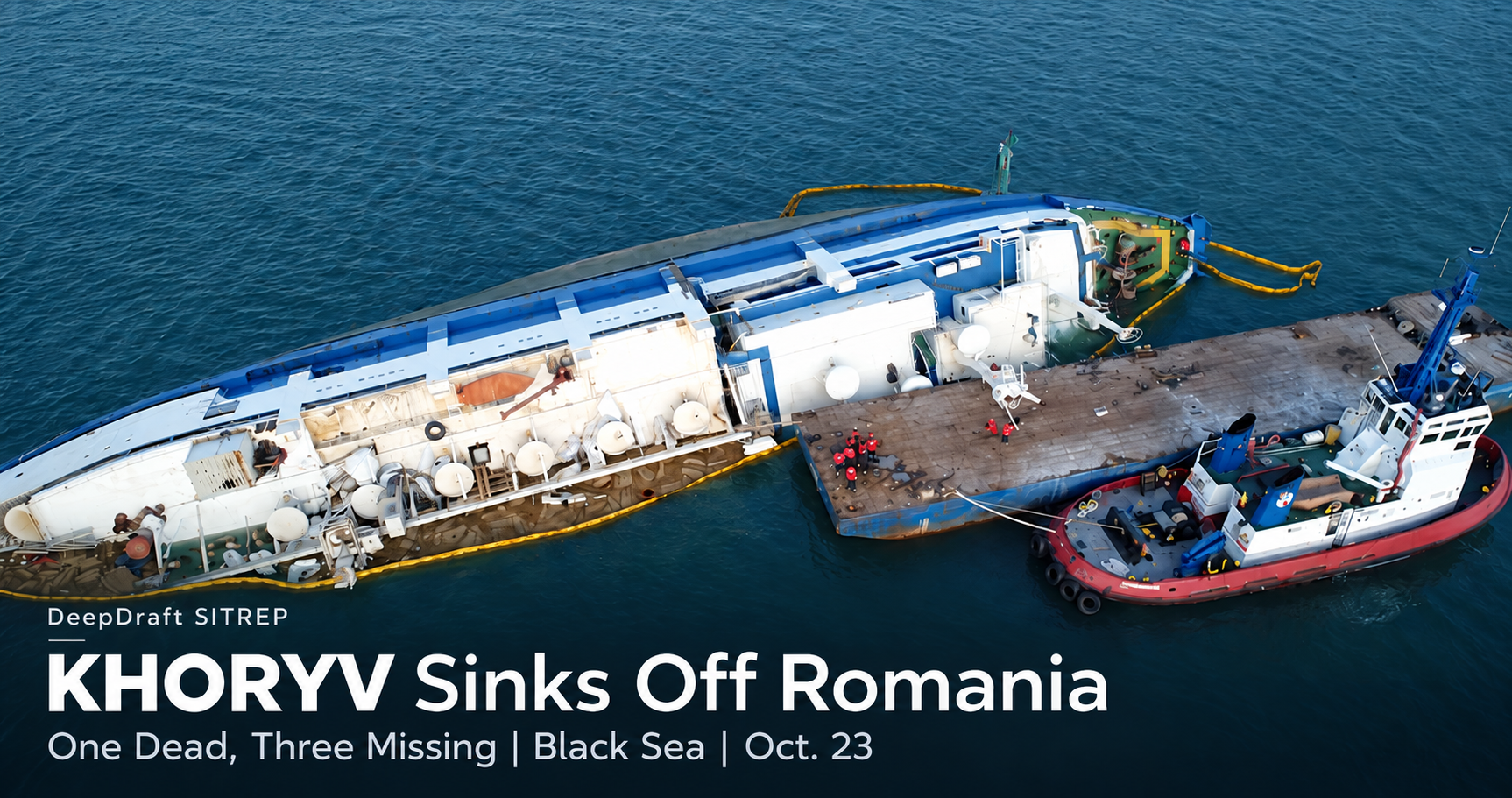
The Comoros-flagged KHORYV sank off Romania on October 23 following a reported drone strike, leaving one seafarer dead and three missing. The casualty adds a fresh lethal threat to merchant shipping approaching the Sulina Canal and Ukraine’s Danube export corridor.
1. KHORYV Sinks Off Constanța Following Reported Drone Attack
• On October 23, the Romanian Maritime Authority received a distress call at approximately 10:00 local time from KHORYV (IMO 8138712), an ore/oil carrier approximately 13 nautical miles off Constanța, outside Romania’s territorial waters.
• The vessel was proceeding from Türkiye towards Sulina, Romania, with maritime tracking reports identifying Ereğli as the Turkish departure port. The vessel was reported under the Comoros flag.
• Romanian authorities initially reported 13 crew members, comprising ten Ukrainian and three Azerbaijani nationals. Nine were rescued, one body was recovered and three seafarers remained missing during the initial search-and-rescue operation.
• The Ukrainian Foreign Ministry subsequently reported that four Ukrainian survivors, including the Master, had been hospitalized. Its account referred to 14 people aboard and a different flag, leaving discrepancies in the reported crew manifest and registration that have not been reconciled.
• Romanian maritime rescue vessels, Coast Guard and Interior Ministry personnel responded in rough seas. Poor visibility and adverse weather prevented helicopter deployment. Romanian President Nicușor Dan attributed the reported drone strike to Russian escalation, although responsibility has not been independently established.
2. Hormuz Ship Attacks Reach October Record as Tanker Exposure Grows
• Reuters reported on October 23 that October had become the deadliest month for attacks on commercial shipping in the Strait of Hormuz and surrounding waterways during the current conflict.
• Washington Institute researcher Noam Raydan recorded 28 confirmed and reported attacks during October, bringing her cumulative count to 113 since the conflict began on February 28.
• More than 30 very large crude carriers (VLCCs) were reported damaged during the conflict, including 11 in October. The affected vessels represent approximately 3.5% of the global VLCC fleet, according to the Reuters assessment.
• Despite the threat, tanker freight earnings exceeding $1 million per day have continued to attract participation in Gulf cargo movements. High freight returns coexist with immediate crew-safety, hull-risk and voyage-execution exposure.
• UK Maritime Trade Operations separately recorded an October 22 tanker incident approximately 7 nautical miles northeast of Limah, Oman, involving a reported projectile strike. The tanker continued towards its next port, making this a distinct operational incident rather than merely another historical component of the monthly attack count.
3. Dry Bulk Freight Strengthens as Capesize Earnings Recover
• The Baltic Exchange’s October 23 weekly report recorded a recovery in Capesize earnings, with the BCI 182 5TC average rising from $30,518 per day on Monday to $34,380 on Friday.
• Pacific demand strengthened early in the week through renewed operator enquiry, increased miner participation and expectations of possible weather-related delays in China.
• The West Australia–China C5 iron ore route advanced from the low $12-per-tonne range to approximately $14.15–14.25 during the week. The October 23 daily assessment subsequently stood at approximately $14.10 per tonne.
• South Brazil and West Africa–China activity also improved, with C3 route discussions progressing from the low $31-per-tonne range towards $34–34.50, before weaker late-week fixture indications tempered sentiment.
• The recovery was not uniform. North Atlantic enquiry remained comparatively subdued, illustrating the continued difference between Pacific mineral-demand strength and Atlantic cargo availability.
4. Container Freight Rises as East–West Shipping Costs Increase
• On October 22, Drewry’s World Container Index increased 2% to $4,585 per 40-foot container, its second consecutive weekly increase and highest level in approximately 15 weeks.
• The increase was driven principally by higher rates on the Asia–Europe and transpacific trade lanes, indicating renewed pressure in major east–west container markets.
• Shanghai–Rotterdam spot rates increased to approximately $3,632 per 40-foot container, while Shanghai–Genoa rates reached approximately $4,152, according to route-level index assessments.
• Transpacific rates also increased, with Shanghai–Los Angeles reaching approximately $8,007 and Shanghai–New York $10,166 per 40-foot container.
• The latest assessments represent a measurable change in container freight economics for spot bookings and near-term cargo procurement. They do not establish that individual contracted freight rates have risen by the same amounts.
Latest DeepDraft Analysis
The Mercenary Master: Shipping’s New Hormuz Reality
As Hormuz tanker earnings exceed $1 million daily, extraordinary transit incentives expose questions about seafarer consent, the Master’s authority and company responsibility for accepting wartime shipping risks.
Related DeepDraft SITREPs
Related DeepDraft Articles & Analysis
Sources
Reuters, Associated Press, Romanian Maritime Authority, Baltic Exchange, Drewry
DeepDraft Security Desk | Maritime Security Dashboard
This update is part of the DeepDraft SITREP series covering developing maritime operational situations.



Leave a Reply