
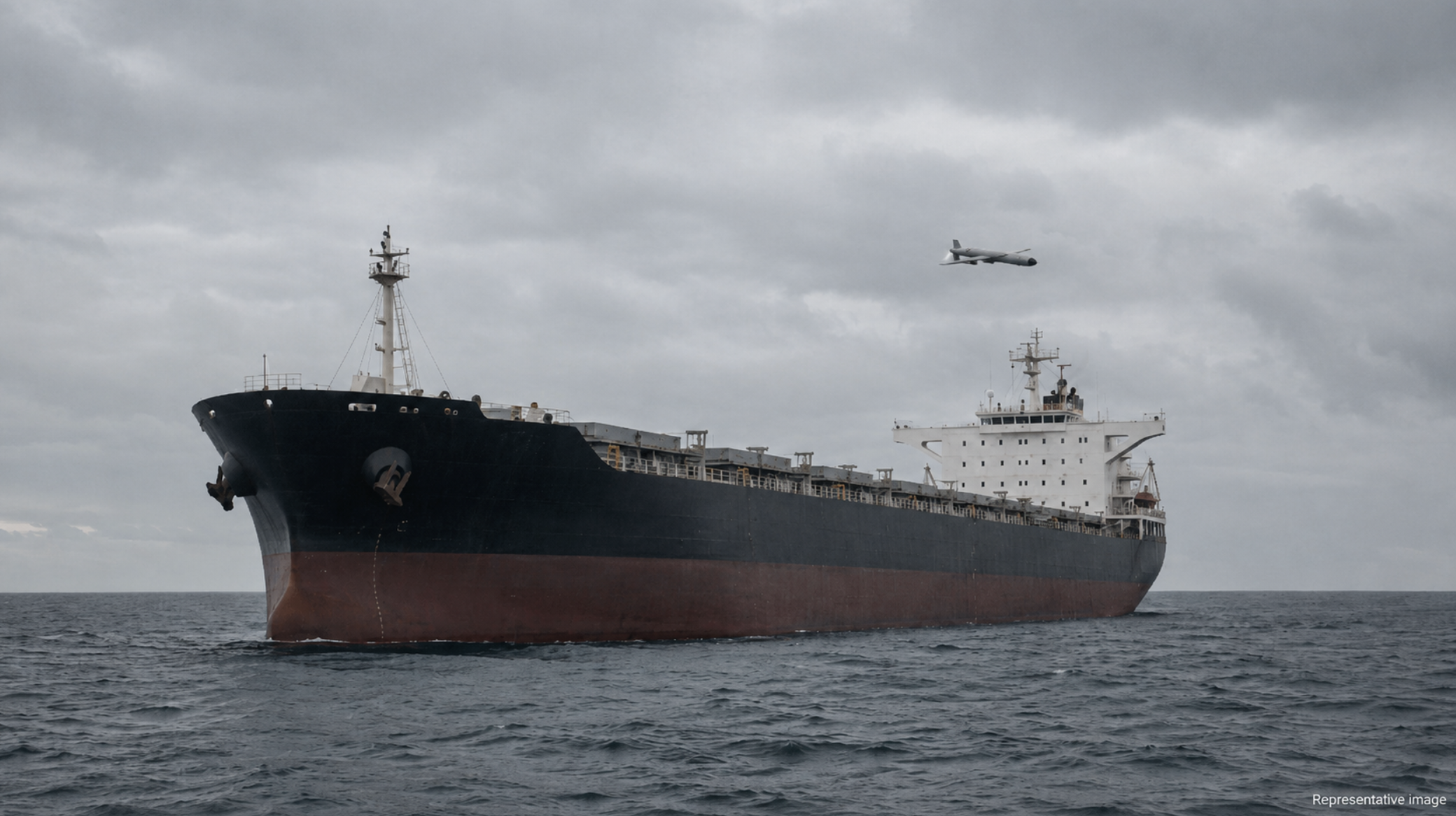
A merchant ship can identify a drone. It can report it, sound the alarm, call the Master, muster the crew, start the fire pump and prepare for impact. What it usually cannot do is stop it.
That is the gap inside modern maritime security guidance. BMP Maritime Security now recognises drones, loitering munitions, uncrewed surface vessels (USVs) and missiles as part of the threat picture.
MARAD advisories now also include uncrewed underwater vehicle attacks among the hostile actions facing commercial ships in high-risk waters. OCIMF has warned that loitering munitions are a rising risk to merchant shipping. Threats may now come from the air, the surface, below the waterline, or from shore. My question is simple.
After the threat is identified, what protects the seafarer?
The Photograph That Changed the Debate
The image that brought this subject back came from the Baltic.
Estonia released images of the Russian-flagged LNG carrier Marshal Vasilevskiy operating between the St. Petersburg area and Kaliningrad with machine guns and sandbagged positions on the monkey island aka bridge roof.
Those familiar with maritime security can easily make out that it is not the normal armed-guard model used against piracy. This is a civilian LNG carrier showing a defensive posture in a state-security environment.
A weapon on the monkey island of a commercial LNG carrier changes how the ship is read by coastal states, naval forces, enforcement agencies and opposing actors.
For a Master, appearance itself becomes part of the risk.

The Escort Has Already Returned
The armed LNG carrier is only one part of the picture. Escort has also returned.
In the Gulf, the United States has used military-guided transits through the Strait of Hormuz. India has moved warships into the Gulf of Oman and Arabian Sea under Operation Urja Suraksha to guide India-bound vessels after leaving the Strait of Hormuz. Russia has used naval presence around sanctioned or Russia-linked trade, including reports of Admiral Grigorovich escorting tankers through UK waters.
The cases are different. The U.S. case is protected passage. India’s is energy security. Russia’s is tied to sanctions, shadow-fleet exposure and political signalling.
For the Master, the passage now carries a security layer that cannot be managed by the ship alone.

This is a real escort image, clean composition, merchant vessel clearly visible, naval escort clearly visible. It is not India, but it fits the argument perfectly: state protection has returned around civilian trade.
This Has Happened Before
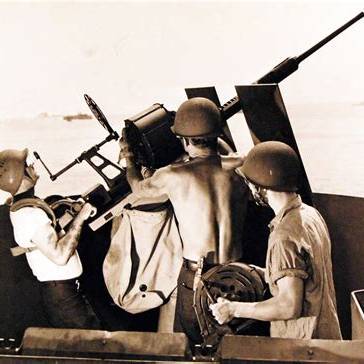
The return of escort is not new. The form is different, but the logic is familiar. During the First World War, merchant ships were armed because of unrestricted submarine warfare. The important point is that the guns came with the Armed Guard system: naval officers, trained gunners, rules and state responsibility onboard.
The same pattern returned in the Second World War on a much larger scale. U.S. Navy records state that 6,236 ships were armed, with defence handled by Armed Guard officers and Navy gunners.
Historically, when civilian trade entered war, states had to take responsibility for its defence. Today, the form is different, but the principle remains.
The threat has now become military and the burden cannot remain only with the Master, the company security officer and the shipboard checklist.
Reading this as a maritime insider, seafarer, or enthusiast?
Subscribe to The DeepDraft for maritime analysis, daily SITREP updates, weekly briefings, and operational signals worth watching.
The Numbers Are No Longer Marginal
Across Hormuz, the Gulf of Oman, the Red Sea, Bab el-Mandeb and the Black Sea, merchant ships are being struck, disabled, sunk, escorted, evacuated and added to casualty lists.
The actors differ. The sea lanes differ. The legal explanations differ. For the crew, the result is the same. The commercial voyage is now meeting weapons built for conflict.
The scale is now too large to treat as exceptional.
| Ship / Area | Reported actor / method | Crew impact | Operational meaning |
|---|---|---|---|
| Middle East tracker Hormuz / Gulf of Oman / wider Middle East |
Confirmed incidents recorded by IMO | 65 confirmed incidents 17 seafarer fatalities as of 11 August 2026 |
The threat is no longer occasional. It has become a sustained operating pattern around commercial shipping. |
| SETTEBELLO Gulf of Oman |
U.S. strike during Iran-linked blockade enforcement | 3 Indian seafarers killed | Civilian shipping is exposed not only to non-state attacks, but also to state enforcement action. |
| VELA NOVA Gulf of Oman |
U.S. strike after alleged blockade breach | No immediate casualties reported | A merchant vessel can become the object of kinetic enforcement without being a warship. |
| TRUE CONFIDENCE Gulf of Aden / Red Sea approach |
Houthi missile attack | 3 seafarers killed | The Red Sea campaign moved from disruption to fatal crew exposure. |
| TUTOR Red Sea |
Houthi attack using explosive uncrewed craft and other weapons | 1 seafarer killed / lost | The threat now includes explosive craft and sustained casualty uncertainty. |
| MAGIC SEAS Red Sea |
Houthi attack involving gunfire, missiles, drones and explosive remote-controlled boats | Crew abandoned ship and were rescued | Layered attacks now combine air, surface and boarding-type pressure. |
| ETERNITY C Red Sea |
Houthi drone, missile and small-craft attack over two days | At least 4 killed 11 missing / unaccounted for reported |
The attack pattern now includes sinking, rescue exposure and crew disappearance. |
| TIHAMAH Bab el-Mandeb |
Houthi attack on cargo vessel | 4 crew killed 2 rescuers killed 10 injured |
The casualty risk extends beyond the ship to rescue response. |
| Red Sea incident record November 2023 onward |
Confirmed Houthi-related incidents monitored by IMO | 61 confirmed incidents since 10 January 2024 17 confirmed incidents from November 2023 to 9 January 2024 |
The Red Sea risk has remained persistent enough to alter routing, insurance and crew exposure. |
| GOLDEN LEO Off Odesa, Black Sea |
Russian missile strike, according to Ukrainian authorities | 10 killed including 4 Indian crew |
The Black Sea threat includes direct missile strikes on merchant vessels and foreign seafarer casualties. |
| NADEZHDA Near Novorossiysk, Black Sea |
Drone strike near Russian export infrastructure | 3 crew seriously injured 22 evacuated |
The risk now sits around ships, ports and export corridors. |
| Novorossiysk terminals Black Sea export infrastructure |
Ukrainian drone strikes on grain and oil export infrastructure | Terminal operations halted or disrupted | The strike environment now reaches the port system that merchant ships depend on. |
The BMP Verb Problem
BMP Maritime Security is necessary guidance. It helps vessels assess routes, structure reporting, prepare crews and apply protective measures. The framework is built around the familiar security logic of detecting, avoiding, deterring, delaying and reporting threats.
The weakness sits inside the verbs. Detect. Avoid. Deter. Delay. Report.
Against pirates, detection creates usable time. The Master can activate SSAS, increase speed, alter course, rig water spray & razor wires, close access points, muster personnel, activate a citadel and, where legally carried, bring a contracted armed team into a defensive posture.
Against a loitering munition, detection may only start the casualty countdown. The UK Department for Transport gives the practical calculation: a drone travelling at 60 km/h, detected at 2 km, leaves roughly 120 seconds. It is more of a casualty countdown than a tactical warning.
You cannot deter a suicide drone with a fire hose. You cannot delay a warhead detonating at 60 km/h. A commercial checklist cannot solve a kinetic military problem.
OCIMF’s loitering munitions paper names the threat clearly but naming the weapon does not protect the ship. Without protected space, counter-drone capability, naval cover or lawful authority to interfere, identification only tells the bridge team what is coming.

The San Remo Trap
Merchant ships carrying civilian trade should not be attacked. If a ship is suspected of carrying prohibited cargo, breaching sanctions or supporting hostile activity, there are lawful tools available such as inspection, boarding, detention, arrest or seizure. Those are not the same as striking a manned civilian vessel.
The San Remo Manual keeps this distinction important. A merchant vessel may become a military objective if it is used in certain ways, including if it is armed to a level capable of damaging a warship. At the same time, light individual weapons for personnel defence, such as against pirates, are treated differently.
Arm the ship too lightly and it cannot defend itself against drones, missiles or uncrewed attack craft. Arm it too visibly and it may change how the vessel is classified, challenged or targeted.
Mounting a machine gun on a gas tanker does not turn it into a frigate. It only adds legal and operational risk to a hull that still has the survivability of a merchant ship.
Piracy guards still have a place against boarding threats, but that model cannot simply be stretched into drone warfare. A rifle may deter a skiff. It does little to change survivability against a loitering munition.

Improvised Defence Creates New Hazards
Passive hardening will expand. Anti-drone nets, bridge shielding, blast film, protected muster spaces, redundant communications, firefighting readiness and drone-watch procedures all have a place.
On a merchant ship, every addition touches another system: visibility, escape, firefighting, pilotage, antenna performance and emergency access. On tankers and gas carriers, the margin is smaller because cargo risk and evacuation routes are part of the safety case.

What Should Be Done
The answer is not to hand rifles to merchant crews.
The first layer is political. Civilian trade must remain outside target selection. If a vessel is suspected of sanctions breaches, prohibited cargo or unlawful activity, the answer is inspection, detention, boarding, seizure or arrest through lawful channels. It should not be a drone strike on a manned civilian vessel.
The second layer is state protection. Where drones, missiles, sea drones and armed conflict threaten civilian shipping, protection cannot be outsourced to the Master. It requires naval presence, protected corridors, threat intelligence, coastal-state coordination, air and surface surveillance, and clear warning systems.
The third layer must be shipboard hardening. Protected muster areas, bridge vulnerability reviews, firefighting readiness, redundant communications, drone alarm procedures, stop-work triggers and emergency steering readiness should become part of serious voyage planning.
The fourth layer is lawful security. Armed guards may remain valid for piracy. In war-risk areas, armed protection should be state-authorised, professionally manned, insured, declared and legally supported. The ship’s crew must not become the weapons team.
The fifth layer is counter-drone technology only where lawful and integrated. Jammers, nets, shields and effectors cannot be bolted onto a tanker as deck stores. They must be assessed for SOLAS compliance, escape routes, antenna interference, fire risk, class impact, cargo risk and port-state acceptance.

DeepDraft View
Merchant vessels are commercial assets, not combat platforms. Maintaining that line is the structural condition under which global trade is flagged, insured, and sailed.
BMP and OCIMF have named the threat correctly, but guidance has a limit. Identification does not stop a drone. Reporting does not defeat a missile. A checklist cannot protect a bridge team once the ship itself has become the target.
History gives the better lesson. Armed merchant ships appear when civilian trade enters war, but weapons cannot come without responsibility. If states cannot keep civilian shipping outside the target system, shipping will adapt. Trade will not stop. Cargo, energy and food will still move. The ship will still sail.
The machine gun on the LNG carrier is not a sign that merchant shipping has found the answer. It is a sign that state protection has failed to keep the commercial voyage outside the conflict. Once that happens, ships will begin looking for their own protection, first through escorts and hardening, then through armed guards and state detachments.
Arming merchant ships should never become the normal answer. But if the sea lane is no longer protected by law, policy or naval presence, the pressure to arm will become unavoidable.
A gun on the bridge wing is not the start of maritime security. It is the visible mark of a policy failure around civilian trade.
Media Section
Sources Reviewed
Reuters: Various Current Updates
IMO: Middle East highlighted incidents tracker.
MARAD Advisory 2026-006: Red Sea, Bab el-Mandeb Strait, Gulf of Aden, Arabian Sea and Somali Basin.
MARAD Advisory 2026-004: Persian Gulf, Strait of Hormuz and Gulf of Oman.
BMP Maritime Security, 2026 edition.
OCIMF: Loitering Munitions: The Threat to Merchant Ships.
UK Department for Transport: Countering Drone Threats to Shipping.
IMO: Privately Contracted Armed Security Personnel guidance.
San Remo Manual on International Law Applicable to Armed Conflicts at Sea.
U.S. Naval History and Heritage Command: Armed Guard regulations, 1917.
U.S. Naval History and Heritage Command: Information for Ship Owners Concerning the Armed Guard Program, 1917.
U.S. Naval History and Heritage Command: Naval Armed Guard Service in World War II.


Leave a Reply