
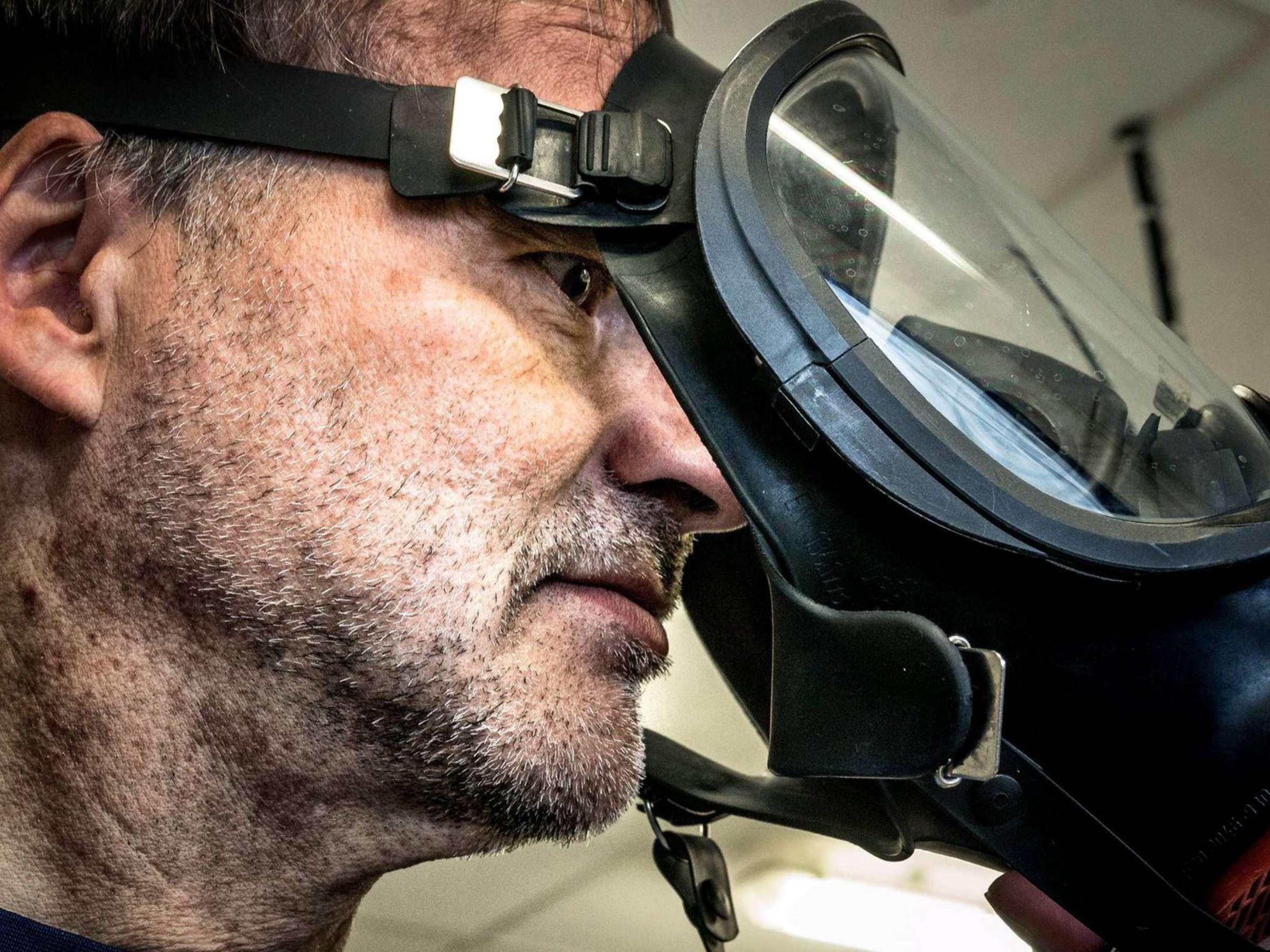
Merchant shipping treats facial hair as a matter of appearance, faith or personal choice. On a minimally manned ship, the real question is whether every seafarer remains capable of wearing breathing apparatus when the emergency plan begins to fail.
During one of the early SIRE 2.0 inspections, the inspector stopped beside the breathing-apparatus locker and asked an officer accompanying us to demonstrate a negative-pressure facepiece seal check.
The officer, an ETO, was experienced, technically competent and wore a full beard as part of his religious observance. He held the facepiece firmly against his face, closed the air inlet and inhaled gently. The mask should have drawn against his skin and remained there without air entering around the sealing edge.
As expected, it did not seal.
Another officer beside him, who was clean-shaven, repeated the same check with the same facepiece and obtained a satisfactory seal immediately. The inspector asked a simple question: “Does your company have a policy for facial beard? The inspection had exposed a familiar gap between documented compliance and demonstrated operational capability, something SIRE 2.0 is increasingly bringing into focus across shipboard operations.
Our answer appeared reasonable. The officer was not part of either the primary or secondary breathing-apparatus team. The designated firefighters were clean-shaven, trained and assigned through the ship’s emergency organisation. The planned response was intact.
At the time, I accepted the distinction between designated BA wearers and everyone else, but I am no longer convinced that it is sufficient. A muster list describes how an emergency is expected to unfold. A serious fire has no obligation to follow it. Once the primary and secondary teams are exhausted, injured, isolated or already committed, the next available seafarer may need the next SCBA set. Rank, department and normal muster duty will not change the atmosphere inside the space.

Photo credit: John L. Beeman / U.S. Navy, aboard USS Tortuga, 26 May 2006.
The matter resurfaced when I read about the U.S. Navy’s directive of 7 July 2026, which tightened medical shaving waivers and linked grooming standards to operational readiness and the safe use of protective breathing equipment.
Military rules do not govern merchant crews, but the development made me reconsider our response to that inspector. We had relied entirely on the availability of the nominated fire teams, without addressing who would wear the next SCBA set if those teams became unavailable. A muster list describes how an emergency is expected to unfold but serious fire has no obligation to follow it.
The Science Is Not About Beards
OSHA’s Respiratory Protection Standard (29 CFR 1910.134) prohibits the use of tight-fitting respirators where facial hair lies between the face and the sealing surface or interferes with valve operation. The UK Health and Safety Executive (HSE) takes the same position, while the MCA’s Code of Safe Working Practices for Merchant Seafarers warns that beards can adversely affect breathing-apparatus face seals, particularly during emergencies.
A negative-pressure seal check can reveal an obvious leak, but it cannot replace formal face-fit testing. Quantitative fit testing measures the effectiveness of the seal between an individual and a particular facepiece, producing a numerical Fit Factor.
The engineering principle is straightforward. Hair crossing the sealing boundary creates leakage paths, regardless of how well the breathing apparatus itself is maintained.
The scientific evidence is equally clear. In a frequently cited 1984 study, Skretvedt and Loschiavo tested 370 workers, including 67 with established beards. The results were significant:
- Half-mask respirators: Median fit factor of 2,950 for clean-shaven wearers against 12 for bearded wearers.
- Full-face respirators: Clean-shaven wearers exceeded 10,000, compared with a median of 30 for the bearded group.
- Qualitative testing: Bearded participants consistently failed the fit test.
Although the study involved negative-pressure respirators rather than modern marine positive-pressure SCBA, it established the substantial deterioration in protection when facial hair enters the sealing area. A properly maintained facepiece cannot compensate for an unreliable seal against the wearer’s skin.

Photo: Vandeputte (VDP)
Reading this as a maritime insider, seafarer, or enthusiast?
Subscribe to The DeepDraft for maritime analysis, daily SITREP updates, weekly briefings, and operational signals worth watching.
Positive Pressure Is Not a Free Pass
One common argument is that positive-pressure SCBA can tolerate a poor face seal because air is continuously supplied into the mask. The science suggests otherwise.
Research by Dahlbäck and Novak demonstrated that extreme inhalation demand, with peak flows around 300 L/min under the tested conditions, could momentarily produce negative facepiece pressure. Where the researchers introduced a defective seal, inward leakage occurred during these pressure drops, creating a potential entry path for the surrounding atmosphere.
There is also a direct cost to cylinder endurance. Dräger specifies approximately 1,836 litres of free air for a 6.8-litre, 300-bar cylinder, giving around 46 minutes at a consumption rate of 40 L/min. Assuming an illustrative continuous face-seal leak of 30–50 L/min. Combined with breathing consumption of 40–60 L/min:
Total discharge = 70–110 L/min
Cylinder duration = 1,836 ÷ total discharge = approximately 17–26 minutes, before operational reserve allowances.
OSHA independently warns that excessive face-seal leakage can markedly shorten SCBA cylinder endurance. Positive pressure provides a safety margin. It does not make an unreliable seal acceptable.

Fires Do Not Respect the Muster List
The primary and secondary fire teams may be ready, but heat, fatigue, injury and repeated entries can rapidly exhaust their capacity. On a minimally manned vessel, the wider crew becomes the final reserve.
The 2020 engine-room fire aboard the LPG/ethylene carrier Moritz Schulte illustrates how quickly a breathing-apparatus response can be stretched. Shipboard teams made repeated attempts to locate a trapped third engineer in intense smoke and heat. One team member replaced his BA cylinder before a further attempt. A shore fire team eventually recovered the engineer more than an hour after the alarm. He died nine days later from the effects of smoke inhalation.The MAIB investigation did not identify facial hair as a factor. Its relevance lies in demonstrating how rapidly a serious fire consumes personnel, air and physical endurance.
There is also a human factor. Seafarers live and work together for months. If a colleague is trapped, someone outside the designated fire party may instinctively volunteer to assist. A spare SCBA set provides little additional capability if the next available trained seafarer cannot obtain a reliable face seal.

Respecting Faith Without Ignoring Physics
This discussion inevitably touches religion. For many Sikh seafarers, maintaining uncut hair is a fundamental article of faith, while some Muslim seafarers maintain beards as part of religious observance. These beliefs deserve respect.
However, a tight-fitting SCBA facepiece cannot distinguish between a religious beard and one maintained for fashion, tradition or personal preference. Where facial hair crosses the sealing surface, the operational limitation remains the same. My argument is therefore about emergency capability. If facial hair prevents a reliable seal, the operational limitation remains the same regardless of why it is worn.
There is no straightforward substitute for the approved tight-fitting SCBA normally carried onboard for firefighting. Powered Air-Purifying Respirators (PAPRs) and loose-fitting industrial hoods are sometimes suggested as alternatives for bearded personnel. However, PAPRs filter ambient air and cannot supply oxygen, making them unsuitable for oxygen-deficient or immediately dangerous atmospheres (IDLH). Any alternative must provide equivalent protection and meet the applicable SOLAS and FSS Code Chapter 3 requirements, with MED Wheelmark certification for equipment subject to the Marine Equipment Directive on EU-flagged vessels, or appropriate flag State approval elsewhere.

The DeepDraft View
Shipping should stop treating facial hair solely as a grooming issue. On a merchant ship, it is an emergency-capability issue.
My professional judgement is clear: every seafarer onboard, from the Master to the most junior rating, should remain capable of safely using the vessel’s approved firefighting SCBA. Where conventional tight-fitting facepieces are carried, facial hair must not interfere with the sealing surface. Any exception must be supported by independently verified equipment approved for the same operational duty, not merely for escape.
This goes beyond what international maritime regulations expressly prescribe, but a shipwide standard must also be supported by practical verification. Being clean-shaven does not automatically make a person SCBA-compatible. Every crewmember should be face-fit tested against the actual make, model and size carried onboard, with suitable facepiece sizes available. A spare BA set offers little additional emergency capability if the next available trained seafarer cannot obtain an effective seal.
Religious or personal accommodation must equally be addressed through demonstrated equipment capability. Where a company permits facial hair, it must provide an approved alternative suitable for the actual shipboard emergency duty. An exemption based simply on the person not being assigned to the fire party leaves the original operational question unanswered.
The Safety Management System must translate this into enforceable practice. Individual face-fit compatibility, clean-seal requirements, pre-use checks and the availability of trained reserve wearers should form part of the vessel’s emergency preparedness arrangements and be verified when crew or equipment changes. The objective is to establish that the people and the equipment can function together when required, rather than relying on a compliant equipment inventory and a completed muster list.
The distinction between certification and actual competence is already familiar in other safety-critical areas of ship operations. Breathing apparatus deserves the same scrutiny. The reason for the beard may differ. The sealing requirement does not.
Beards have been part of the seafarer’s identity for centuries. The breathing-apparatus seal is part of the seafarer’s survival.
When the two conflict, survival must take priority.

Media Section
Sources Reviewed
- OCIMF – SIRE 2.0 Programme and Inspection Guidance.
- IMO – SOLAS Chapter II-2 and International Code for Fire Safety Systems (FSS Code), Chapter 3.
- IMO – International Safety Management (ISM) Code.
- UK MCA – Code of Safe Working Practices for Merchant Seafarers, 2026 Edition.
- U.S. Navy – NAVADMIN 162/26, 7 July 2026.
- OSHA – 29 CFR 1910.134, Respiratory Protection, and relevant Standard Interpretation Letters.
- UK HSE – Respiratory Protective Equipment Fit Testing, INDG479.
- Skretvedt, O.T. & Loschiavo, J.G. (1984) – Effect of Facial Hair on the Face Seal of Negative-Pressure Respirators. American Industrial Hygiene Association Journal.
- Dahlbäck, G.O. & Novak, L. (1983) – Do Pressure-Demand Breathing Systems Safeguard Against Inward Leakage? American Industrial Hygiene Association Journal.
- Dräger – Compressed Air Breathing Cylinders, Technical Data.
- NIOSH – A Guide to Air-Purifying Respirators, Publication 2018-176.
- UK MAIB – Engine-Room Fire aboard Moritz Schulte, Investigation Report 4/2023.


Leave a Reply