
Shipping needs cleaner fuels, but it also needs smarter ships. A small accommodation-side fitting points to a bigger lesson: reduce waste before reducing capability.
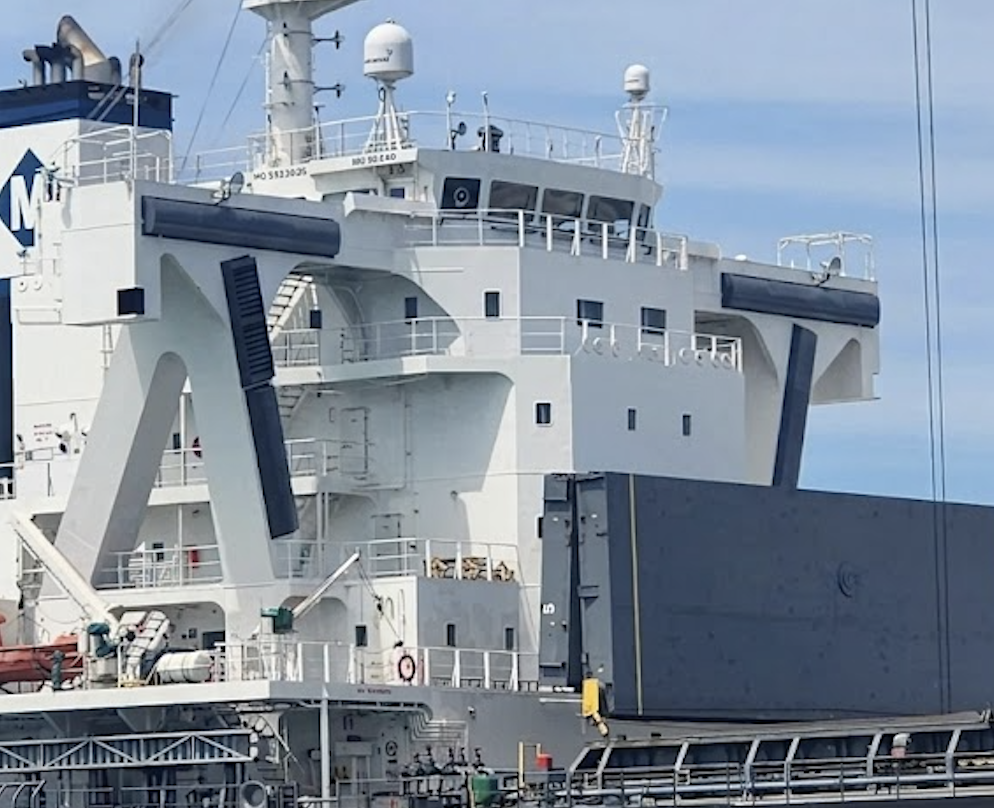
A few days ago, I came across a photograph of a bulk carrier on social media. The ship looked unusual. On the forward side of the accommodation was a dark structure that did not match the usual flat-faced accommodation profile most of us are used to seeing on bulk carriers.
My first reaction was the same reaction many seafarers would have.
What is it, and what purpose is it serving?
That curiosity led me to Tsuneishi’s FAIS design. The Fresh Air Intake System, takes cooler outside air directly into the engine to improve combustion efficiency.
Shipping’s decarbonisation debate is usually dominated by visible solutions and visible claims: future fuels, wind-assisted propulsion, ESG targets, carbon pricing, CII ratings, green corridors, and fleet renewal plans. These subjects matter, but they often pull attention away from a more basic operational question.
Before changing the fuel, adding another system, or presenting another sustainability target, how much energy is the ship wasting?
Every tonne of resistance removed is fuel that does not need to be burned. Every design improvement that reduces load before it reaches the engine protects both efficiency and capability.
The Numbers Behind the Shape
The engineering case is stronger when the figures are seen together. In this case, the most important figure is small enough to be ignored and practical enough to matter.
Tsuneishi states that FAIS, the Fresh Air Intake System, lowers the temperature of air supplied to the engine by about 10°C and can improve fuel efficiency by about 1%. That is the central number for this article.
One percent does not sound large in isolation, but at sea percentages become tonnes. A vessel burning 25 to 35 tonnes per day would see a 1% saving equal roughly 0.25 to 0.35 tonnes per day. Across long voyages, sister vessels, and annual operations, that becomes real bunker, real CO₂, and real CII exposure.
The important point is not that FAIS is a dramatic technology. It is that the saving is built into the ship and works before the engine is asked to burn more fuel. Practical efficiency often comes from removing losses that older ships accepted as normal.

Where the Fitting Sits Matters
The fitting caught attention because it sits on the accommodation, and inside the engine room. FAIS is a simple idea in principle. Instead of relying only on warmer air drawn from spaces affected by machinery heat or accommodation-side arrangements, the system brings cooler outside air directly to the engine. Cooler intake air improves combustion conditions, and Tsuneishi states that the result can be about 1% better fuel efficiency.
This is not something a watchkeeper will feel directly. The vessel will not suddenly handle differently because the engine is receiving cooler air. The effect appears later, in consumption trends, performance monitoring, CII exposure, and comparison across voyages or sister vessels.
That is usually how good efficiency works at sea. It does not always announce itself during the watch. It becomes visible in performance over time.
Reading this as a maritime insider, seafarer, or enthusiast?
Subscribe to The DeepDraft for maritime analysis, daily SITREP updates, weekly briefings, and operational signals worth watching.
Small Savings Versus Headline Technologies
I have written before about airborne kites and Flettner rotors. Those technologies try to add useful force to the ship from outside the conventional engine-propeller system. They have value, but they also carry route dependence, operating limits, maintenance requirements, and commercial questions.
FAIS belongs to a different category. It does not add a visible propulsion system. It does not ask the bridge team to think about deployment logic, weather windows, or deck arrangement. It improves a basic condition before combustion: the temperature of the air supplied to the engine.
Larger technologies may produce larger savings in the right conditions, but a small built-in gain can work quietly in the background across ordinary voyages. For a seafarer, that is a practical form of efficiency: reduce waste before the engine is asked to burn more fuel.

The Problem With Making Ships Weaker
This is where small built-in savings such as FAIS become operationally important. They improve efficiency without reducing the ship’s available power.
The regulatory pressure is real. EEXI and CII have pushed shipowners toward technical and operational measures.
Some ships comply through engine power limitation – EPL, or shaft power limitation – ShaPoLi. From a Master’s perspective, power limitation is not wrong by itself. The risk begins when a change in available response is treated as a compliance detail. A ship still needs manoeuvring authority. She needs reliable response when clearing developing weather, working against or across strong current, handling restricted waters, manoeuvring under pilotage, avoiding traffic, or recovering from an emergency.
There is a second issue. Many newer ships are not older designs with a limiter fitted. They are designed from the beginning around lower power demand, optimised hull forms, improved fuel performance, and tighter margins. For these ships, the question is not how to override a limiter. The question is what practical manoeuvring margin has been designed into the vessel.
As Master, my concern is simple. Some newer ships do not feel the same in the hand. Power is tighter, hull forms are optimised for efficiency, and the reserve that older ships carried almost naturally is no longer something we should assume. The new ships meet the required calculation and targets, but in close quarters the Master is still dealing with wind, current, shallow water effect, stopping distance, engine response, rudder effect, traffic movement, and the distance available to recover. If something serious happens, the investigation may fall back on familiar conclusions: poor manoeuvring judgement, insufficient distance, late action, or weak bridge resource management. Those may be valid in some cases. But if the vessel itself carries less practical manoeuvring margin than earlier generations, that also belongs in the safety discussion. Otherwise, the operational consequence is pushed back onto the Master alone.
This concern is already recognised in regulation and guidance. AMSA has warned that power-limiting systems must not restrict a ship’s safe operation under COLREGS and that immediate access to the full engine power range may be required by overriding the limitation. IMO MEPC.390(81) addresses shaft and engine power limitation systems used to comply with EEXI requirements and the use of power reserve.
For new ships, the same concern appears through IMO’s minimum propulsion power guidance under the EEDI framework. That guidance exists because energy-efficient ship design still has to leave enough installed propulsion power to maintain manoeuvrability in adverse conditions.
Efficiency is calculated before delivery. Handling is tested later, in real water, real traffic, real current, and real weather. Any reduction in available response must be understood before the moment of need.
The industry must not confuse a compliant ship with a capable ship.

Shipping Is Not the Climate Villain, But It Has Work to Do
I have argued before that shipping is too often made the convenient villain in the climate debate. That argument still stands, but it should not become an excuse. Shipping has work to do and it must be practical, technically honest, and operationally safe.
Global trade depends on ships. Around 80% of international trade volume is carried by sea. Shipping’s emissions are also real. IMO’s Fourth GHG Study estimated that total shipping emitted 1,056 million tonnes of CO₂ in 2018, about 2.89% of global anthropogenic CO₂ emissions for that year.
The answer is practical reduction, not panic or denial.
LNG, methanol, ammonia, biofuels, and future synthetic fuels all carry operational questions: availability, bunkering infrastructure, energy density, cost, safety, methane slip, toxicity, training, maintenance, and emergency response. A cleaner fuel does not excuse an inefficient ship. A green certificate does not improve a vessel’s behaviour in a narrow channel, strong current, or emergency manoeuvre.
If a ship wastes energy, she will waste whatever fuel she carries.
Their value is simple: FAIS reduce waste before it reaches the engine.

DeepDraft View
FAIS may improve engine intake conditions, but the ship still has to be operated properly. Weather routing, hull condition, trim, propeller condition, auxiliary load, speed management, and engine maintenance still decide how much of the design benefit is actually realised at sea.
The next stage of maritime efficiency will not come from one headline solution. Wind-assist may help on suitable trades. Alternative fuels will form part of the transition. Digital optimisation has a role. Regulations will continue to tighten.
FAIS shifts attention to a quieter part of the efficiency chain: the condition of the air before it reaches the engine. It is not a standalone answer, and it should not be presented as one. Its value is that it can work in tandem with other evolving technologies, including wind-assist, improved hull forms, digital optimisation, alternative fuels, and better operational performance.
Before limiting power, reduce resistance.
Before changing fuel, reduce waste.
Before celebrating compliance, check capability.
A future ship should not be weaker simply to look greener on paper. It should be smarter, cleaner, and still capable in the hands of the people who have to manoeuvre her.
Media Section
Sources
- Tsuneishi Shipbuilding: Cutting-edge Technologies of New Ships
- Tsuneishi Shipbuilding: AEROLINE / FAIS Technology Description
- Tsuneishi Shipbuilding: KAMSARMAX Features
- Tsuneishi Shipbuilding: TESS64 / TESS AEROLINE Product Material
- IMO: EEXI and CII Short-Term GHG Reduction Measures
- IMO MEPC.390(81): Shaft / Engine Power Limitation and Power Reserve
- IMO: Minimum Propulsion Power Guidance under EEDI Framework
- AMSA: Engine Power Limitations on Ships in Coastal Pilotage Areas
- IMO Fourth GHG Study 2020
- UNCTAD Review of Maritime Transport
- IMO GreenVoyage2050: Wind-Assisted Propulsion Technologies
- DNV: Wind-Assisted Propulsion Systems


Leave a Reply