
A tanker switching off AIS is not a ghost ship. It is a visible ship that has stopped identifying itself to the public tracking layer.
Over the last few years, maritime language has become crowded with new labels like the shadow fleet, grey fleet, dark transit, ghost tanker. I have written earlier about the shadow and grey fleet because those terms carry commercial, legal, and operational consequences. The latest phrase entering public discussion is “dark transit,” especially around ships moving through the Strait of Hormuz.
Part of this terminology comes from the natural behaviour of commercial media, where complex operational conditions are often compressed into dramatic language that travels faster than the underlying detail. Traders, journalists, insurers, governments, naval forces, sanctions teams, and the public follow tanker movements through AIS-based tracking platforms. When AIS transmission stops, the vessel disappears from that screen.
Onboard, the act itself is routine. If the Master, in consultation with the CSO where required, considers AIS transmission a security risk, he orders it switched off. The duty officer records the time, position, reason, and later the time of restoration. The ship has not activated any stealth mode but has disappeared from the public tracking layer.
That is the distinction being missed in the current Hormuz discussion.

The Tracking Screen Is Not the Sea
When AIS, the Automatic Identification System, first came onboard, I was a junior officer. On many ships, it was another box fitted near the bridge console. We entered the voyage data, checked that it was working and then carried on with normal watchkeeping. It was not the centre of the bridge picture.
That changed gradually and AIS became integrated with radar, ECDIS, VTS, vetting, chartering, port planning, and public tracking platforms. It also moved into ordinary life. Today, even my wife, a dentist with no maritime background, can open an app and see where my ship is. A system built to support identification has become one of the main ways the outside world sees shipping.
On the bridge, its value remains limited but important. AIS is not the foundation of collision avoidance and safe navigation still rests on lookout, radar, ARPA, COLREG judgement, and bridge discipline. I covered the wider AIS and VDES shift earlier in VDES and AIS: What Actually Changes on the Bridge. When AIS is switched off, nothing changes physically. The ship is still being navigated, and the Master’s responsibility remains.
What changes is how easily others can identify and follow it.
The Tactical Logic of Friction
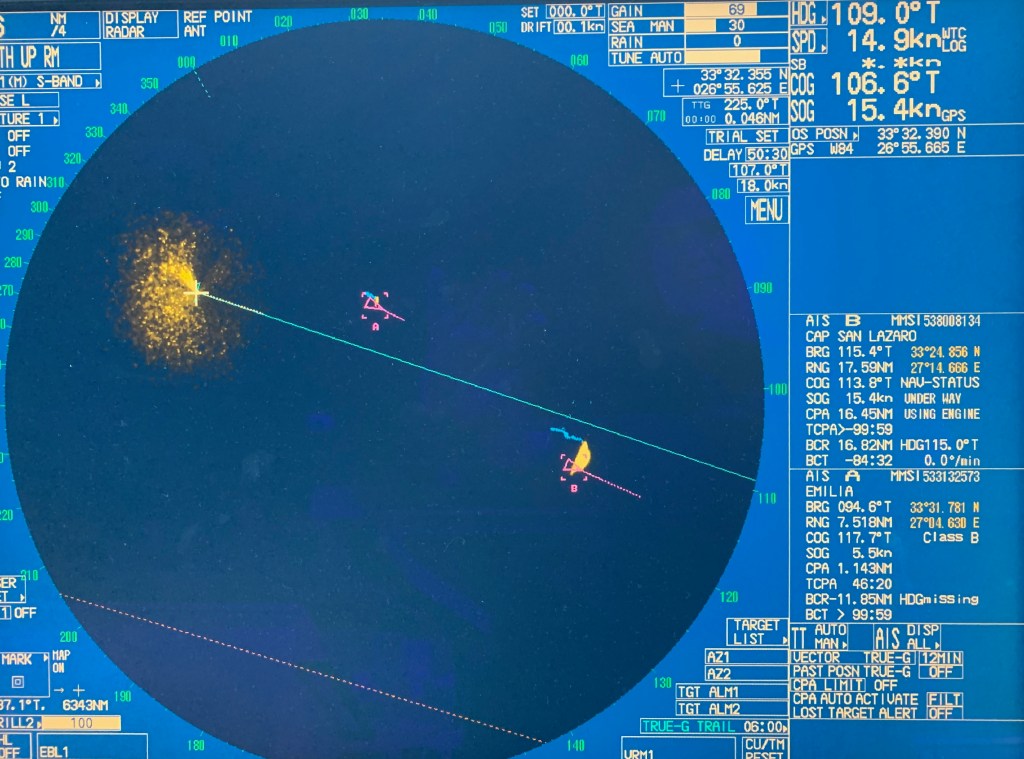
A ship without AIS can still be detected. Coastal radar, naval sensors, aircraft, drones, satellites, RF detection, and nearby ships may still pick up the vessel in different ways. In Hormuz, no ship is expecting to become invisible in the literal sense.
Commercial satellite capability has also changed the meaning of “dark.” Synthetic Aperture Radar can detect vessels through darkness and cloud. Optical satellite imagery can confirm ship presence when conditions allow. Radio-frequency detection can locate vessels through emissions from navigation radar, satellite communications, or other onboard systems. Analysts increasingly combine AIS, SAR, optical imagery, RF detection, port activity, voyage history, and behavioural patterns to reconstruct the movement of vessels that have stopped transmitting.
LRIT, Long-Range Identification and Tracking, is another layer usually missed outside shipping. It is not public and is a SOLAS-based tracking system used by flag States and authorised governments. AIS may disappear from the public screen, but that does not mean the vessel has disappeared from official maritime domain awareness.
Radar can show that a large target is moving through a sector of the strait. AIS gives an organised identity package: name, MMSI, position, course, speed, draft, ship type, destination, ETA, and a track from which movement pattern can be inferred. AIS silence therefore does not defeat serious surveillance. A state actor, naval force, or well-resourced intelligence provider may still rebuild the picture through multiple sources. What AIS-off removes is the easiest layer of open identification.
In Hormuz, a vessel broadcasting AIS is announcing its identity, position, course, speed, and movement pattern to anyone watching the open tracking layer. Switching AIS off removes that live self-identification during the most exposed part of the passage.
This is not stealth in the military sense. It is controlled visibility.

Going Dark Is Not Always the Same Thing
There is a difference between switching AIS off for security and manipulating AIS to mislead.
In a high-threat passage, the Master may decide that broadcasting identity, position, course, and speed increases exposure. AIS is switched off, the reason is recorded, and the system is restored once the danger has passed. That is a security control.
But some AIS gaps serve a different purpose. Wrong destinations, altered voyage details, broken tracks, suspicious STS blackouts, or positions that do not match actual movement may point toward concealment, sanctions avoidance, cargo masking, or commercial opacity.
“Dark transit” is not the same as the shadow fleet or grey fleet. It describes a behaviour: a vessel becomes difficult to follow through AIS-based tracking. Shadow and grey fleet describe a wider commercial and legal condition involving ownership, insurance, sanctions exposure, cargo origin, and trading pattern. They may overlap, but they are not the same. I covered that wider legal and operational world in When Shipping Turns Grey: Life and Law Inside the Shadow Fleet.
In Hormuz, AIS silence may coincide with GNSS jamming, spoofed positions, altered traffic patterns, naval coordination, and dense tanker movement. The watchkeeper may have to rely more heavily on radar fixing, parallel indexing, visual bearings where available, ARPA discipline, and continuous cross-checking. I examined that electronic-navigation layer in GNSS Interference at Sea: Navigating GPS Spoofing in the Strait of Hormuz.
So “going dark” should not be used as one label for every AIS gap. A security switch-off, a false destination, a spoofed position, and an STS blackout may look similar on a tracking platform. Operationally, they are very different.

Reading this as a maritime insider, seafarer, or enthusiast?
Subscribe to The DeepDraft for maritime analysis, daily SITREP updates, weekly briefings, and operational signals worth watching.
Hormuz Is Turning AIS Silence Into an Operating Model
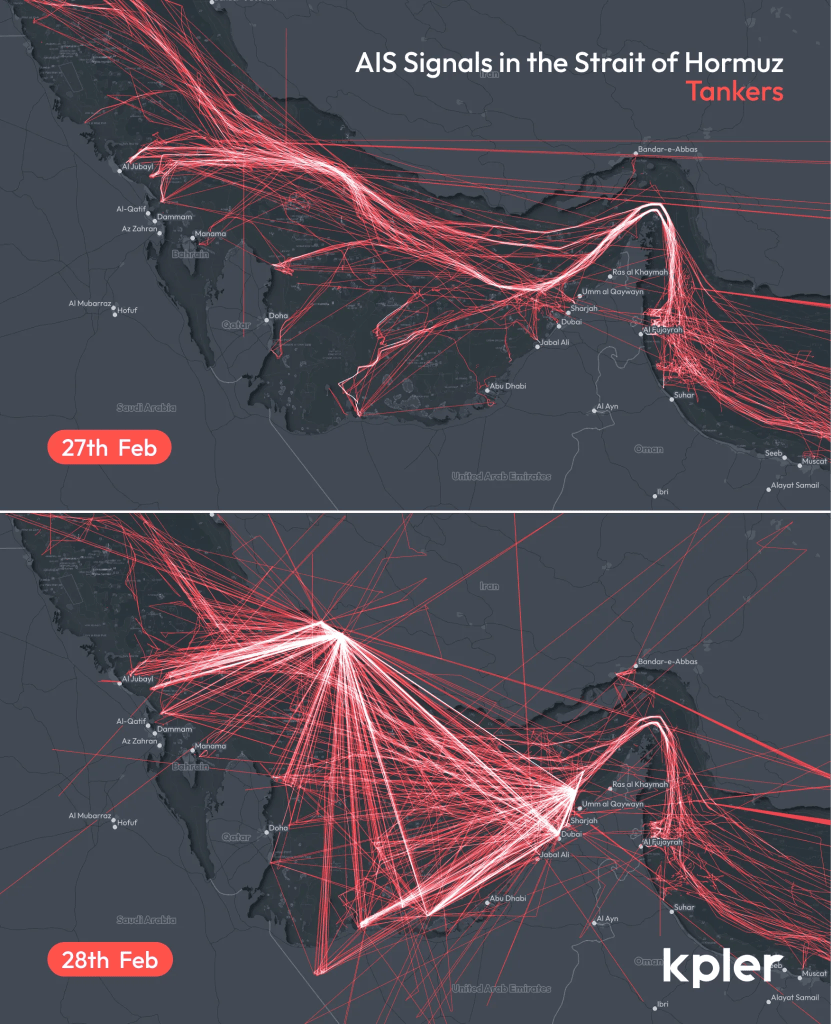
The CNN report uses the Greek-owned VLCC Kiku as one example of a wider pattern: AIS-off movement through the exposed Hormuz leg, reappearance outside the strait, and ship-to-ship transfer activity off the UAE coast.
Kiku is not the story. The operating model is.
Cargo interests are trying to keep oil moving through a waterway where normal passage has become exposed. Shuttle tankers carry the higher-risk leg through the Gulf and the strait, then transfer cargo outside the Gulf to receiving vessels that avoid the most dangerous section.
From the OSINT screen, the pattern looks like flow and direction: cargo moves, tracks break, signals return, and transfers appear outside the Gulf. From the bridge, the same pattern means non-standard transits, security coordination, anchorage exposure, STS operations, and reduced cooperative visibility.
OSINT sees movement. The Master sees exposure.
The Compliance Trap
The legal and commercial line is narrow.
AIS is expected to remain operational unless safety or security requires otherwise. If the Master switches it off, the reason, time, position, and restoration must be recorded. That may satisfy the shipboard requirement, but it does not end the matter commercially.
A legitimate security transit and a deceptive shipping practice may look similar to an automated screening system. Both can appear as a broken AIS track in a sensitive area. The difference lies in context: threat assessment, voyage pattern, cargo history, company instruction, timing of restoration, and consistency with the declared trade. That does not mean cover is automatically lost or the voyage becomes unlawful. But it can trigger questions from banks, insurers, charterers, sanctions teams, and compliance platforms. The logbook remains necessary. It may not be sufficient. I examined the Master’s exposure to sanctions screening in The Master’s Role in OFAC Compliance.
During one STS compatibility check, I was asked to confirm that, within the previous 12 months, the vessel’s AIS had not been tampered with or willingly switched off except in line with applicable IMO guidance.
That question is important because it separates two very different issues: manipulation and legitimate security use. A Master may switch off AIS for a recorded security reason. Tampering with AIS data, false entries, or unexplained gaps sit in a different category. This is where AIS has now reached. It is no longer only a bridge or navigation matter. It sits inside chartering, STS compatibility, vetting, insurance, banking, and sanctions screening. Many people reviewing those records are not seafarers. If the context is not documented properly, a legitimate security decision can begin to look like concealment.
The ship may go dark for security. The company must later prove it was not concealment.

DeepDraft View
A tanker with AIS switched off is not a ghost. It is a real vessel managing visibility in a high-risk waterway.
Broadcasting identity and movement through Hormuz can increase exposure. Switching AIS off may reduce that exposure, but the ship remains in the traffic picture, and the Master remains fully responsible for the passage.
The real issue is proof. Was AIS switched off for a documented security reason, or was it used to hide movement, cargo, ownership, or intent? That difference matters to the Master, the company, the charterer, the insurer, and the regulator.
A dark transit is a visibility decision that must stand up to scrutiny. The question after the passage is simple: was AIS switched off for a documented security reason, or did the gap hide something else?
That is why the term needs care. In Hormuz, AIS silence may be a security measure. Elsewhere, the same missing track may raise a compliance question.
The ship does not disappear when AIS is switched off. Only the easiest version of the ship does.
Media Section
Sources Reviewed
- CNN article text provided by user, dated 22 August 2026, including reported AIS-off Hormuz transits.
- IMO and SOLAS material on AIS purpose, carriage, and operational expectations.
- BIMCO AIS Switch Off Clause 2021 background and sanctions-compliance framing.
- International Group of P&I Clubs discussion on AIS monitoring, dark-activity assumptions, and sanctions-risk interpretation.
- OFAC maritime sanctions guidance and related analysis on AIS manipulation and deceptive shipping practices.
- Commercial and academic sources on SAR, RF sensing, and dark-vessel detection.
- Reporting and analysis on GNSS interference, AIS spoofing, and electronic-warfare conditions around Hormuz and the Gulf.



Leave a Reply