
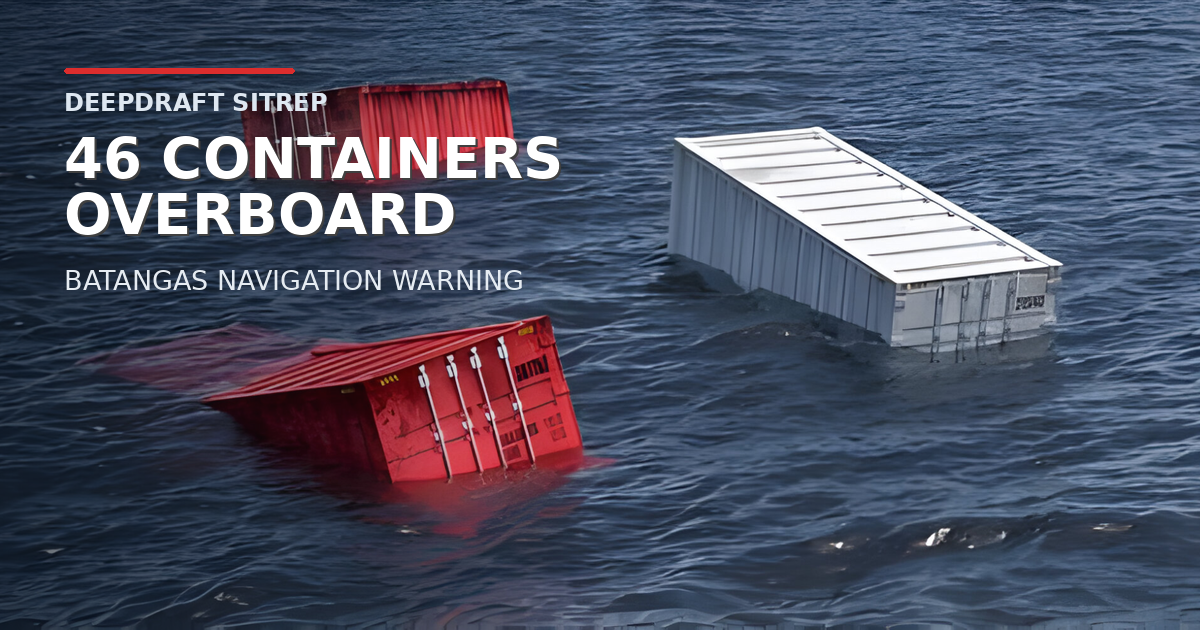
The Philippine Coast Guard issued a navigation warning after Span Asia 39 lost 46 containers off Batangas.
The immediate DeepDraft signal is a floating-hazard risk for coastal traffic, Manila approaches and response coordination.
1. Span Asia 39 Container Loss Creates Navigation Hazard Off Batangas
• The interisland containership Span Asia 39 lost 46 containers in the Batangas region, prompting a Philippine Coast Guard navigational warning for a busy coastal shipping lane.
• The 8,300 dwt vessel reported the loss at about 1100 local time on September 3 while approximately 1.5 nautical miles offshore near Hamilo Point.
• The ship had departed Davao International Container Terminal on August 31 with 332 containers onboard and was bound for Manila North Harbor.
• The lost units were reported as empty and comprised 30 units of 20-foot containers, 11 units of 40-foot containers and five open-type containers.
2. Coast Guard Response Moves Into Drift-Tracking and Coastal Control
• PCG reporting cited rough sea conditions, heavy rolling and loosened lashings while the vessel was in the vicinity of Hamilo Point.
• Coast Guard Station Batangas, Coast Guard Sub-Station Nasugbu and CGS Cavite personnel were dispatched for on-site verification and incident assessment.
• A drone from CGS Cavite was deployed for aerial assessment, monitoring and verification of the reported container positions.
• BRP Malapascua was assigned to accelerate search, drift-tracking and containment operations, while precautionary navigational warnings and VHF Securite broadcasts were issued to transiting vessels.
3. Panama Canal Slot Measures Add Separate Transit-Control Pressure
• The Panama Canal Authority maintained Neopanamax maximum authorized draft at 14.63 metres, or 48.0 feet TFW, while postponing the planned reduction to 14.48 metres, or 47.5 feet TFW.
• Neopanamax daily slots were adjusted to nine from September 3, while Panamax slots were set at 25 from September 3 and 23 from September 15.
• The Canal Authority warned that reduced daily transits may increase waiting times for vessels arriving without a secured reservation.
• A confirmed reservation through the Transit Reservation System remains the only mechanism that guarantees a transit date.
4. Hormuz Traffic Remains Suppressed Under Security Pressure
• Reuters reported that four commodity vessels transited the Strait of Hormuz on Thursday, down from nine a day earlier and below the 10-day average of about 15.
• The figure comprised two medium-range tankers, one Kamsarmax and one Handysize vessel, while excluding vessels that may have crossed with AIS switched off.
• Kpler data cited by Reuters showed only two VLCCs had crossed Hormuz so far that week.
• Bab el-Mandeb also remained below recent flow levels, with 22 commodity vessels crossing on Thursday, down from 31 the previous day.
5. IMO Net-Zero File Remains Open Before MEPC 85
• IMO lists ISWG-GHG 22 as completed from September 1 to 4, with the next ISWG-GHG session scheduled for November 23 to 27.
• MEPC 85 is scheduled for November 30 to December 3, keeping the Net-Zero Framework inside an active regulatory decision window.
• The Maritime Executive reported that the latest round closed with key issues still divided, including fuel-intensity pathways, pricing structure, lifecycle treatment and transition support.
• Ship managers should treat the framework as a live planning file until final MEPC 85 decisions clarify the MARPOL compliance route.
Strategic Summary & Actions Required
• Masters transiting Batangas, Manila approaches or nearby Philippine coastal waters should maintain sharp visual and radar lookout for floating or semi-submerged containers and respond to PCG VHF Securite traffic.
• Ship managers should preserve the Span Asia 39 case as a fleet circular item on container securing, heavy rolling, weather avoidance, deck inspection and cargo-lashing verification.
• Operators with Panama Canal exposure should separate draft permission from transit certainty: 48.0 feet TFW may hold, but slot reductions still affect arrival planning and guaranteed passage.
• CSO, DPA and chartering teams should keep Hormuz and Bab el-Mandeb under documented route authority, especially where AIS-dark movements, low observed flows or owner approvals affect passage planning.
• Technical and compliance managers should prepare MEPC 85 scenarios without treating ISWG-GHG 22 as a settled compliance instruction.
Operational Status
AMBER — Batangas Floating Container Hazard / Coast Guard Warning Active / Drift-Tracking Response / Panama and Hormuz Transit Watch
Latest DeepDraft Analysis
Latest DeepDraft Analysis
Dark Transits in Hormuz: The Illusion of Disappearance
Dark transit does not make a vessel disappear. DeepDraft explains how AIS-off movement still leaves Masters, owners and insurers exposed to operational, legal and security risk. crew-safety planning and documented commercial decisions.
Related DeepDraft Articles & Analysis
Sources
The Maritime Executive, PortCalls Asia, Panama Canal Authority, Reuters, IMO
This update is part of the DeepDraft SITREP series covering developing maritime operational situations.


Leave a Reply