
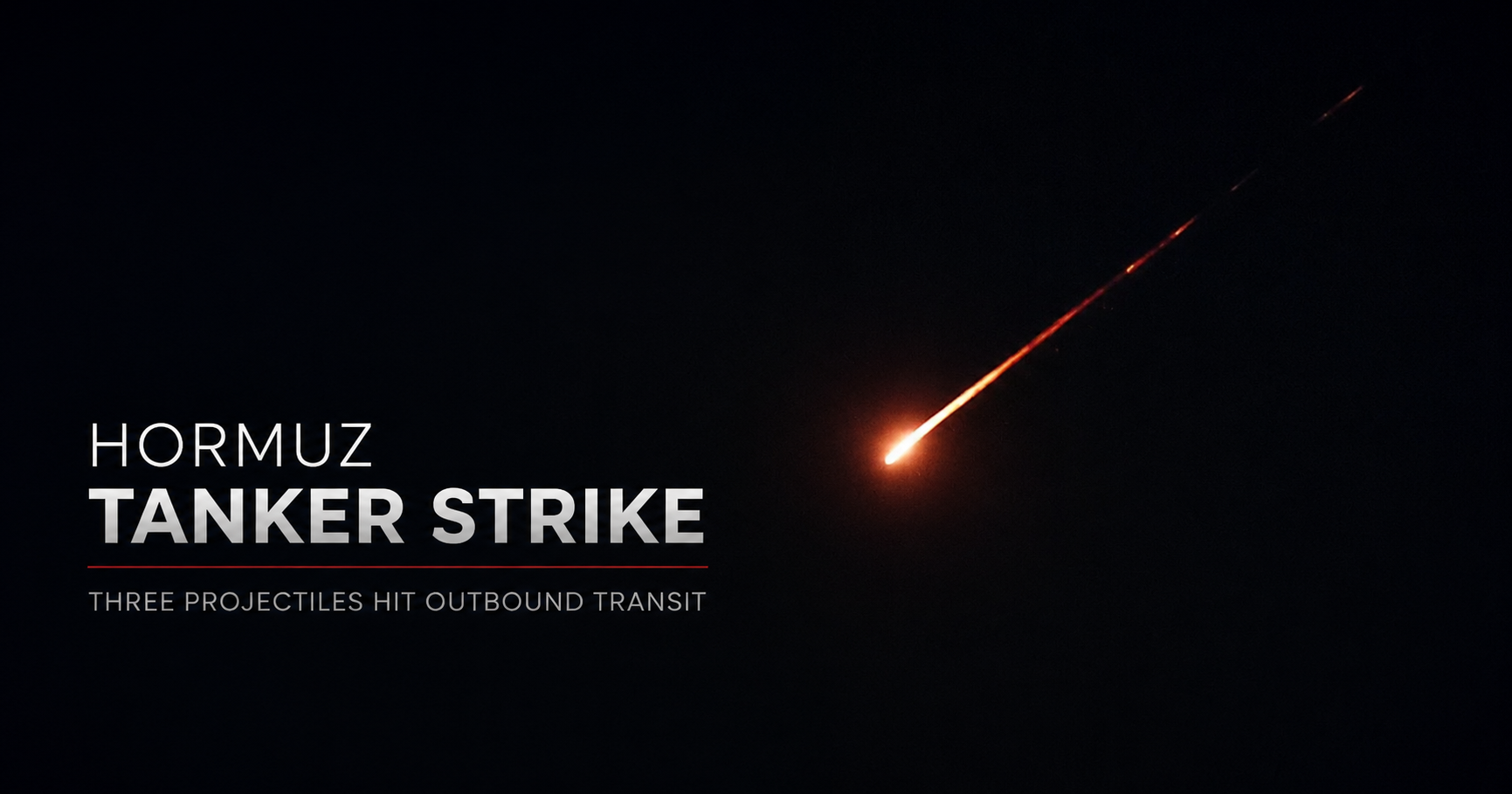
A tanker was struck during outbound Strait of Hormuz transit east of Khasab, Oman.
The same reporting cycle brought U.S. strikes on Iranian launchers and renewed navigation-risk escalation inside the chokepoint.
1. Tanker Hit East of Khasab During Outbound Hormuz Transit
• UKMTO reported that a commercial tanker was struck by three unknown projectiles while transiting out of the Strait of Hormuz.
• The incident position was reported about 17 nautical miles east of Khasab, Oman, near the eastern exit of the Strait.
• No casualties were reported, and authorities said the incident remained under investigation.
• Initial reporting did not confirm pollution, flooding, fire or loss of propulsion, but the strike creates immediate evidence-preservation and voyage-risk exposure for vessels operating through the same corridor.
2. U.S. Strikes Larak Island Launchers After Mine-Deployment Warning
• U.S. forces struck two Iranian launchers on Larak Island on August 30.
• U.S. officials said IRGC forces had been observed preparing to launch rockets carrying sea mines into the Strait of Hormuz.
• The action followed U.S. statements that mines had recently been cleared from international shipping routes in the Strait.
• For Masters and CSOs, the operational issue is not only kinetic risk. It is the re-entry of mine, projectile and military-warning uncertainty into voyage authorization for Hormuz transits.
Reading this as a maritime insider, seafarer, or enthusiast?
Subscribe to The DeepDraft for maritime analysis, daily SITREP updates, weekly briefings, and operational signals worth watching.
3. Oil and Transit Market Pressure Moves Back Into Voyage Economics
• Reuters reported Brent crude at USD 91.05 and WTI at USD 86.59 in early September 1 trading after the latest Gulf fighting restored supply-disruption risk.
• Reuters also reported visible commodity-vessel transits through Hormuz down to five per day over the weekend.
• The tanker strike and Larak launchers create fresh exposure for war-risk pricing, charterparty deviation language, laycan reliability and cargo-delivery assumptions.
• Charterers, owners and brokers should separate normal market movement from direct Strait risk when fixing Gulf cargoes, especially where routing authority, insurance approval and port-window commitments are linked.
4. Drone, False-Report and Bridge-Verification Layer
• Iranian state and semi-official media reported that the IRGC shot down a U.S. MQ-9 drone over the eastern Strait of Hormuz.
• U.S. confirmation was not identified in the verified source set, so the drone claim should be treated as an Iranian claim unless confirmed by U.S. or coalition authorities.
• CENTCOM also accused Iran-linked channels of using false maritime reports to intimidate shipping around Hormuz.
• Bridge teams should treat projectile reports, drone claims, mine warnings, VHF instructions and coastal-state messaging as controlled communications requiring full logging, shore-side escalation and company security review before operational response.
5. Secondary Maritime Signals: Fleet Resilience and Shadow-Fleet Enforcement
• Höegh Autoliners ordered six additional Aurora class vessels, reported as dual-fuel LNG and zero-carbon-ready tonnage.
• Höegh also signed a five-year agreement to equip its fleet with navigation-resilience technology, a relevant signal as GNSS/AIS reliability becomes a security issue in high-risk waters.
• EU forces stopped a sixth suspected shadow-fleet tanker in the Mediterranean for flag verification, reinforcing sanctions and registry-risk pressure on tanker operations.
• These are important industry and compliance signals, but they do not outrank the fresh Hormuz projectile strike as today’s operational lead.
Strategic Summary & Actions Required
• Masters transiting Hormuz should increase bridge-team readiness, preserve AIS, ECDIS, radar, VDR, GMDSS and security-log records, and report any projectile, drone, mine or military-contact event through company and recognized maritime security channels.
• Ship managers should re-check CSO/DPA escalation trees, vessel hardening, emergency drills, citadel and damage-control readiness before authorizing Gulf transits.
• Charterers and operators should review war-risk cover, deviation rights, off-hire exposure, force majeure language, laycan windows and delivery obligations on Hormuz-linked voyages.
• Insurers and P&I teams should treat the tanker strike and Larak launcher action as a fresh underwriting and claims-notification trigger, not merely background Gulf tension.
• Technical and navigation teams should reinforce GNSS cross-checking, visual/radar fixing discipline and bridge-verification procedures where false reporting or electronic interference may affect decision-making.
Operational Status
CRITICAL RED — Strait of Hormuz Projectile Strike / Mine-Deployment Warning / U.S.-Iran Military Escalation / War-Risk and Voyage Authorization Pressure
Latest DeepDraft Analysis
Dark Transits in Hormuz: The Illusion of Disappearance
Dark transits in Hormuz expose how AIS gaps, spoofing risk and selective visibility can distort threat perception, insurance review and voyage authorization decisions.
Related DeepDraft Articles & Analysis
Sources
UKMTO, Reuters, Associated Press, The Maritime Executive, The DeepDraft
This update is part of the DeepDraft SITREP series covering developing maritime operational situations.



Leave a Reply