
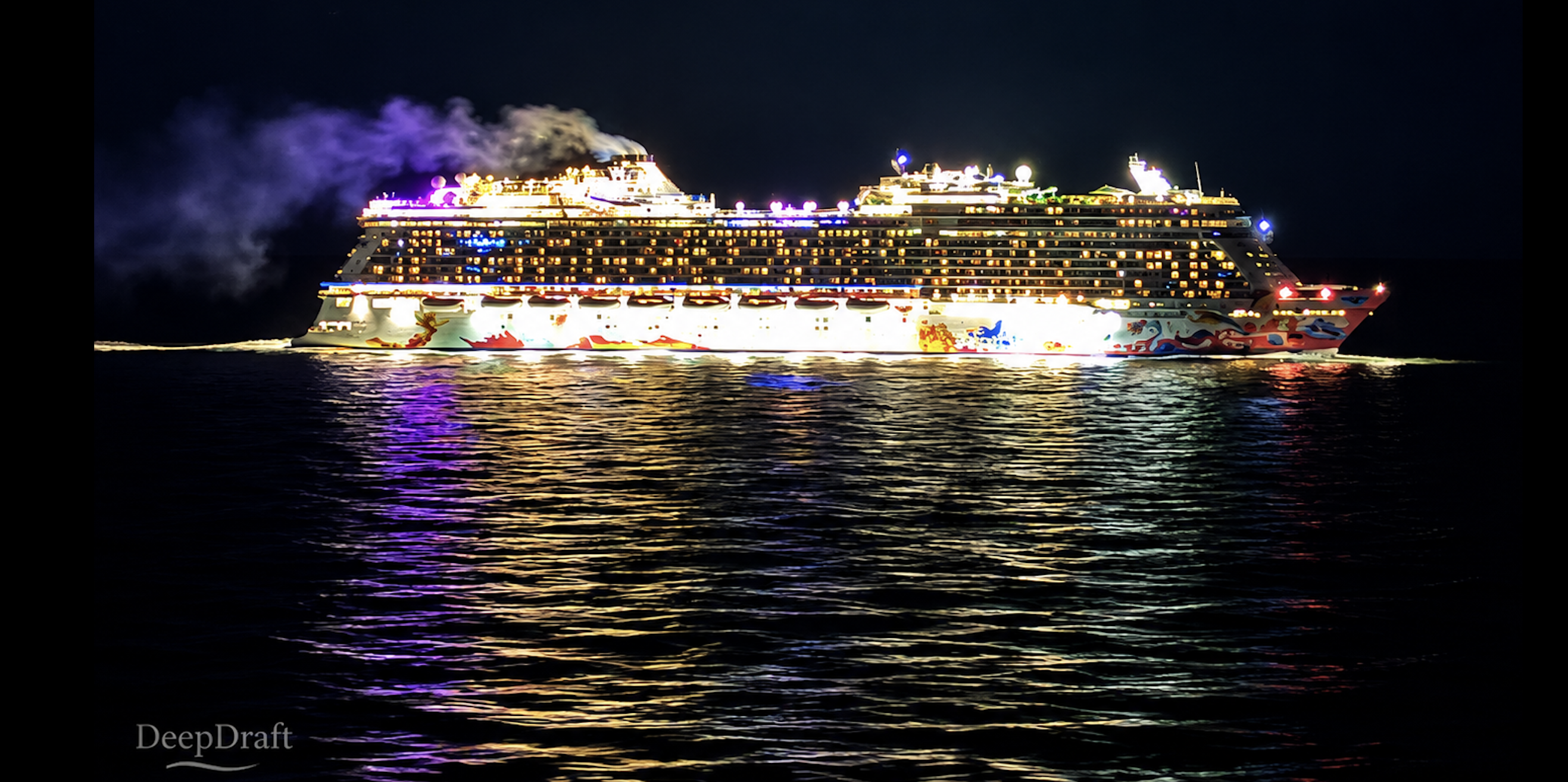
We spend a lot of effort making ships visible at night. Sometimes we make them harder to understand.
Anyone who has kept a navigation watch at night knows how little light it takes to disturb the bridge team. An open cabin curtain, an accommodation door left open, or a foc’sle or midship store light forgotten after work is enough for the duty officer to have it corrected. The reason is simple: night vision is part of safe navigation.
Yet the same vessel may transit crowded waters with container access lighting, cruise ship hotel lighting, and aft security lamps burning so brightly that her COLREG navigation lights lose their dominance. The bridge team is expected to maintain a proper lookout while the vessel’s own lighting may make aspect recognition harder for everyone around her. What begins as lighting management becomes a collision-avoidance issue.
The importance of a reliable visual picture was explored in When Bridge Windows Look the Wrong Way.
Night Transit in Congested Waters
The Singapore Strait, Malacca Strait, English Channel and other congested approaches already test a bridge team at night, with dense traffic, small craft and shore lighting competing for attention.
Some tanker operators and Masters prefer daylight transits through the most demanding sections when the commercial window allows it. The issue is margin, at night small targets are harder to detect, aspect recognition takes longer, and unnecessary lighting adds to the workload.
A vessel can be brightly visible and still be operationally unreadable. In close-quarter waters, collision avoidance is not only about detecting a light. It is about quickly reading aspect, movement, and intention. Excessive shipboard lighting delays that reading. Sidelights lose dominance. Sternlights disappear inside accommodation glare. Masthead lights sit among other white lights. Small fishing craft and service boats can merge into the illuminated profile of a larger vessel ahead or astern.
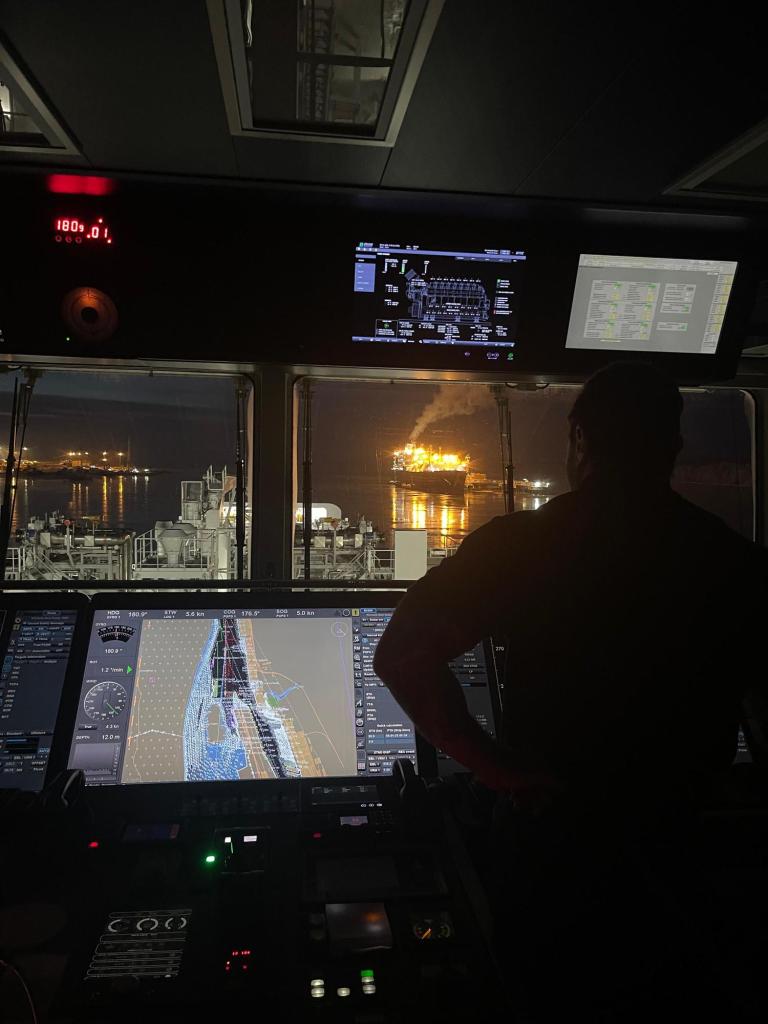
I recall one night passage through the Singapore Strait with a brightly lit cruise vessel ahead. Between our ship and the cruise vessel was a small fishing boat showing a single light. Against the cruise ship’s illuminated profile, that small light was almost lost, and the fishing boat was nearly missed. This was not a theoretical COLREG discussion but a man in a small boat who could have died.
The same competition for bridge attention was examined in Unlimited Internet, Limited Attention.
Fishing vessels create the same problem at a different intensity. Across several trading areas, I have encountered fishing vessels operating under extremely powerful working or fish-attraction lights. At close range the glare can destroy night vision to the point where the surrounding water, fishing gear, small craft and even other traffic become difficult to pick out. Casualty investigations have found bright fishing-vessel deck lights reducing the watchkeeper’s ability to distinguish objects beyond the glare, while also obscuring the vessel’s prescribed navigation lights. I have also encountered laser beams directed towards the bridge, apparently to warn ships about nets or fishing gear ahead. Whatever the intention, directing a laser at a watchkeeper introduces another visual hazard when established COLREG signalling methods already exist.
What COLREGs Already Require
Navigation lights are the night-time language of collision avoidance. Their arcs, position, height, intensity and screening allow another vessel to read aspect, movement and responsibility.
COLREGs already recognise that other lighting can degrade this system. Rule 6 requires vessels to consider background light at night, including shore lights and backscatter from their own lights. Rule 20(b) prohibits other lights that can be mistaken for prescribed lights, impair their visibility or distinctive character, or interfere with proper lookout. Annex I goes further, requiring sidelights to be positioned so they are not interfered with by deck lights.
The question is therefore not only whether the navigation light is fitted and visible at its required range, but whether it remains readable against the rest of the ship.

Reading this as a maritime insider, seafarer, or enthusiast?
Subscribe to The DeepDraft for maritime analysis, daily SITREP updates, weekly briefings, and operational signals worth watching.
The Compliance Illusion
Many ships are technically compliant and still operationally confusing. The navigation lights may be correctly fitted and tested, yet from another bridge the vessel can still appear as a wall of white light in which the prescribed lights are no longer dominant.
Cruise ships are the most visible example. At night, a large cruise vessel can resemble a floating waterfront, with passenger spaces, balcony lighting, deck lighting, accommodation lighting, and decorative illumination all forming one luminous profile. The legal navigation lights may be burning correctly within that profile, but their distinctiveness can be reduced by the surrounding light.
Container ships create a different problem. IMO guidance requires proper illumination of access ways and working spaces between container bays for safe movement and securing work, and on some large ships these routes extend over a considerable length of deck. The operational need for lighting is understandable, but the design should prevent that light from spilling beyond the working area. Proper shielding, downward-directed fittings and controlled light levels can keep access routes illuminated without creating glare outside the ship. The problem is not that the lights are on; it is when their output scatters into the surrounding sea and makes navigation lights or nearby small craft harder to distinguish.
Security lighting creates a similar problem in the Malacca and Singapore Straits, where some vessels keep powerful aft or over-side lights on because of armed-robbery concerns. BMP Maritime Security guidance recommends minimising external lighting except mandatory navigation lights, with additional over-side lighting used when a threat is identified. Continuous floodlighting during passage can create backscatter, obscure the sternlight and reduce night vision while addressing a different risk.

The Casualty Record
The risk is already established in casualty investigations. In the 2018 collision between the tanker Sola TS and the Norwegian frigate HNoMS Helge Ingstad, the tanker was showing her navigation lights but also had forward-facing deck lights switched on after departure. Investigators found that these lights made it difficult for the frigate’s bridge team to distinguish the tanker’s navigation lights and Aldis lamp flashes, contributing to the failure to recognise the target as a vessel. The Norwegian Maritime Authority subsequently issued guidance requiring deck lighting on vessels underway to be reduced to the minimum necessary so that navigation lights remain clearly visible.
ATSB investigations found the same pattern in collisions involving Glasgow Express / Mako and Khudozhnik Ioganson / Zodiac. In both cases, bright working or deck lighting reduced the usefulness of prescribed navigation lights, making vessel aspect or heading more difficult to interpret.
The US Coast Guard has issued similar warnings that decorative, LED and other additional lighting can impair the distinctive character of prescribed navigation lights and interfere with proper lookout.
The pattern is consistent: the vessels were visible, but their aspect was harder to interpret because other lighting had reduced the navigational value of the prescribed lights.

The Inspection and Regulatory Blindspot
Shipping inspections can become remarkably precise about navigation lights. SIRE 2.0, RightShip and Port State Control may check lamp condition, alarms, LED service life, luminous intensity, sectors and even whether sidelight screens are painted the matt black required by Annex I. A relatively minor defect may require rectification before departure, adding another headache for the Master.
Yet that same Master may sail into dense night traffic surrounded by ships whose compliant navigation lights are difficult to distinguish among accommodation, access, decorative or security lighting. We inspect the lamp, the screen and the alarm, while often missing the ship’s complete night-time light profile.
COLREG Rule 20(b), Rule 6 and Annex I already contain the principle, and casualty investigations have shown the consequence. What is missing is a consistent requirement that prescribed navigation lights remain clearly distinguishable under the vessel’s normal sea-passage lighting condition.
The solution is practical. Access and working lights should be controlled or shielded, passenger vessels should verify that exterior lighting does not overwhelm prescribed lights, and security lighting should remain threat-based. Companies can address this through the SMS, but SIRE, RightShip, PSC and IMO also need to assess the vessel as another bridge team actually sees her at night.
The industry does not need another reminder about proper lookout. It needs ships that do not make that lookout unnecessarily difficult.

DeepDraft View
COLREGs depend on mutual readability. Every vessel must show lights that allow another bridge team to understand her aspect, movement, and responsibility. When those prescribed lights are surrounded by competing illumination, the legal requirement may still be met on paper while the collision-avoidance message itself becomes less clear.
This issue affects lookout, safe speed, risk assessment, and the time available for avoiding action. We already react immediately when a cabin curtain, store light, or open accommodation door interferes with night vision onboard. The same discipline should apply to the vessel’s external light profile. DeepDraft’s SIRE 2.0: Navigation and Communications shows how detailed individual navigation checks already are.
A ship can be fully compliant with COLREGs and still be operationally difficult to read at sea. The next step for regulators, inspectors, and operators is therefore straightforward: assess not only whether the navigation lights work, but whether another bridge team can still read the vessel clearly in her normal night-time condition.
Media Section
Sources Reviewed
- USCG Navigation Center, guidance on decorative, strobe, high-intensity, and specialty lighting under Rule 20(b).
- Norwegian Safety Investigation Authority, collision between HNoMS Helge Ingstad and Sola TS., Norwegian Maritime Authority, Safety Notice SM 2-2020, Deck Lights.
- ATSB, collision between Glasgow Express and Mako.
- USCG Safety Alert 10-15, Navigation Lights, USCG Alert 09-09, Navigation Lights, Maintaining Distinctive Character.
- IMO CSS Code Annex 14 guidance on container access-way and working-space illumination.
- BMP Maritime Security 2025 guidance on ship protection measures and night lighting.




Leave a Reply