

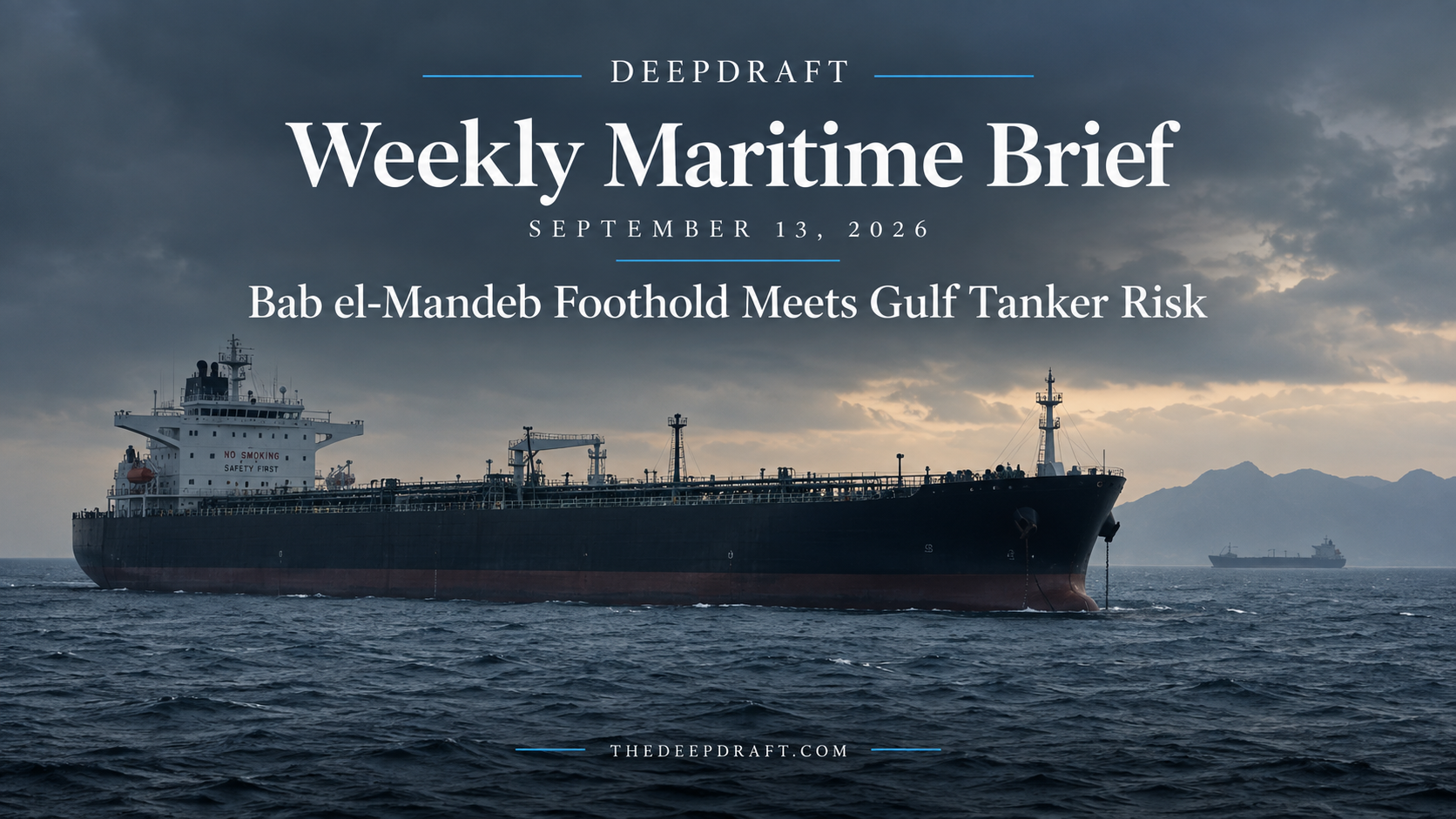
A Saudi-linked tanker attack in the Red Sea has moved the Houthi blockade from rerouting threat to confirmed vessel damage.
The operational consequence now runs through Bab el-Mandeb routing, southern Red Sea insurance and Saudi crude liftings.
1. ENCELIA Strike Confirms Vessel-Level Red Sea Risk
• Houthis claimed missile and drone strikes against the Saudi oil tankers ENCELIA and LAYLA in the Red Sea.
• Maritime security sources confirmed ENCELIA was struck off Jizan, near Yemen’s border.
• Saudi reporting said ENCELIA suffered a fire at the bow, with crew reported safe.
• Reuters could not immediately confirm the claimed attack on LAYLA, so it remains a claimed second strike, not a confirmed casualty.
2. Bab el-Mandeb Flow Splits as Saudi Crude Moves Under Pressure
• The Singapore-flagged VLCC XIN LONG YANG and Chinese-flagged VLCC COSNEW LAKE exited the Red Sea through Bab el-Mandeb carrying a combined 4 million barrels of Saudi crude.
• Both vessels were chartered by Unipec and had loaded at Yanbu before proceeding toward discharge ports in China.
• At least two other Unipec-chartered VLCCs scheduled to enter the Red Sea and load Saudi crude slowed or circled in the Gulf of Aden.
• Bab el-Mandeb transits fell to 27 vessels from 38 the previous day, while Hormuz traffic remained subdued.
3. Insurance and Oil Markets Reprice the Southern Red Sea
• Indicative war-risk premiums for southern Red Sea voyages rose above 1% of vessel value, from about 0.75% on Tuesday and 0.3% last week.
• Some Saudi-linked ships and vessels calling southern Saudi Red Sea ports such as Jizan and Al Shuqaiq were quoted as high as 3%.
• Southern Red Sea risk now carries direct voyage-cost exposure, with even small premium movements adding hundreds of thousands of dollars to a short voyage.
• Brent crude broke above USD 100 per barrel for the first time since May as Red Sea attacks added a second chokepoint shock to the Hormuz disruption.
4. Hormuz Custody and Panama Canal Restrictions Add Parallel Routing Pressure
• A Greek-operated Dynacom product tanker, KAVOMALEAS, was reported to have been towed toward the Iranian side of Hormuz after an earlier projectile strike near Oman.
• Marine Insight reported the vessel was near Larak Island and in Iranian custody; Dynacom said it had not authorized any tow and was verifying the vessel’s position.
• The Panama Canal Authority said severe El Niño probability had risen from 25% in April to 81% in July, with capacity restrictions likely to include draft limits and reduced daily booking slots.
• MSC introduced a USD 100 per TEU Panama Canal surcharge from August 19, while CMA CGM increased its Panama Canal surcharge from USD 40 to USD 100 per TEU from July 25 on specified trades.
Strategic Summary & Actions Required
• Masters transiting the southern Red Sea, Jizan approaches, Al Shuqaiq approaches or Bab el-Mandeb should treat Saudi link, cargo origin, charterer exposure and AIS visibility as direct targeting-risk factors.
• Ship managers should refresh BMP-style bridge routines, citadel readiness, emergency communication trees, fire-response checks and company security authorization before Red Sea entry.
• Charterers and operators should reprice southern Red Sea options using live war-risk quotes, off-hire exposure, deviation clauses, cargo delay exposure and alternative Cape routing assumptions.
• Tanker desks should separate northern Saudi Red Sea calls from southern Saudi calls, because current premium indications show materially different risk pricing by port and proximity to Yemen.
• Canal-routing teams should review Panama Canal draft, booking and surcharge exposure before fixing Asia to U.S. East Coast, Gulf, Caribbean, Central America and North Coast South America cargoes.
Operational Status
CRITICAL RED — Red Sea Tanker Strike / Bab el-Mandeb Transit Split / Southern Red Sea War-Risk Surge / Parallel Hormuz and Panama Routing Pressure
Latest DeepDraft Analysis
ECDIS Corrections: Why Updated Charts Still Confuse the Bridge
https://thedeepdraft.com/2026/07/20/ecdis-corrections-aio-ep-no-overlay/
Updated ECDIS can still leave bridge teams exposed where AIO, EP polygons, No Overlay areas and date-dependent corrections are not operationally assessed.
Related DeepDraft Articles & Analysis
Sources
Reuters, Saudi Press Agency, Marine Insight, Panama Canal Authority, Supply Chain Dive
This update is part of the DeepDraft SITREP series covering developing maritime operational situations.

Leave a Reply