
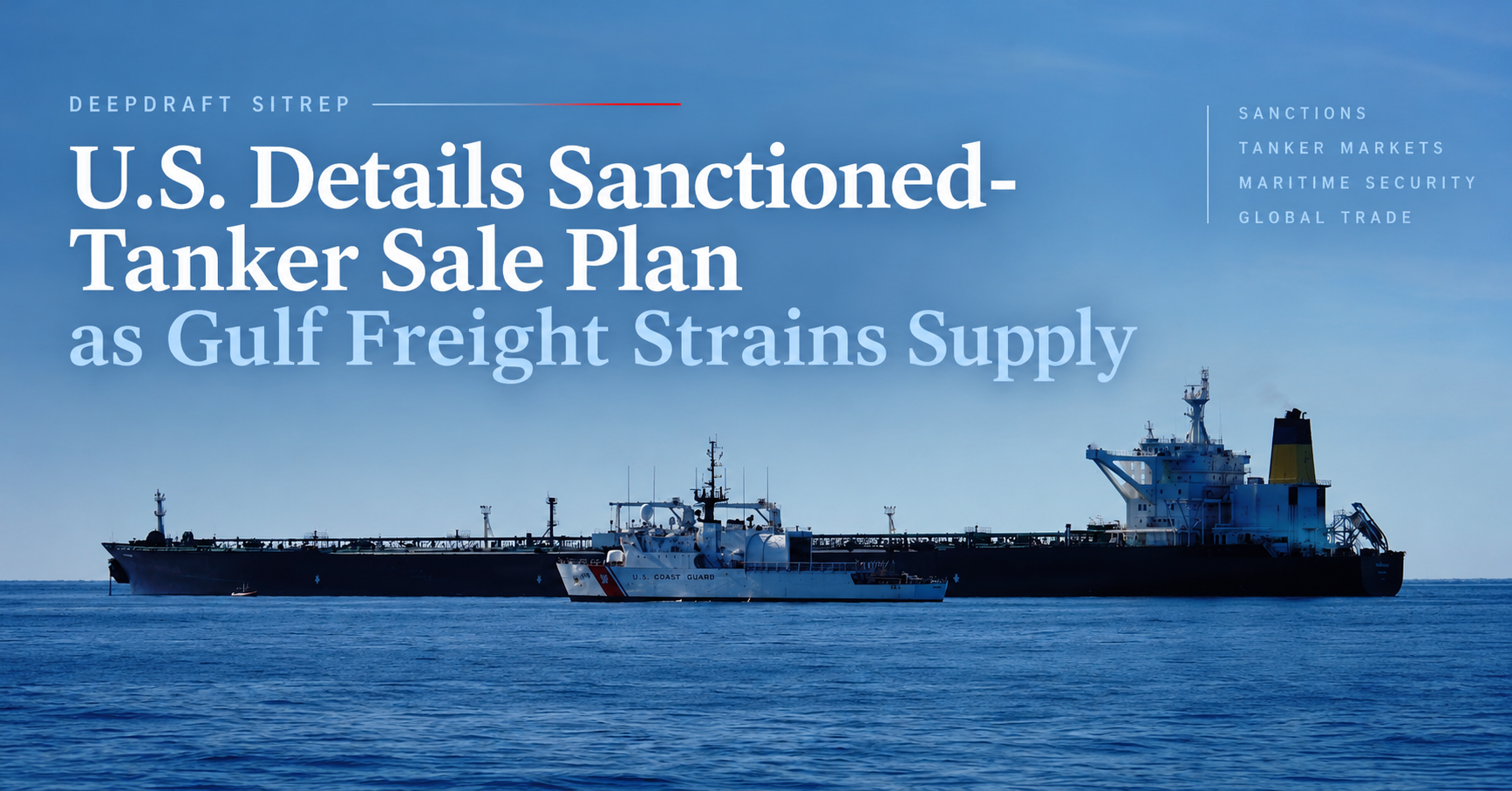
Washington has outlined a pathway for selected sanctioned tankers to return to legitimate oil transportation. The announcement comes as a major containership salvage develops in the South Atlantic and fresh naval confrontations add to maritime-security tensions.
1. U.S. Outlines Sanctioned-Tanker Return to Legitimate Trade
- On October 19, U.S. Energy Secretary Chris Wright announced that Washington was working with investors to purchase, refurbish and return selected sanctioned tankers to legitimate crude transportation.
- Wright told a Citadel Securities event in New York that the vessels would transport non-sanctioned oil. The announcement does not constitute a general lifting of sanctions on Russian or Iranian petroleum.
- Kpler estimates that only about 24 of 160 OFAC-sanctioned VLCCs could realistically re-enter mainstream trades. Braemar’s assessment is lower, at approximately 19 VLCCs after additional restrictions are considered.
- INTERTANKO has questioned the safety implications, highlighting vessel condition, ownership transparency, insurance and inspection histories.
- No named tanker receiving a new approval, completed ownership transfer or actual return to compliant service has been established in the reporting reviewed.
2. South Atlantic: Salvage Contracted as Missing Officer Investigation Develops
- On October 19, claims specialist W.E. Cox reported that SMIT salvors had been engaged under Lloyd’s Open Form terms following the fire aboard ESPIRITO SANTO EXPRESS, IMO 9793923.
- The Singapore-flagged containership, operated by Hapag-Lloyd and owned by Seaspan, suffered its casualty on October 15 while sailing from Singapore towards Santos, Brazil.
- Portugal’s maritime accident investigation office, GAMA, confirms that AEOLIAN ARROW, IMO 9671814, recovered all 28 containership crew members, including 19 from a lifeboat and nine from a liferaft.
- During recovery of the rescue boat, the bulk carrier’s chief officer fell overboard. Recovery attempts failed, and the officer remains missing. GAMA classifies the occurrence as a very serious maritime casualty.
- W.E. Cox advises that cargo interests will need salvage security before cargo is forwarded or released. The extent of vessel damage and cargo losses remains under assessment.
3. Gemini Cooperation Announces New Asia-Europe Port Rotations
- Maersk confirmed on October 19 further Gemini network changes with Hapag-Lloyd, including the introduction of the AE18 service through the Suez Canal.
- The new AE18 rotation links Shanghai, Xiamen, Tanjung Pelepas, Algeciras and Tangier. Its first scheduled departure is MAERSK EDIRNE from Shanghai on November 22.
- AE2 will substitute Rotterdam for its westbound Tangier call. AE11 will introduce Salalah and Port Said, while AE19 adds Damietta and substitutes Nansha for Shanghai.
- Initial implementation is scheduled between November 15 and November 22. Hapag-Lloyd management expects most Gemini services could resume Suez routing during the first quarter of 2027, subject to conditions.
4. Chinese Navy Challenges U.S. Warship Near Sabina Shoal
- China’s Southern Theatre Command reported that USS CHARLESTON (LCS 18) entered waters adjacent to Sabina Shoal in the Spratly Islands early on October 20.
- Chinese authorities described the entry as unauthorized and said naval forces tracked and monitored the U.S. vessel.
- Reuters reported that the U.S. Navy had not immediately commented. China’s characterization of the transit remains a unilateral sovereignty claim.
- Separately, Taiwan’s Coast Guard reported a confrontation with a Chinese Coast Guard vessel near the Pratas Islands on October 20. No confirmed commercial shipping interruption resulted from either reported encounter.
5. Iran Claims U.S. Drone Downing and Warns About Subsea Cables
- On October 20, Iran’s IRGC claimed it had intercepted and destroyed a U.S. MQ-9 drone over the Strait of Hormuz during the early hours of Tuesday.
- IRNA’s headline identifies an MQ-1, while its report identifies an MQ-9. The claimed loss and precise aircraft identification remain independently unconfirmed.
- Separately, TASS reported an IRGC representative’s warning that submarine telecommunications cables passing through Hormuz could become future targets.
- The cable statement is a threat, not evidence of a physical attack or communications outage. No new confirmed merchant-vessel casualty can be attributed to either announcement.
Latest DeepDraft Analysis
The Mercenary Master: Shipping’s New Hormuz Reality
An examination of extraordinary tanker freight, danger payments and the responsibility borne by Masters and crews when commercial incentives intersect with wartime navigation and safety decisions.
Related DeepDraft SITREPs
Related DeepDraft Articles & Analysis
Sources
Bloomberg, GAMA Portugal, W.E. Cox Claims Group, Maersk, Reuters.
This update is part of the DeepDraft SITREP series covering developing maritime operational situations.


Leave a Reply