
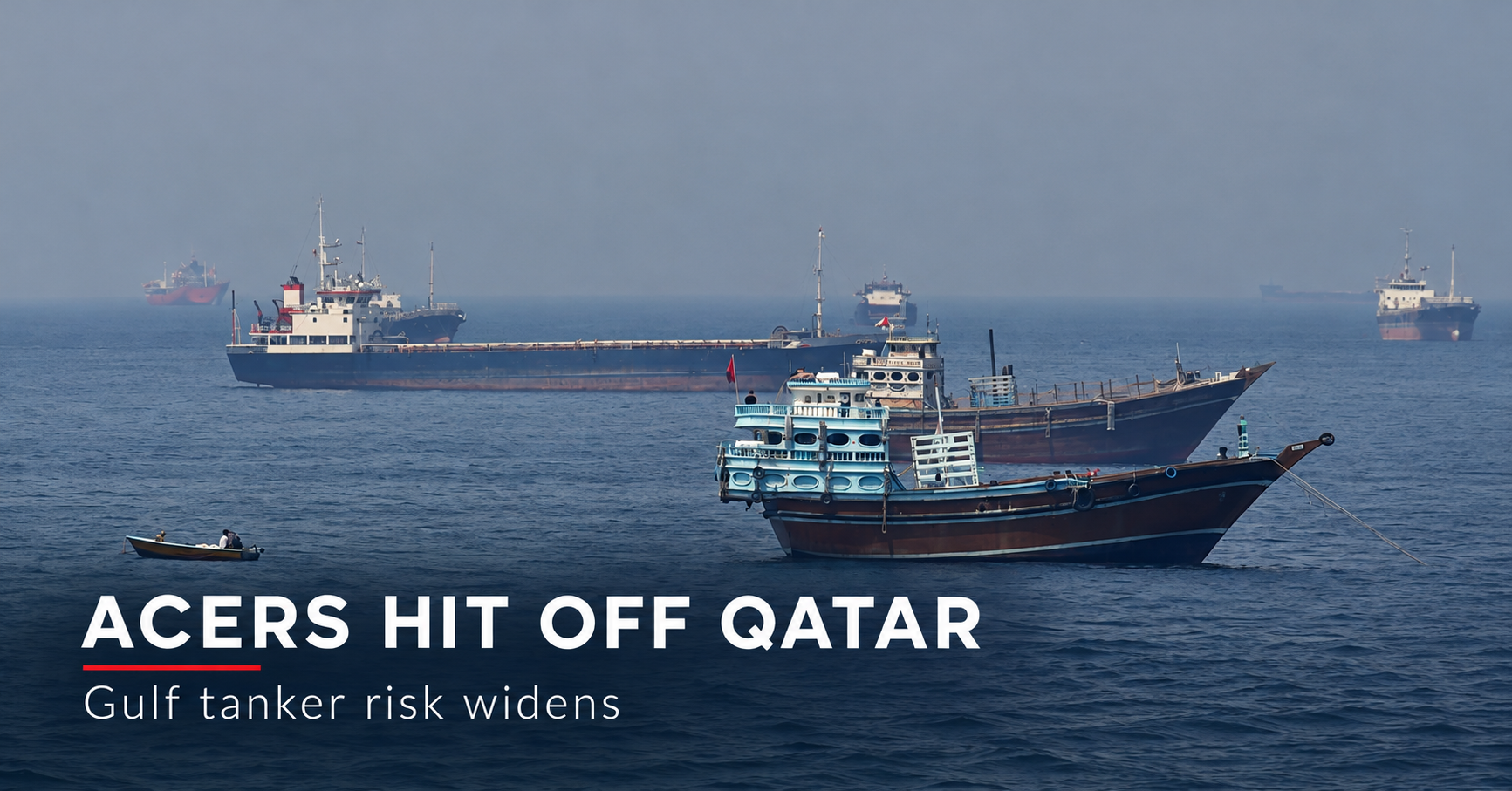
The Qatar tanker attack is now a named-vessel casualty file, while fresh U.S. and UK sanctions widen compliance exposure across Iranian oil and Russia-linked shadow-fleet trades.
Unverified reports of naval-mine strikes in Hormuz remain a high-risk watch item, but the strongest verified signal is the ACERS attack combined with new sanctions enforcement.
1. ACERS Identified After Qatar Projectile Strike
• The tanker casualty north of Qatar has been identified in maritime reporting as ACERS, IMO 9301902, Antigua and Barbuda flag.
• The vessel is reported as a combined chemical/oil tanker of about 51,371 dwt, built in 2006.
• UKMTO reported that a tanker was struck by multiple projectiles about 51 nautical miles north of Madinat ash Shamal, Qatar, with casualties reported.
• The attack occurred outside the Strait of Hormuz lane, pushing Gulf security exposure deeper toward Qatar, Bahrain, Saudi Arabia, Kuwait and Iraq approach routes.
• Casualty severity, damage extent and responsibility for the strike remain under investigation.
2. Hormuz Mine Reports Remain Unconfirmed, But Transit Risk Is Rising
• Iranian and Russian media reports describe explosions and possible naval-mine strikes affecting tankers in the Strait of Hormuz.
• The precise number of affected vessels, vessel identities, casualty status and pollution impact have not been confirmed through primary maritime-security channels.
• Masters should not treat the mine reports as verified incident data until supported by UKMTO, NAVAREA, flag-state, naval or company reporting.
• The operational risk remains material because tanker attack tempo around Hormuz has already increased, and the Qatar strike confirms that projectiles are reaching vessels outside the Strait itself.
• Bridge teams should preserve track data, AIS logs, VDR records, security communications and all coastal-state or naval instructions during Gulf passages.
3. U.S. Iran Sanctions Expand Shipping-Sector Exposure
• The U.S. Treasury announced a broad Iran sanctions package targeting nearly 60 Iran-linked entities, individuals and vessels across oil, cyber, missile, nuclear and procurement networks.
• OFAC expanded sanctions risk into five sectors of the Iranian economy, including shipping.
• The action targets networks moving Iranian crude, petroleum products and petrochemicals through brokers, companies and shadow-fleet vessels across multiple jurisdictions.
• Indian exposure is now explicit, with reporting identifying Mumbai-based firms and Indian nationals among those facing U.S. sanctions over alleged Iran oil-trade links.
• Charterers, brokers, traders, ship managers and banks should re-screen Iran-linked cargoes, STS chains, beneficial ownership, payment flows, AIS histories and fixture counterparties before acceptance or performance.
4. UK Adds Russia Shadow-Fleet Tankers as Arctic Routing Draws Scrutiny
• The UK sanctioned 12 additional oil tankers it identifies as part of Russia’s shadow fleet.
• Reporting identifies Dakar as one of the listed tankers, with the vessel noted for an unusual late-season Northern Sea Route voyage.
• The action adds compliance risk for owners, managers, technical service providers, insurers, ports, bunker suppliers and counterparties handling Russia-linked oil movements.
• Northern Sea Route use by older sanctioned tonnage increases operational scrutiny around ice navigation, emergency response, class status, insurance validity and port-state exposure.
• Commercial teams should check whether fixtures, bunkers, spares, agency support or technical assistance could expose the company to sanctions or secondary-risk claims.
5. Market and Freight Layer: Gulf Attacks Feed Oil and Tanker Cost Pressure
• Oil and tanker-market reporting shows prices and freight sentiment rising after the latest Gulf tanker attack.
• Maersk has announced an increase in its UK and Ireland inland emergency fuel surcharge to 20% from October 12, citing Middle East conflict and oil-price pressure.
• The surcharge shows that Gulf security risk is already feeding through into container logistics costs beyond tanker markets.
• Operators should separate actual freight exposure from security premium, bunker exposure, inland surcharge pass-through and contract-notification obligations.
• Cargo interests should review demurrage, delay, deviation, sanctions, force majeure, safe-port and war-risk language across Gulf-linked and sanctions-sensitive trades.
Strategic Summary & Actions Required
• Masters entering the Gulf should update voyage-risk assessments for Qatar, Bahrain, UAE, Oman, Saudi, Kuwait, Iraq and Hormuz routes, with the ACERS strike treated as proof that risk is not confined to the Strait.
• CSO and DPA teams should verify UKMTO reporting procedures, emergency medical planning, evidence preservation, VDR retention, AIS policy and company escalation triggers before Gulf entry.
• Charterers and operators should price Gulf projectiles, possible mine-risk claims, war-risk cover, deviation rights, off-hire exposure, laycan risk and safe-port obligations into current fixtures.
• Compliance teams should immediately re-screen Iran and Russia-linked trades against the new U.S. and UK sanctions actions, including vessel ownership, management, cargo origin, STS history, insurers, brokers and payment channels.
• Managers should treat unconfirmed Hormuz mine reports as a routing-watch trigger, not a verified casualty count, until confirmed by UKMTO, NAVAREA, flag-state, naval or company sources.
Operational Status
CRITICAL RED – ACERS projectile strike off Qatar / Casualties reported / Gulf threat widened beyond Hormuz / U.S. Iran sanctions expanded / UK Russia shadow-fleet designations active / Mine reports unconfirmed
Latest DeepDraft Analysis
Beards and SCBA on Merchant Ships: Face Seal and Firefighting Risk
SCBA face-seal readiness is a fleet firefighting control, requiring fit testing, spare BA planning and emergency role allocation inside the shipboard SMS.
Related DeepDraft Articles & Analysis
Sources
UKMTO, Lloyd’s List, Reuters, U.S. Treasury, gCaptain
This update is part of the DeepDraft SITREP series covering developing maritime operational situations.



Leave a Reply