
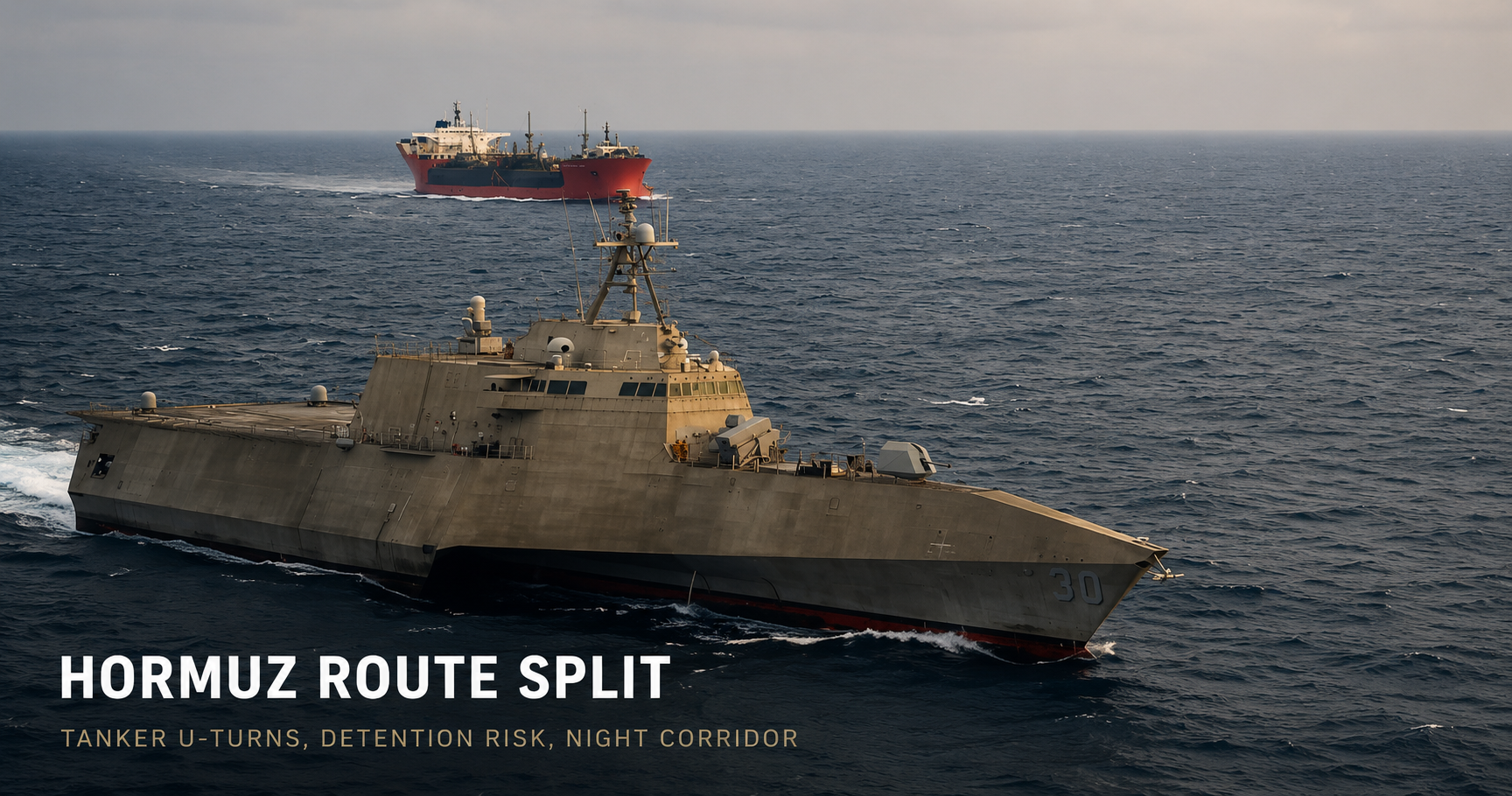
China-linked VLCCs aborted Hormuz movements as Iran-linked reports claimed a tanker warning, while U.S. officials described a parallel southern-channel night corridor.
1. China-Linked VLCCs Abort Hormuz Movements
• Three China-linked supertankers reportedly changed course around the Strait of Hormuz as risk remained elevated. Sea V, laden with Iraqi crude, turned back near the strait entrance, while Hestia and Erecter also reversed or held position.
• Sea V was reported as Hong Kong-flagged and 317,788 dwt; Hestia as Hong Kong-flagged and 299,990 dwt; Erecter as Hong Kong-flagged and 301,021 dwt.
• Maritime Executive reported that WANA News and Fars News Agency claimed the IRGC Navy warned and turned back a Chinese oil tanker moving toward the southern corridor. The vessel was not independently named in Iranian-linked reporting.
• Windward observations cited by Maritime Executive described two China-linked tankers aborting outbound transits and an inbound Hong Kong-flagged crude tanker turning around mid-transit on August 19.
2. Amara Detention Meets U.S. Southern-Channel Claim
• The Liberia-flagged product tanker Amara, linked to the UAE and reported at 47,931 dwt, was said to have been directed toward Bandar Abbas after a Hormuz transit compliance dispute.
• Maritime Executive reported that Amara was inbound in ballast for Jebel Ali and appeared anchored near Larak Island after Iranian reports cited refusal to pay service fees as the reason for stopping the vessel.
• U.S. officials said 15 to 20 tankers have been entering and exiting the strait nightly through a southern channel along Oman, under U.S. military guidance.
• The same report said the corridor moves roughly 10 million barrels of oil per day, while U.S. officials described separate inbound and outbound time slots for empty and loaded tankers.
3. Visible Traffic and Oil Price Signal Stay Distorted
• Reuters reported that only six commodity vessels crossed Hormuz on Tuesday, down from nine the previous day and below the 10-day daily average of 11.
• Inbound traffic included an empty VLCC following the Omani side of the strait and two other tankers; outbound traffic included two medium-range fuel tankers and one post-Panamax vessel.
• Reuters also reported that before the war, Hormuz handled about one-fifth of global crude oil and LNG shipments, making the difference between visible AIS movement and escorted or dark transit commercially material.
• Brent settled at USD 91.62 per barrel and WTI at USD 85.83, their highest closes since July 24, as slow Hormuz traffic and Middle East escalation held the risk premium in crude.
Reading this as a maritime insider, seafarer, or enthusiast?
Subscribe to The DeepDraft for maritime analysis, daily SITREP updates, weekly briefings, and operational signals worth watching.
4. Black Sea Grain Shutdown Becomes Parallel Cargo Risk
• Attacks on shipping have shut down more than 97 percent of Russia and Ukraine’s grain export capacity in the Azov and Black Sea basin.
• Russia and Ukraine exported an average 7.2 million tonnes of grain per month from terminals in the region last season, based on Reuters calculations using official data and analyst estimates.
• Ukraine’s Black Sea terminals currently have no shipments, while Russia’s only grain terminal not officially shut was reported as a small Tuapse facility with about 160,000 tonnes per month of capacity.
• Wheat prices have risen about 6.5 percent this month and roughly 30 percent year-on-year, making the Black Sea disruption a cargo procurement, voyage planning and substitution-cost issue for importers.
5. Arctic Route Trial Adds Longer-Range Routing Pressure
• South Korea is due to flag off PanStar Acro from Busan toward Europe via the Arctic route, with planned calls at Felixstowe, Rotterdam and Gdansk.
• The voyage is expected to take 40 to 45 days and would be South Korea’s first commercial container voyage to Europe through the Arctic if completed.
• PanStar is using a 2,700 TEU vessel modified for polar navigation and seeking at least 1,300 TEU of cargo, including auto parts, food, cosmetics and shipments from China and Japan.
• South Korean officials say the Arctic route could shorten voyages by up to 35 percent versus the Suez route, but the voyage requires Russian cooperation and raises sanctions, ice-support, insurance and emergency-assistance questions.
Strategic Summary & Actions Required
• Masters approaching Hormuz should treat route authority as contested, not normalized. Confirm company, charterer, P&I, flag and naval reporting instructions before committing to either Iranian-route, Omani-route, dark-transit or escorted movement.
• Ship managers and CSO teams should preserve voyage orders, AIS history, VDR data, bridge communications, agent messages and any fee or clearance demand linked to Hormuz transit.
• Charterers and operators should price laycan failure, off-hire, deviation, sanctions exposure, war-risk premium and failed transit risk where Chinese, UAE-linked, Iran-linked or Gulf-loading cargoes are involved.
• Tanker desks should separate visible AIS movement from actual corridor movement. Reuters/Kpler data shows low confirmed transits, while Axios reports U.S.-guided night movement outside normal visibility.
• Grain, container and cargo owners should not treat Hormuz in isolation. Black Sea grain capacity loss and Arctic route testing show cargo routing is fragmenting across energy, food and container sectors.
Operational Status
CRITICAL RED – Hormuz Tanker Control Split / Vessel U-Turns and Detention Risk / Partial U.S.-Guided Night Corridor / AIS-Visible Traffic Distortion
Latest DeepDraft Analysis
The Return of Armed Merchant Shipping
https://thedeepdraft.com/2026/08/17/the-return-of-armed-merchant-shipping/
DeepDraft argues merchant ships can identify drones, missiles and USVs, but only state protection, hardening and lawful security can close the gap after detection.
Related DeepDraft Articles & Analysis
Sources
Reuters, Axios, Bloomberg/gCaptain, The Maritime Executive, The DeepDraft
This update is part of the DeepDraft SITREP series covering developing maritime operational situations.



Leave a Reply