
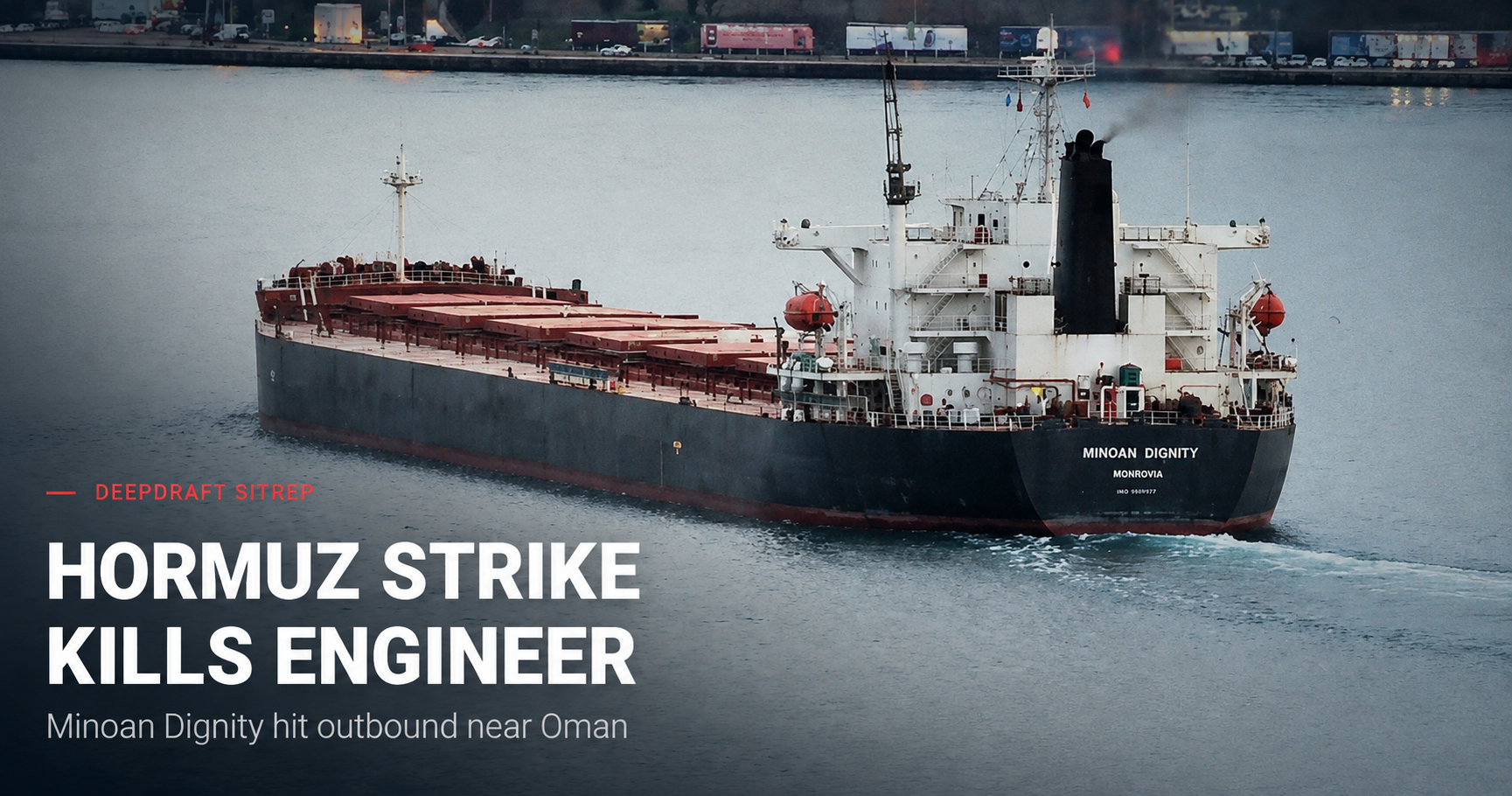
Minoan Dignity was hit while transiting outbound through Hormuz, killing the chief engineer and damaging the engine room.
The same 24-hour cycle produced a southern Red Sea constructive total loss and a tanker-routing shift away from Hormuz and Bab el-Mandeb.
1. Minoan Dignity Fatal Hormuz Strike
• The 76,801 dwt Liberia-flagged panamax bulk carrier Minoan Dignity was struck by an unknown projectile while transiting near the Omani side of the Strait of Hormuz.
• The projectile reportedly hit the vessel’s starboard side and damaged the engine room.
• One seafarer was killed. Industry reporting and security sources identify the casualty as the chief engineer.
• Two helicopter evacuation attempts were reported unsuccessful, with Omani Coast Guard support expected for crew assistance.
• The vessel is reported as Greek-managed and registered to Asante Management Co, with Athens-based Modion Maritime Management listed in shipping databases.
2. Yemen Attack: Cargo Vessel Declared Constructive Total Loss
• UKMTO Warning 117-26 reported that an unmanned cargo vessel was struck by multiple unknown projectiles about 40 nautical miles southeast of Al Mukha, Yemen.
• The vessel was declared a complete constructive loss after the attack.
• The vessel name and the circumstances that left it unmanned were not immediately provided.
• JMIC reported that Al-Mokha port remains completely closed to commercial traffic after more than 25 cumulative missile impacts and fires at its berths.
• The Bab el-Mandeb and southern Red Sea threat layer remains active, with vessels near Al Mukha advised to transit with caution and report suspicious activity.
3. Tanker Routing and STS Impact: China State Shippers Avoid Both Chokepoints
• Reuters reported that COSCO Shipping Energy Transportation and China Merchants Energy Shipping have kept oil tankers out of the Strait of Hormuz and Bab el-Mandeb since late July.
• The two state-controlled shippers together control more than 100 VLCCs and previously handled roughly half of China’s Middle East crude imports.
• Kpler data cited by Reuters showed ship-to-ship transfers involving China and Hong Kong-owned vessels in the Gulf of Oman exceeded 600,000 bpd in June and July.
• Reuters reported no such activity in April and May, and less than 30,000 bpd in each of the first two months of 2026.
• Between August and mid-September, about a dozen supertankers each controlled by COSCO and CMES are slated for loadings outside the Gulf, mostly at Fujairah and at or near Omani ports.
4. Authority, Missile and Detention Risk Layer
• Iranian state-linked media claimed a UAE-linked tanker was detained near Qeshm Island for alleged non-compliance with Iran’s transit rules.
• The claim remains operationally relevant but not fully verified, with no vessel name, owner, cargo or official confirmation from Tehran or Abu Dhabi in the available source set.
• U.S. and Iranian public positions remain directly opposed. Washington says no Iran talks are scheduled and the blockade remains in force, while Iranian officials say the Strait remains shut until interim-deal conditions are met.
• Reuters reported that the UAE Defence Ministry detected two ballistic missiles launched from Iran and assessed them as targeting maritime traffic.
• Hormuz traffic remains at severe disruption levels, with industry reporting citing single-digit vessel exits and no VLCC or LNG carrier passage in the latest tracked set.
Strategic Summary & Actions Required
• Masters approaching Hormuz should treat outbound passages near the Omani side as a live kinetic-risk area and review emergency steering, engine-room fire response, protected muster arrangements and abort-routing authority before commitment.
• CSO, DPA and fleet managers should require UKMTO, JMIC, NAVCENT, flag, insurer, charterer and company alignment before approving Hormuz transit, especially where route instructions or fee demands are received.
• Charterers and operators should price dual-chokepoint exposure across Hormuz and Bab el-Mandeb, including deviation, off-hire, unsafe port, war-risk, cargo delay and crew-casualty clauses.
• Vessels near Al Mukha should treat port access as closed or severely restricted until direct confirmation is obtained from local agents, port authorities, flag, insurers and security channels.
• Tanker desks using Fujairah, Oman or Gulf of Oman STS options should verify cargo title, sanctions exposure, STS plan approval, vetting status, laycan language and evidence preservation before fixture execution.
Operational Status
CRITICAL RED – Hormuz fatal projectile strike / Bab el-Mandeb constructive total loss / dual-chokepoint security pressure / route authority and crew safety risk
Latest DeepDraft Analysis
The Return of Armed Merchant Shipping
Related DeepDraft Articles & Analysis
Sources
UKMTO/JMIC, Reuters, The Maritime Executive, Splash247, gCaptain, The DeepDraft
This update is part of the DeepDraft SITREP series covering developing maritime operational situations.


Leave a Reply