
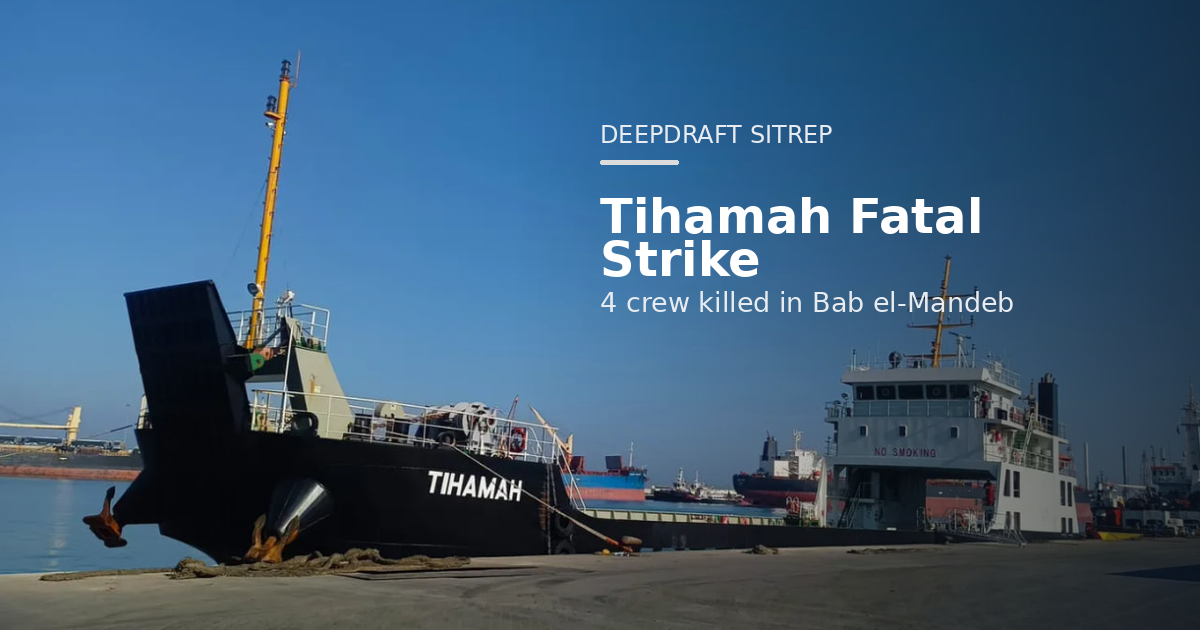
Four crew were killed after the Egyptian-owned cargo ship Tihamah was struck in Bab el-Mandeb.
The same reporting window brought a confirmed U.S. strike on Vela Nova in the Gulf of Oman and another single-digit Hormuz traffic count.
1. Tihamah Fatal Strike Reopens Bab el-Mandeb Crew-Risk
• Four crew members were killed after the small cargo ship Tihamah was attacked in the Bab el-Mandeb Strait on August 11, according to Yemen’s transport ministry.
• Reuters reported the dead included three Pakistanis and one Indonesian.
• The crew reportedly lost control of the vessel after the attack.
• UKMTO received a report that the ship was hit by an unknown projectile.
• Ambrey said the vessel was at anchor northeast of Perim Island, Yemen, when the incident occurred.
• Yemeni military sources said three coastguard personnel were injured by a drone while attempting to rescue the crew.
2. Vela Nova Disabled in Gulf of Oman Blockade Enforcement
• The Panama-flagged containership Vela Nova was struck in the Gulf of Oman after allegedly attempting to violate the U.S. blockade against Iran.
• gCaptain reported that U.S. Central Command confirmed American forces disabled the vessel on August 11.
• CENTCOM said a U.S. Navy MH-60 helicopter fired on the ship after the civilian crew continued toward an Iranian port despite repeated warnings.
• UKMTO initially reported the ship was struck approximately 71 nautical miles from Pakistan in international waters.
• The master reported the vessel was hit in the stern and steering compartment, leaving it not under command.
• The resulting fire was extinguished, all crew were accounted for and no injuries were reported.
3. Chokepoint Traffic and Market Consequence
• Reuters reported Bab el-Mandeb and Red Sea traffic has fallen by more than 50% since the earlier 2023 to 2025 Houthi attack wave.
• Kpler data cited by Reuters showed an average of 32 ships per day passing Bab el-Mandeb last week, down from about 50 before the latest Houthi blockade announcement.
• Reuters also reported Strait of Hormuz traffic fell to six vessels on Monday, down from a 10-day average of about 11 and pre-war levels of roughly 130 to 140.
• The Vela Nova incident confirms blockade enforcement is extending beyond the Strait itself into the Gulf of Oman.
• For container, tanker and dry-bulk operators, the Red Sea and Gulf operating picture is now a dual-chokepoint control problem: crew-risk in Bab el-Mandeb and state-enforcement risk in the Gulf of Oman.
4. Security Guidance, AIS and Bridge-Control Layer
• MARAD warns that vessels with Israeli, U.S. or UK association, or wider fleet-company links to Israel, may remain at high risk from Houthi hostile action in the southern Red Sea, Bab el-Mandeb and Gulf of Aden.
• Potential hostile actions listed by MARAD include UAV, USV, UUV, ballistic missile, cruise missile, small-boat fire, explosive boat, illegal boarding, detention and seizure threats.
• MARAD advises U.S.-flagged vessels in the Red Sea, Bab el-Mandeb, Gulf of Aden, Arabian Sea and Somali Basin to consider AIS shutoff where the Master believes continued AIS operation compromises ship safety or security.
• The advisory also recommends route and speed variation, avoidance of repeated waypoint patterns, and hourly positional updates to NAVCENT NCAGS if AIS is secured.
• Masters should treat anchoring, slow speed, restricted manoeuvring and loitering near Yemen-facing waters as elevated exposure conditions.
5. Secondary Maritime Signals
• Rhine low-water disruption remains commercially relevant, with German industrial and inland-waterway cargo users reporting freight bottlenecks, force majeure exposure and substitution limits.
• The Min Jiang Kou fire south of Costa Rica remains a separate casualty and SAR item, but it does not outrank simultaneous fatal chokepoint attack and blockade-enforcement developments.
• Hanwha’s Austal USA bid, hybrid ferry battery orders and Singapore cargo-drone developments are industry-significant but not today’s primary 24-hour operational signal.
Strategic Summary & Actions Required
• Masters approaching Bab el-Mandeb should recheck company transit authority, AIS policy, abort criteria, citadel readiness, rescue-communication channels and slow-speed exposure before entering or anchoring near Yemen-facing waters.
• Ship managers should issue a same-day fleet security note covering projectile, UAV, rescue-interference and loss-of-control scenarios for vessels trading through the southern Red Sea, Gulf of Aden and Bab el-Mandeb.
• CSO, DPA and bridge teams should avoid treating AIS decisions as a template. AIS, route variation, dark-hours timing and NAVCENT NCAGS reporting must be tied to flag, company and Master authority.
• Charterers and operators should separate Red Sea crew-risk from Gulf of Oman blockade-enforcement risk when reviewing laycan, deviation, off-hire, force majeure, war-risk and customer-notification language.
• Insurers and P&I desks should reassess voyage approval triggers where a vessel may face both non-state projectile risk and state military enforcement within the same regional voyage cycle.
Operational Status
CRITICAL RED – Bab el-Mandeb Fatal Strike / Gulf of Oman Blockade Enforcement / Hormuz Six-Vessel Traffic Count / Dual-Chokepoint Crew and Route Risk
Latest DeepDraft Analysis
Airborne Wind Propulsion: The Missing Manual Behind the Fuel-Saving Claim
Airborne kite propulsion may cut fuel use, but the real operational test is launch control, recovery authority, tether safety, crew workload and SMS integration.
Related DeepDraft Articles & Analysis
Sources
Reuters, gCaptain, MARAD, UKMTO, The DeepDraft
This update is part of the DeepDraft SITREP series covering developing maritime operational situations.


Leave a Reply