
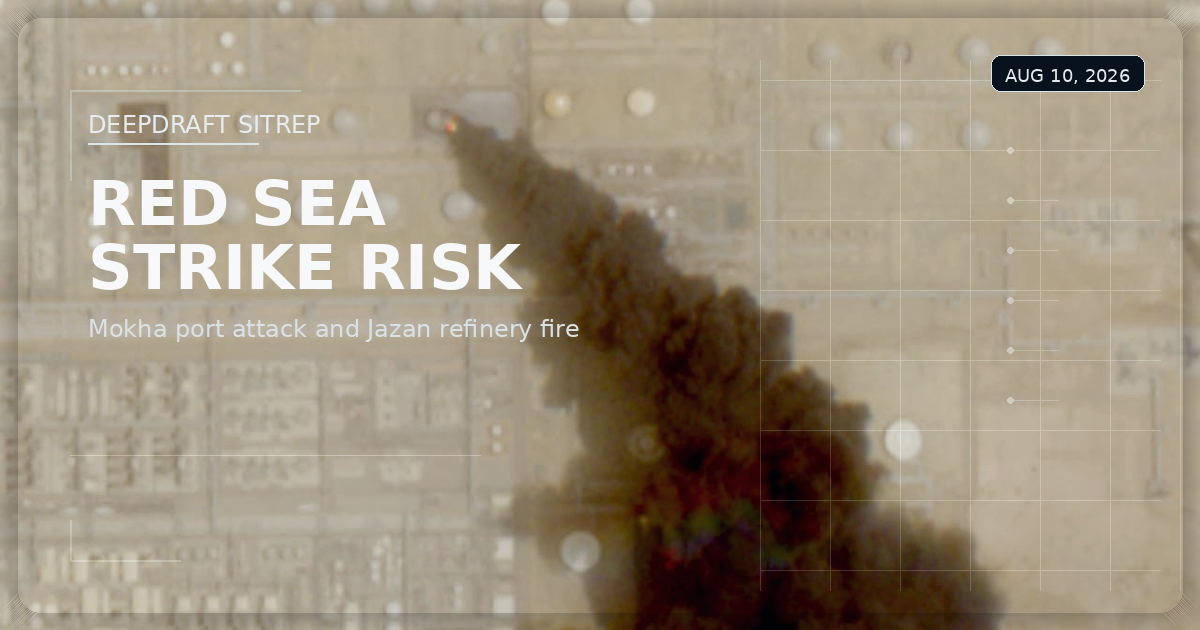
Houthi missile and drone attacks returned live strike risk to Yemen’s Red Sea port system while Saudi Arabia confirmed a refinery fire at Jazan.
The day’s operating picture now links Bab el-Mandeb exposure, conditional Hormuz reopening and renewed Black Sea shipping-security controls.
1. Houthi Red Sea Strike Package Hits Mokha and Jazan
• Yemen’s Houthi movement resumed missile and drone attacks on the Red Sea port city of Mokha on August 9.
• Reuters imagery and reporting showed smoke rising during the attack, with Houthi-linked media showing launches of ballistic missiles and drones.
• AP reported at least seven people killed, including four troops and three civilians, with 15 civilians injured.
• Yemeni officials said the attack damaged port buildings, piers, commercial goods and food supplies.
• Mokha is a government-held Red Sea port close to Bab el-Mandeb, making the strike operationally relevant for Red Sea routing, port calls, humanitarian cargo and local security planning.
• The Houthis also claimed a drone attack on Saudi Aramco’s Jazan refinery on Saudi Arabia’s Red Sea coast.
• Saudi Arabia’s energy ministry confirmed a fire at the refinery, said it was extinguished, and reported no injuries.
2. Hormuz Reopening Remains Conditional Despite Oman Route Talks
• Iran’s foreign minister said negotiations with Oman over new maritime routes through the Strait of Hormuz were in the final stages.
• Iranian statements also said the agreement would not by itself reopen the strait.
• Reuters reported that any new shipping lanes would be used only after U.S. conditions are met and the Strait is reopened.
• AP reported that Iran and Oman are working on a temporary arrangement under which ships would enter near Iran and exit near Oman, although final terms may still change.
• AP also reported Iranian political signals that vessels belonging to “hostile countries” could face prohibition from transit.
• For operators, the operational distinction is now clear: a route framework may be nearing agreement, but transit authority, sanctions exposure, insurance treatment and actual vessel movement remain unresolved.
Reading this as a maritime insider, seafarer, or enthusiast?
Subscribe to The DeepDraft for maritime analysis, daily SITREP updates, weekly briefings, and operational signals worth watching.
3. Türkiye Pushes Black Sea Shipping Truce as Straits Stay Open
• Türkiye said ship passage through the Turkish Straits toward the Black Sea was continuing smoothly.
• Turkish officials said temporary security measures had been implemented, but navigation remained open under the Montreux Convention framework.
• Turkish Foreign Minister Hakan Fidan said Ankara had urged Russia and Ukraine to declare a moratorium on attacks in the Black Sea.
• The Turkish signal follows recent attacks on commercial vessels and port-linked targets in the wider Black Sea operating area.
• Black Sea desks should treat the Turkish statement as a control signal: the Bosphorus and Dardanelles remain open, but port-call security, war-risk instructions and voyage evidence remain live requirements.
4. Routing, Insurance and Charterparty Impact
• The same 24-hour window produced three separate voyage-control questions: Red Sea strike exposure, conditional Hormuz access and Black Sea attack-risk management.
• Masters transiting near Bab el-Mandeb or calling Red Sea ports should verify current security advisories, company transit authority, AIS policy, abort criteria and emergency communications.
• Charterers should recheck laycan, deviation, war-risk, force majeure, off-hire, demurrage and customer-notification language where cargo depends on Red Sea, Gulf or Black Sea routing.
• Tanker and energy desks should separate physical-infrastructure risk at Jazan from legal and clearance risk at Hormuz.
• Operators should preserve all port, VTS, security, naval, insurer and charterer instructions where route authority may later be disputed.
Strategic Summary & Actions Required
• Masters approaching Mokha, Bab el-Mandeb, Jazan or Saudi Red Sea approaches should treat the strike package as a live port and energy-infrastructure threat, not only a Yemen conflict update.
• Ship managers should issue a short fleet security note covering drone, missile, air-defence, port-fire, refinery-fire, evacuation and communications procedures for exposed Red Sea routes.
• Charterers and operators should price Red Sea and Hormuz exposure separately because a physical strike risk and a conditional transit-permission regime create different off-hire, deviation and insurance triggers.
• Black Sea operators should continue documenting strait-passage instructions, port-call security notices and charterparty directions while Türkiye presses for a shipping-attack moratorium.
• Insurers, CSO teams and DPAs should review whether voyage approval thresholds change when Red Sea, Hormuz and Black Sea risks are all active in the same reporting window.
Operational Status
CRITICAL RED — Red Sea Port Strike / Saudi Refinery Fire / Bab el-Mandeb Exposure / Conditional Hormuz Access / Black Sea Shipping Controls
Latest DeepDraft Analysis
Bonding Is Not Insulation: The Cargo Transfer Checklist Item Tankers Still Misread
DeepDraft explains why bonding and electrical isolation are separate tanker-transfer controls, and why cargo teams must verify the physical barrier before opening the manifold.
Related DeepDraft Articles & Analysis
Sources
Reuters, Associated Press, The DeepDraft
This update is part of the DeepDraft SITREP series covering developing maritime operational situations.



Leave a Reply