

Before any kite is allowed to fly from a ship, the manual must be stronger than the fuel-saving claim.
That was the note I wrote before opening the performance tables.
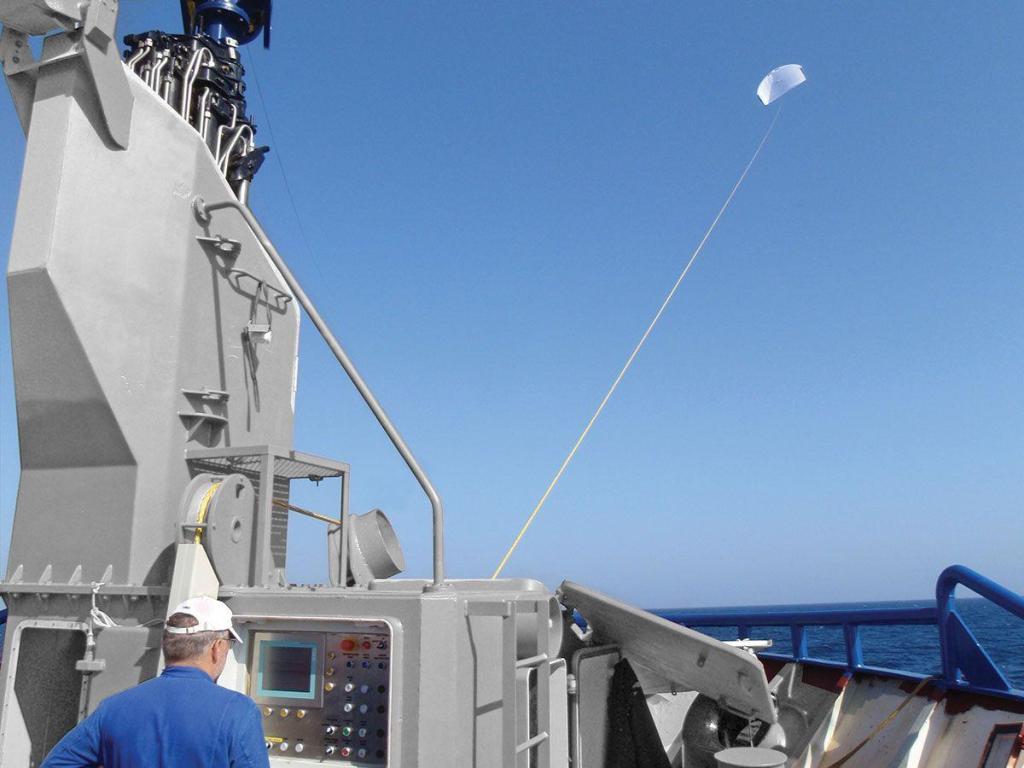
A few weeks ago, Windtracx, a company developing an aero-kite drone system for merchant ships, shared technical material, comparison documents, and an independent performance assessment with me. The proposal was interesting: a rigid airborne kite, launched from the vessel, flown at altitude, and used to generate forward traction without placing a large sail, rotor, or wing inside the vessel’s normal working envelope.
I have written before that shipping should not become the easy scapegoat in the climate debate. It is efficient, essential, and already operating under serious regulatory and commercial pressure. My position has not changed. The industry needs practical efficiency, realistic timelines, and equipment that can be managed safely by the people who actually run ships.
That is why airborne wind propulsion deserves a fair look. It also deserves a hard one.
An airborne kite is different.

How the Aero-Kite Drone Is Supposed to Work
This is not a conventional sail, a Flettner rotor, or a fixed wing mounted on deck. It is closer to a controlled airborne towing device.
In the material shared with me, the system is described as a rigid aero-kite drone installed with a launch and recovery platform on the forecastle. When conditions are suitable, the officer starts the sequence from the control interface. The system then checks wind direction, wind speed, ship’s heading, vessel speed, system health, tether readiness, sensor condition, and whether the launch area is clear.
The first phase is powered take-off. The aero-kite uses its own propellers to lift from the platform. Once airborne, the drone transitions into traction mode. The propellers are no longer the main source of motion. The wing, control surfaces, wind flow, and automated flight path generate pull through the tether. The kite does not push the ship like an engine. It pulls the ship through a tensioned line.
Recovery is the reverse challenge. The system must reduce traction, control the flight path, manage the tether, land the drone back on the platform, and stow it before port approach, heavy weather, traffic restrictions, or any situation requiring full manoeuvring freedom.
Airseas’ Seawing is a useful reference point. Its work with Ville de Bordeaux shows the route from concept to confidence. Class involvement, installation, sea trials, traction validation, automation tuning, and operating procedures. That is why this is not one item of equipment. It is drone, wing, propellers, control surfaces, tether, winch, sensors, software, launch platform, bridge interface, alarms, deck exclusion zones, and emergency recovery logic.
A ship can carry complex machinery. The issue is whether that complexity is properly absorbed into shipboard operation.

The Performance Case
The performance assessment shared with me examined a 50.6 m² kite on a typical 75,000 DWT LR1 tanker, in laden condition, at 13 knots. The reported weighted average fuel saving across selected routes was 5.03%. The spread was wide: Houston to Rotterdam showed 10.21%, while Lagos to Rotterdam showed 2.46%. The same report calculated a 522.67 kW contribution to EEDI/EEXI and a FuelEU Maritime wind reward factor of 0.99.
Wind assistance performance is decided by heading, season, loading condition, sea state, and actual deployment time. Higher savings may appear in promotional or ideal-condition material, but the ship-specific assessment shared with me is more useful because it gives route-based figures for an LR1 tanker.
The technical caveat is important. The study used a simplified single-degree-of-freedom model. In plain terms, it mainly measured the forward balance: how much useful pull the kite gives against the propulsive power required from the engine. That is a valid first estimate, but it is not the full ship.
The report itself recognises the limitation. The simplified simulation neglected sway, roll, and yaw, and did not account for hydrodynamic resistance induced by wind propulsion. It recommends further four-degree-of-freedom analysis to examine rudder angle, heel, leeway, and hydrodynamic losses. The losses may be small, but they are not yet fully checked.
If the tether force is not acting cleanly along the centreline, it can create yaw and leeway. The autopilot or helmsman may then need rudder to hold track, and rudder angle is not free. It creates hydrodynamic drag. The loss may be small, but it has to be checked.
For a Master, that is the dividing line. A fuel-saving estimate is useful, but before it becomes an operational claim, the ship’s full motion, inertia, rudder response, and control behaviour must be properly tested. Otherwise, we are only looking at the pull, not the ship.

The 0200 Test
The real test is the middle watch.
At 0200, the kite has been flying within limits and the ship is making her passage. Then the watch changes, as it often does at sea. Wind freshens, rain comes through, the bow starts working harder, and a target that looked harmless on ARPA now needs attention.
Many difficult decisions at sea do not begin with a dramatic casualty. They begin with two or three ordinary things arriving together.
At that moment, the useful pull it was giving ten minutes earlier is no longer the main question. The bridge needs to know whether it can remain deployed, whether it must be recovered, who has the authority to stop it, and whether the vessel can still alter course without waiting for an automated sequence to finish.
Recovery is where confidence will be earned. Is it fully automatic, or does it need crew intervention? If deck crew are required, how much notice do they need at 0200, and is it safe for them to go forward in the weather that triggered the recovery? At the same time, the wing may be descending through the forward sector, the tether remains live, and the vessel may need to hold a heading for safe landing. If any of this affects visibility, crew safety, or immediate manoeuvring, it has to be written in the manual, not worked out by the OOW under pressure.
A kite that is safe only during a quiet watch has not passed the shipboard test. It must remain manageable when the watch becomes busy.

Reading this as a maritime insider, seafarer, or enthusiast?
Subscribe to The DeepDraft for maritime analysis, daily SITREP updates, weekly briefings, and operational signals worth watching.
The COLREGs Question
For normal passage, the starting point is clear. A merchant ship using her engine remains a power-driven vessel, even if an airborne kite is adding forward pull.
During launch or recovery, the kite may pass through the forward sector, the tether remains active, and the ship may need to hold heading for safe retrieval. A large wing descending towards the deck can also affect the bridge view ahead.
That raises the real COLREGs question: can the vessel become restricted in her ability to manoeuvre during that phase?
This cannot be left as a Master’s personal interpretation at sea. If launch or recovery limits immediate alteration of course, affects visibility, or requires the vessel to hold heading until the system is safely recovered, then flag, class, company, and regulators must define the status.
Does RAM apply during that phase? Should AIS status change? Is a new AIS or regulatory category required for tethered airborne propulsion? Should Rule 18 eventually recognise this operating condition more clearly?

The Missing Manual
For me, the decisive document is the manual.
Class approval will matter, but it cannot be treated as a closing formality. DNV’s WAPS framework and Lloyd’s Register’s WAPS guidance show that wind-assisted propulsion is moving into a classed environment where structure, safety, integration, and operating limits must be defined before fleet use.
The harder layer is the Safety Management System. The Master’s authority to abort, recover, or refuse deployment must be absolute.
A kite system enters the watchkeeping routine, deck safety regime, PMS, Master’s authority, and company risk assessment. The manual must define the operating envelope in language that works onboard: wind speed, gusts, sea state, vessel motion, visibility, traffic density, CPA, launch limits, recovery limits, and prohibited areas.
The deck side also has to be clear. A tensioned tether is not normal deck equipment. If it parts, the crew need to know the fall area, snap-back zone, access restrictions, and alarm priority.
Another contingency is tether parting. A failed tether is a snap-back hazard on deck. If part of the line enters the water, it also becomes a propulsion risk by fouling the propeller or thrusters. The manual must define the alarm, safe-state response, bridge action, deck exclusion, recovery method, and contingency measures.
It must also turn that response into shipboard practice: drills, role-specific training for the Master, OOW, deck crew and engineers, PMS checks, emergency records, and auditable reporting of failed launches, aborted recoveries, defects, downtime, deployment hours, recovery time, and actual fuel savings. A tether-failure response has to be practised before it is needed.
Until that is done, the kite remains promising equipment.
It has not yet become part of the ship.
DeepDraft View
Wind-assisted propulsion should not be dismissed. It is one of the few efficiency measures that can reduce fuel consumption without waiting for a global green-fuel supply chain to mature.
But the standard must remain operational.
In the last decade, ships have absorbed one compliance layer after another: EGCS, BWTS, EGR, SCR, emissions monitoring, reporting systems, energy-efficiency documentation, new software interfaces, and additional inspection routines. Each system may have a reason and justified on paper. But onboard, they do not arrive as paper. They arrive as alarms, maintenance, spares, training, checks, breakdowns, records, extra attention and work.
Aero-kite and drone-kite systems have a credible technical argument. They can access stronger wind at altitude, reduce deck obstruction, and offer route-dependent fuel-saving potential for certain vessel types. They also create a new operating layer above the ship, connected by a tensioned tether and governed by automation.
The industry should not ask only whether the kite can fly, or whether the model shows a saving. It should ask whether the system can be safely launched, recovered, stopped, isolated, maintained, audited, and understood by the crew during an actual voyage.
The performance case is serious enough to deserve attention, especially because it offers measurable savings without waiting for alternative fuels.
The promise is lift. The test is control.
Media Section
Sources Reviewed
- Blue Wasp Marine, Preliminary Performance Assessment of Windtracx Kite on an LR1 Tanker, 21 October 2025.
- Windtracx WASP Competitive Analysis 2026.
- IMO GreenVoyage2050 kite technology portal.
- DNV WAPS class services.
- Lloyd’s Register WAPS guidance and WAPS/WAPS* notation update.
- Bureau Veritas / Airseas Seawing installation on Ville de Bordeaux.
- Airseas product installation information.


Leave a Reply