
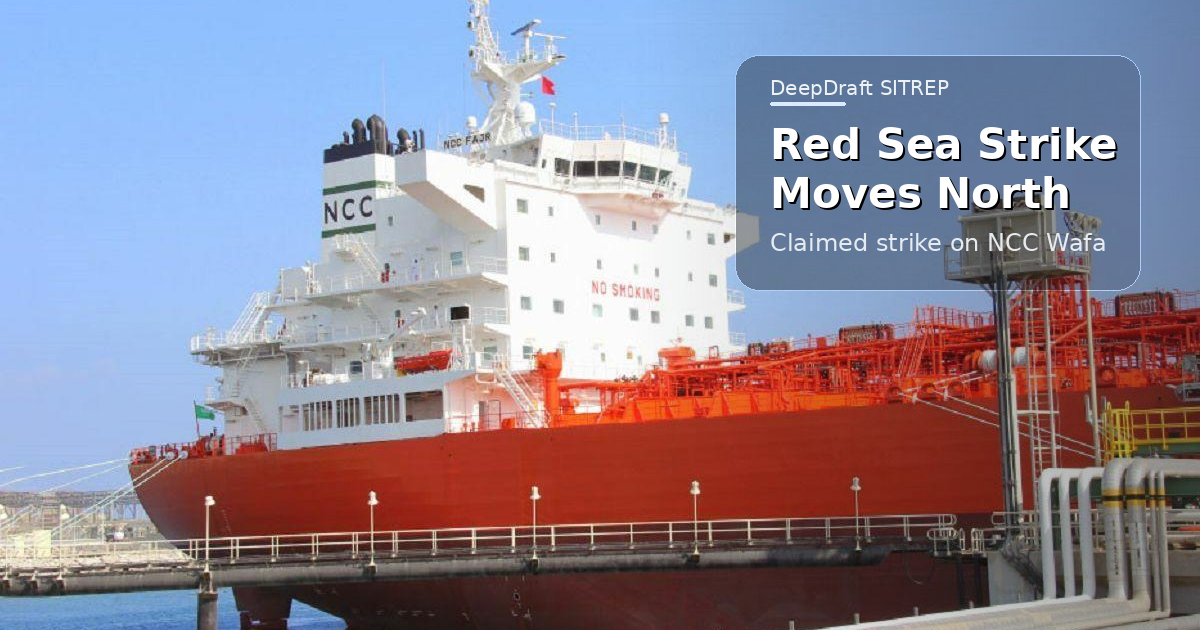
A claimed Houthi strike on NCC Wafa moves Saudi-linked Red Sea exposure north toward Yanbu.
The same 24-hour cycle keeps MSV Faize Noore Oliya, Black Sea drone disruption and Hormuz toll resistance inside the operating picture.
1. NCC Wafa Claimed Hit Off Yanbu
• Yemen’s Houthi movement claimed it targeted the Saudi tanker NCC Wafa off Yanbu in the northern Red Sea with ballistic missiles.
• Seatrade Maritime identified the vessel as the Saudi tanker NCC Wafa and reported that the claimed attack has not been independently verified.
• Anadolu Agency reported the Houthi claim that this was the eighth Saudi oil tanker targeted since the group announced its maritime blockade on July 22.
• No immediate Saudi authority confirmation of damage, casualties or pollution was available in the verified source set, so voyage teams should treat the event as a claimed strike pending official or company confirmation.
• The operational change is geographic: the Houthi campaign is now being framed against Saudi-linked shipping in the northern Red Sea, close to Yanbu and the Suez-bound route, not only Bab el-Mandeb.
2. Red Sea Vessel Loss Confirms Active Casualty Risk
• MSV Faize Noore Oliya sank off Yemen after being hit by a projectile, with India’s shipping minister confirming all 14 seafarers were rescued.
• The latest DeepDraft SITREP already reported the vessel loss, including the August 4 projectile strike, crew rescue and transfer to Mokha.
• DeepDraft also noted maritime security analysis placing the attack about 13 nautical miles south of Hodeidah and assessing the method as consistent with an explosives-laden boat.
• The confirmed sinking turns the NCC Wafa claim into part of a wider Red Sea attack pattern rather than an isolated statement.
3. Black Sea Drone Strikes Tighten Tanker and Commodity Flows
• Reuters reported that attacks on ships, ports and export terminals are disrupting grain and oil flows through the Black Sea.
• Ukrainian attacks on tankers in July damaged several vessels and forced temporary loading suspensions at Novorossiysk and the CPC terminal.
• War-risk insurance for Black Sea terminal calls has risen as high as 2% of vessel value, up from about 1% two weeks earlier.
• BIMCO warned that if reduced Black Sea volumes persist, global dirty tanker volumes could decline by 3% in an already challenged market.
• CPC disruption is commercially material because the pipeline carries about 1.8% of global oil supply from Kazakhstan to Russia’s Black Sea coast.
4. Hormuz Tolls Add Legal, Insurance and Charterparty Exposure
• Shipping bodies continue to oppose tolls or clearance fees for the Strait of Hormuz because they could create a precedent for other international straits.
• IMO has stated that transit passage through internationally used straits should remain non-discriminatory and unimpeded under the recognised traffic separation scheme.
• The International Chamber of Shipping has called for vessels to pass through Hormuz unimpeded and without tolls or clearance mechanisms.
• Marine insurance exposure remains live because Lloyd’s Market Association wording could allow cover to be cancelled if a shipowner pays an Iranian transit toll.
• Hormuz-linked fixtures should separate route authority, payment legality, insurance validity, off-hire, deviation and sanctions clauses before accepting transit instructions.
Strategic Summary & Actions Required
• Masters on Red Sea and Yanbu-linked voyages should verify UKMTO/JMIC reporting, company route authority, AIS policy, abort criteria and emergency communications before entering exposed sectors.
• Ship managers should treat the NCC Wafa claim as unconfirmed but operationally relevant, and brief bridges for missile, drone-boat, fire, blackout, muster and crew-accounting scenarios.
• Charterers and operators should price Saudi-linked Red Sea exposure separately from general Red Sea risk, including Suez access, Cape deviation, insurance, bunker, laycan and customer-notification exposure.
• Black Sea desks should recheck war-risk pricing, CPC loading windows, port-call security, alternative routing and charterparty language where cargo stems depend on Novorossiysk or regional terminals.
• Hormuz-linked commercial teams should avoid treating toll or clearance payments as routine voyage expenses until insurers, sanctions counsel, P&I and flag-state positions are confirmed in writing.
Operational Status
CRITICAL RED — Claimed Northern Red Sea Tanker Strike / Confirmed Red Sea Vessel Loss / Black Sea Tanker Disruption / Hormuz Toll and Insurance Exposure
Latest DeepDraft Analysis
Bonding Is Not Insulation: The Cargo Transfer Checklist Item Tankers Still Misread
Bonding and insulation are not interchangeable. Tanker officers must physically verify static-electricity controls before cargo transfer, not rely on checklist language alone.
Related DeepDraft Articles & Analysis
Sources
Seatrade Maritime, Anadolu Agency, Reuters, Ship & Bunker, The DeepDraft
This update is part of the DeepDraft SITREP series covering developing maritime operational situations.



Leave a Reply