
A Liberia-flagged bulker has been hit near Khasab while Hormuz reopening talks continue.
The same reporting cycle produced a confirmed Indian vessel loss in the Red Sea and a widening oil-spill threat off Oman.
1. Minoan Pioneer Strike Turns Hormuz Talks Into Vessel-Level Risk
• The Liberia-flagged bulk carrier Minoan Pioneer, IMO 9471630, was reported hit by an unknown projectile while transiting northbound through Omani territorial waters in the Strait of Hormuz.
• The incident occurred late on August 3 UTC, about 20 nautical miles northeast of Khasab, Oman, after a mayday call was relayed to UKMTO.
• Reporting from maritime security sources indicates the projectile struck the engine room and crew accommodation area, causing fire, complete blackout and abandonment.
• One seafarer, reported as the third engineer, remains missing. The remaining crew were evacuated safely.
• The vessel was last reported at anchor, with assistance required and communications unresolved.
2. MSV Faize Noore Oliya Sinks Off Yemen After Projectile Strike
• The Indian-flagged MSV Faize Noore Oliya sank in the Red Sea off Yemen on August 4 after being struck by a projectile.
• India’s shipping minister said all 14 seafarers were rescued, including 13 Indian nationals.
• The rescued crew were taken by the Yemeni Coast Guard to the Port of Mokha.
• Maritime security analysis cited in industry reporting placed the attack about 13 nautical miles south of Hodeidah and assessed the method as consistent with an explosives-laden boat.
• No group had claimed responsibility at the time of reporting, so attribution should remain cautious in voyage risk assessments.
3. Traffic Data Shows Negotiations Have Not Restored Flow
• Reuters reported only eight Strait of Hormuz transits on Tuesday, including five tankers and three bulk carriers.
• Pre-conflict traffic through Hormuz was typically about 130 to 140 ships per day.
• Bab el-Mandeb traffic also remained constrained, with 20 vessels crossing on Tuesday, 10 entering and 10 exiting.
• Some vessels may be operating with transponders switched off, meaning AIS-based counts may understate actual movement but still show severe traffic compression.
• ADNOC-linked LNG tanker Mubaraz, loaded at Das Island on July 14, reappeared off India’s west coast with Dahej listed as the August 5 discharge point.
4. Caroline Bezengi Spill Adds Shadow-Fleet Pollution Exposure Off Oman
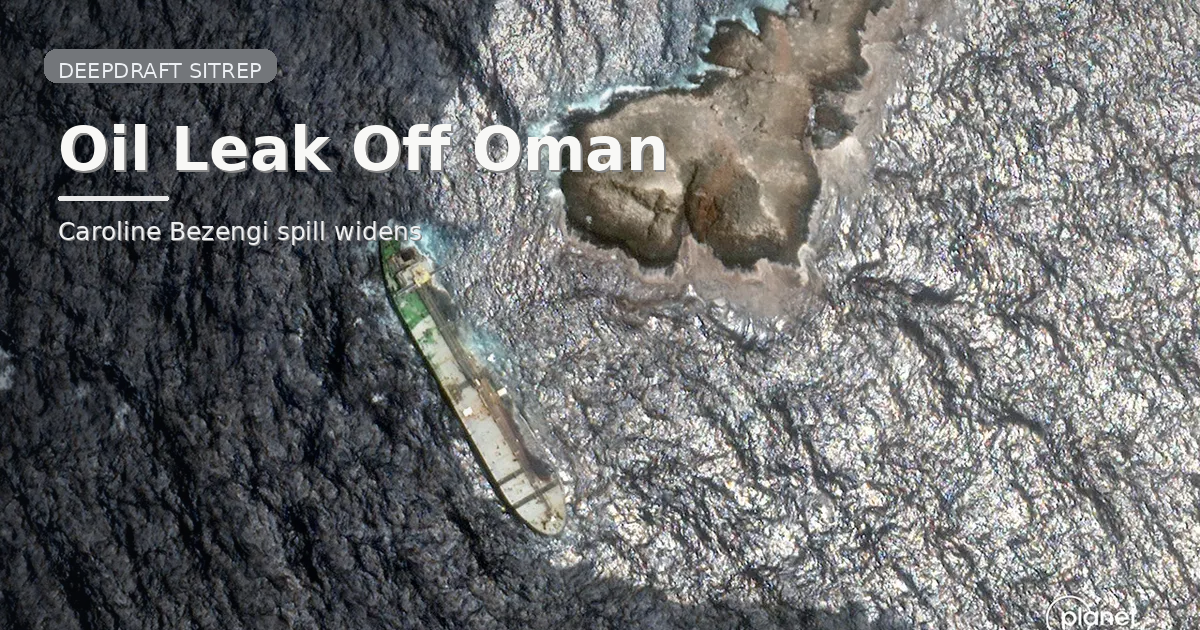
• The Cameroon-flagged Suezmax Caroline Bezengi remains grounded off Qibliyah Island, part of Oman’s Dhofar coastal area.
• AP reported satellite imagery showing the spill had expanded to about 150 square kilometres, compared with about 20 square kilometres a week earlier.
• The oil sheen was assessed at roughly 90 kilometres long, with thicker crude reaching parts of the island shoreline.
• Reuters previously reported the tanker had loaded Russian oil at Novorossiysk before its last voyage.
• The incident converts a stranded shadow-fleet casualty into an active pollution, salvage, liability and coastal-response problem.
5. Black Sea and Shadow-Fleet Enforcement Add Secondary Risk Signals
• FESCO paused new Black Sea shipment orders after Ukrainian drone attacks damaged one of its vessels.
• The vessel Yanina reportedly sank after being damaged by Ukrainian seaborne drones while carrying goods including frozen food and construction materials.
• MarineLink, citing Reuters, reported 35 attacks on Ukrainian vessels in ports, 22 attacks on vessels at sea and 67 strikes on port facilities in July.
• Separately, EU naval forces intercepted the sanctioned tanker MT Toa Payoh, IMO 9298492, west of Pantelleria for flag verification.
• The tanker was allowed to continue after inspection, but the operation confirms that shadow-fleet enforcement is moving through naval boarding, flag verification and documentary scrutiny.
Strategic Summary & Actions Required
• Masters approaching Hormuz should treat the Khasab corridor as an active vessel-strike area and confirm UKMTO reporting, company route authority, AIS policy, emergency communications and abort criteria before transit.
• Ship managers should brief bridges for projectile, fire, blackout and abandonment scenarios, with engine-room boundary cooling, emergency power, muster accounting and external communication chains checked before entry.
• Charterers and operators should price Hormuz and Bab el-Mandeb exposure separately, using live war-risk terms, deviation rights, off-hire wording, laycan protection and cargo-delay notification before accepting orders.
• Red Sea voyages near Hodeidah should treat small craft, bomb-boat and projectile exposure as active threats even where the vessel is not Saudi, Israeli or U.S.-linked.
• Pollution, sanctions and insurance teams should track Caroline Bezengi as a live spill file, because shadow-fleet casualty risk is now producing coastline, salvage, cargo-origin and liability consequences off Oman.
Operational Status
CRITICAL RED – Strait of Hormuz Vessel Strike / Red Sea Vessel Loss / Severe Chokepoint Traffic Compression / Oman Shadow-Fleet Pollution Exposure
DeepDraft Analysis
ECDIS Corrections: Why Updated Charts Still Confuse the Bridge
Updated ECDIS corrections still need bridge-level interrogation where AIO, EP polygons, No Overlay areas and future-dated changes can alter the voyage picture.
Related DeepDraft Articles & Analysis
Sources
UKMTO/JMIC, Reuters, India Ministry of External Affairs, gCaptain, The Maritime Executive
This update is part of the DeepDraft SITREP series covering developing maritime operational situations.


Leave a Reply