
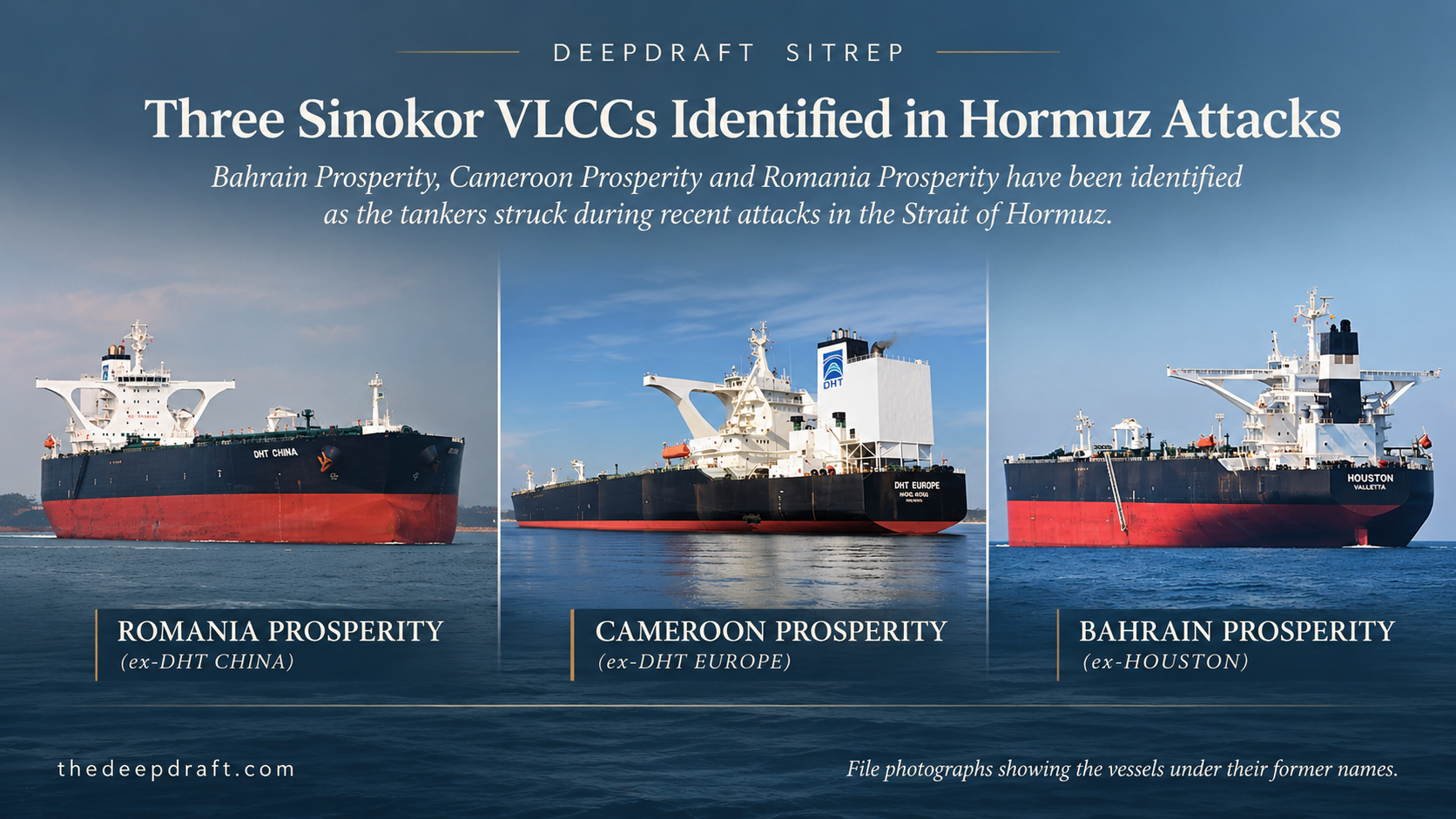
Three VLCCs commercially managed by South Korea’s Sinokor have been identified as the tankers struck during outbound passages through the Strait of Hormuz. All three vessels continued their voyages, with their crews accounted for.
1. Three Sinokor VLCCs identified in Hormuz attacks
• Maritime security reporting has identified the affected vessels as:
• BAHRAIN PROSPERITY (IMO 9596947), built 2012.
• CAMEROON PROSPERITY (IMO 9315159), built 2007.
• ROMANIA PROSPERITY (IMO 9315161), built 2007.
• All three vessels are Liberia-flagged VLCCs. Reports based on revised UKMTO warnings 219-26, 220-26 and 221-26 place the incidents on 22 November UTC.
• All three tankers continued their outbound passages. The extent of damage and any environmental consequences remain unconfirmed. The reported weapon type remains an unidentified projectile.
2. Sinokor fleet faces operator-specific security exposure
• All three affected tankers appear on the Persian Gulf Strait Authority’s non-compliance list, according to Riviera Maritime Media.
• The list was expanded to approximately 240 vessels on 2 November.
• In October, the Iranian authority accused Sinokor vessels of repeated crossing violations and announced enforcement measures against the company’s fleet from 1 November.
• The authority has also threatened restrictions against vessels conducting ship-to-ship transfers or transshipment operations with listed vessels.
• Iran’s claims concerning subsequent tanker mine strikes remain independently unconfirmed. No reliable evidence establishes that these claims represent additional casualties separate from the previously reported attacks.
3. Qatar LNG loading activity reaches post-war high
• Kpler data reported by Reuters on 25 November recorded 36 LNG carrier berthings at Qatar’s Ras Laffan terminal during November.
• The figure exceeds October’s 35 berthings and September’s 21.
• Twenty-nine of the November berthings involved vessels not transmitting AIS signals, compared with 27 in October and seven in September.
• Despite the increase in loading activity, Qatar’s LNG exports remain at approximately 40% of pre-war levels, according to analysts.
• Increased terminal activity has therefore not translated into a proportionate recovery in export volumes.
4. China completes first international-shipping bio-LNG bunkering
• Pacific International Lines and Qingdao Port announced China’s first liquefied biomethane bunkering operation for an internationally trading vessel on 25 November.
• The LNG dual-fuel container ship KOTA ODYSSEY received ISCC-certified liquefied biomethane at Qingdao’s QQCTN terminal.
• The fuel was delivered through a truck-to-ship transfer.
• The operation also marked PIL’s first use of liquefied biomethane as a marine fuel.
• According to the carrier, the fuel can be used in existing LNG dual-fuel machinery without engine modifications.
Related DeepDraft SITREPs
Latest DeepDraft Analysis
Painted Deck Lights: The Ex d Defect a Safety Inspection Can Miss
A SIRE 2.0 observation reveals how routine painting can obstruct certified features of flameproof deck lights, exposing weaknesses in tanker safety inspections and corrective-action follow-up.
Related DeepDraft Articles & Analysis
Sources
Riviera Maritime Media, TradeWinds, The Maritime Executive, Reuters, American Journal of Transportation
This update is part of the DeepDraft SITREP series covering developing maritime operational situations.
Sinokor, VLCC, Strait of Hormuz, tanker attacks, Bahrain Prosperity, Cameroon Prosperity, Romania Prosperity, maritime security


Leave a Reply