
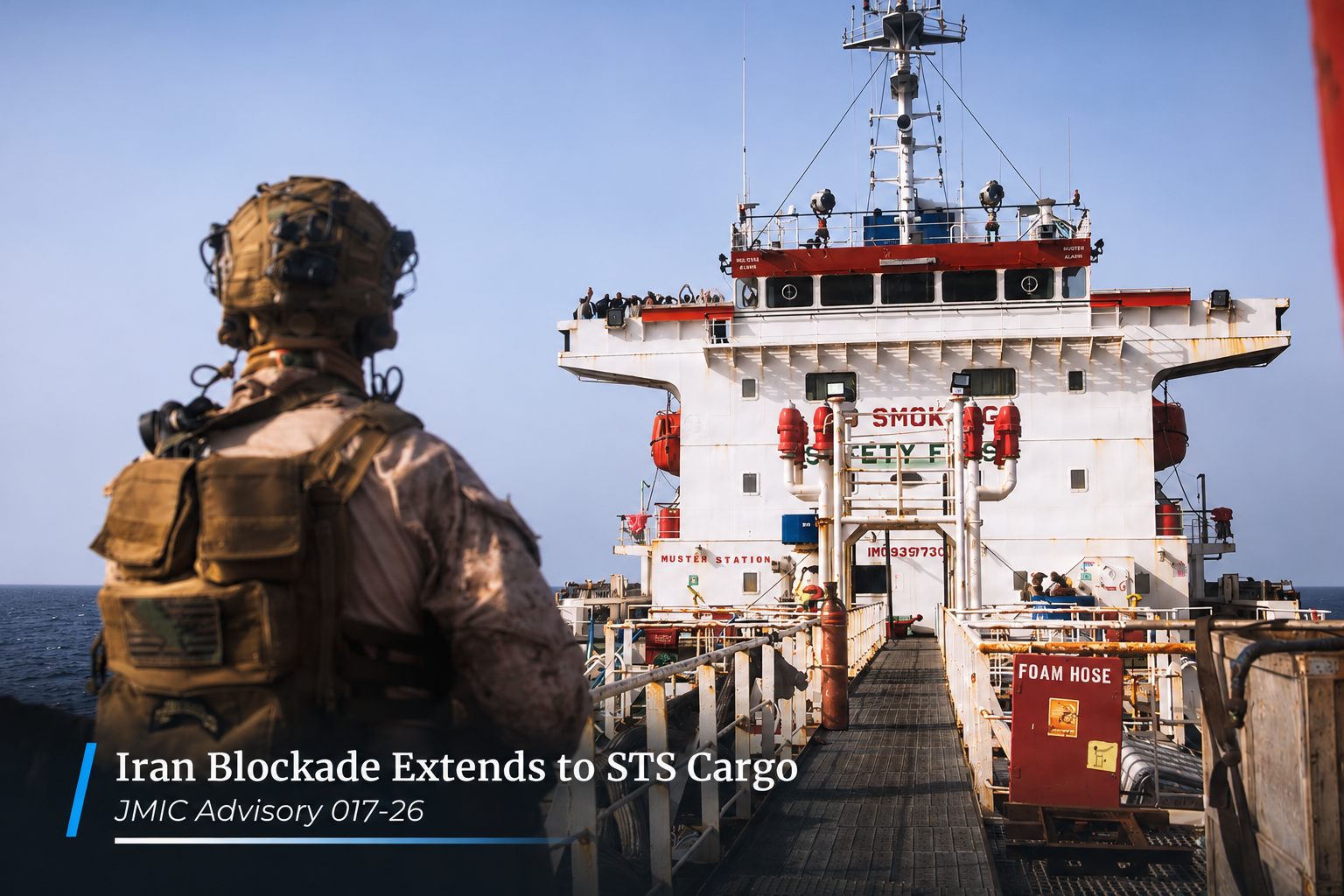
Ships receiving Iranian-origin cargo through offshore transfers can now face the same enforcement measures as vessels loading directly in Iran. The expanded wording materially changes the exposure of owners, charterers and Masters involved in ship-to-ship cargo movements.
1. Iranian-origin STS cargo enters blockade scope
• JMIC Advisory 017-26 states that a ship receiving cargo from a vessel subject to the blockade may itself be treated as attempting to evade enforcement.
• The provision applies when the transferred cargo was loaded at an Iranian port or coastline, even if the receiving ship never entered Iranian waters or called at an Iranian terminal.
• The receiving vessel may be stopped, boarded, diverted, captured or ordered to return the cargo to its originating Iranian port.
• Failure to comply may produce rapid escalation, including disabling or destructive fire. This is materially more serious than routine sanctions-screening exposure.
• The advisory applies across all flags. Neutral passage to non-Iranian destinations remains permitted but is subject to visit and search.
2. Outbound tanker struck north of Khasab
• UKMTO Warning 212-26 was issued as a time-late report on 19 November. The underlying incident occurred at approximately 1645 UTC on 18 November.
• The tanker was outbound approximately six nautical miles north of Khasab when an unknown projectile struck its engine room.
• All crew members were reported safe and accounted for. The warning did not identify the vessel, flag, cargo, operator or projectile source.
• The extent of machinery damage, continued propulsion capability and environmental consequences remained unknown at the cutoff.
• No vessel identification circulating through open-source accounts has been adopted because it was not confirmed by UKMTO, MSCIO, the flag state or an operator.
3. Current STS activity raises enforcement exposure
• UANI reported two transfers of Iranian crude or fuel oil in the Strait of Hormuz on 18 November, based on commercial satellite analysis.
• It identified at least 55 tankers carrying Iranian crude, petroleum products or LPG along the Iranian coastline. These figures remain UANI assessments, not official JMIC totals.
• UANI has recorded at least 58 Iranian oil and petrochemical loadings since the blockade was reinstated on 14 July.
• The practical exposure now extends beyond the original loading vessel. Cargo provenance, bill-of-lading history, previous AIS behaviour and transfer counterparties can determine whether a receiving ship is treated as evading the blockade.
• Masters cannot independently resolve cargo-title or sanctions questions at sea. Owners and charterers need the documentary chain settled before an STS operation places the vessel within interception range.
4. NEW MWANZA investigation begins after rock strike
• Tanzania’s TASAC reported that MV NEW MWANZA struck Bismarck Rock at approximately 1029 local time on 18 November while sailing between Mwanza South and Mwanza North during trials.
• The vessel returned safely at approximately 1212. Everyone aboard disembarked without reported injury, and no pollution was recorded.
• Authorities stated that no ordinary passengers were being carried during the trial movement.
• The Mwanza regional administration established a 14-day investigation. Its findings, including the navigational sequence and bridge-team actions, had not been released by the cutoff.
Latest DeepDraft Analysis
CII Ratings: Less Fuel Burned, More CO₂ per Cargo Tonne-Mile
CII can improve even when cargo-based emissions worsen because the IMO calculation uses certified capacity and distance rather than the cargo actually transported. The analysis examines why a vessel may reduce fuel consumption while becoming less efficient per tonne of cargo moved. The DeepDraft
Related DeepDraft SITREPs
Related DeepDraft Articles & Analysis
Sources
Joint Maritime Information Center, UK Maritime Trade Operations, MSCIO, United Against Nuclear Iran, Tanzania Shipping Agencies Corporation | DeepDraft Security Desk
This update is part of the DeepDraft SITREP series covering developing maritime operational situations.



Leave a Reply