
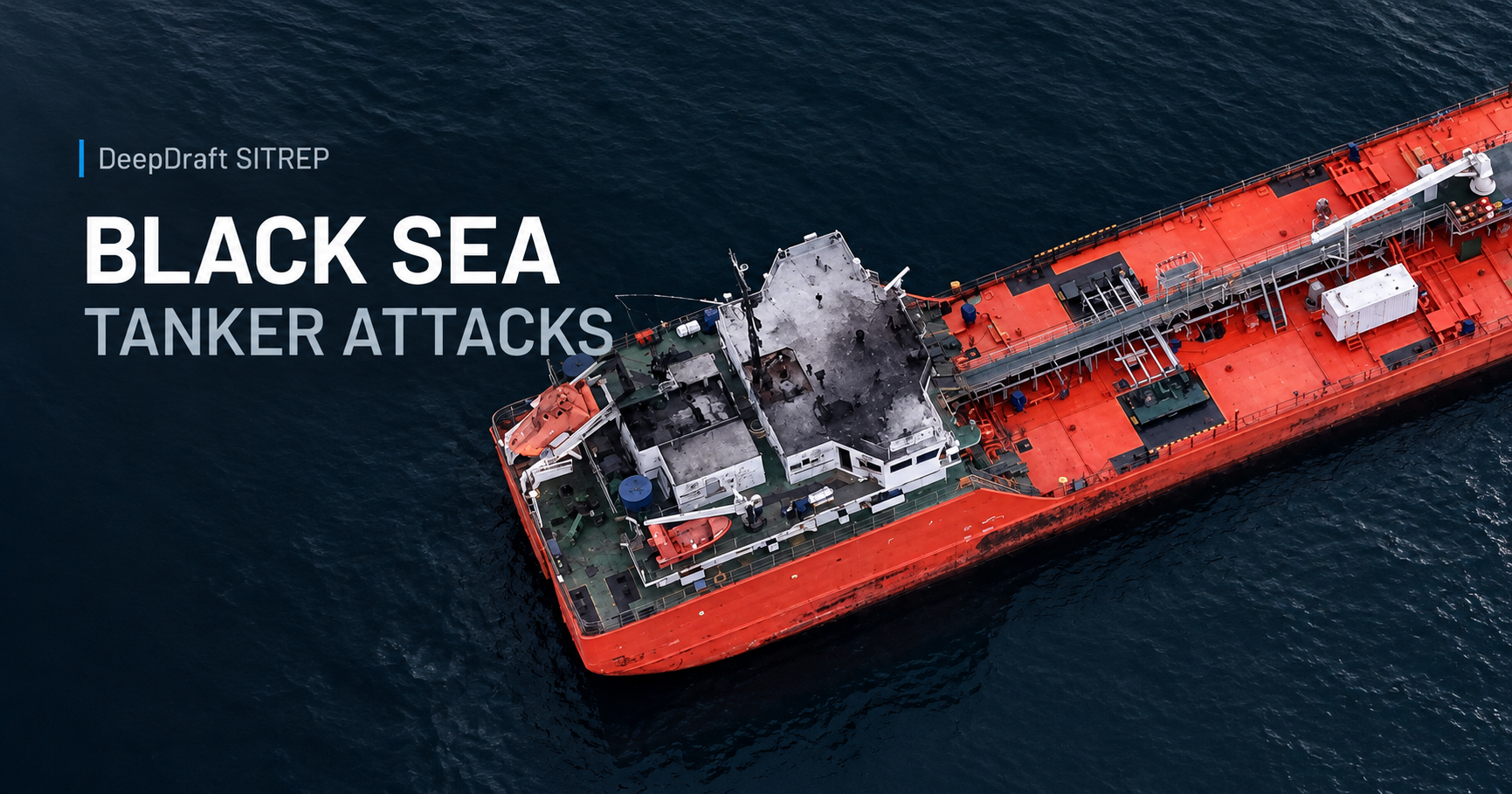
Two chemical tankers have suffered fires near Romania’s Black Sea coast, with seven seafarers missing from WINE TRADER. Fresh Suez Canal inspection requirements and U.S. Iran sanctions add separate operational and commercial pressure.
1. Black Sea: WINE TRADER Fire Leaves Seven Seafarers Missing
• San Marino-flagged chemical tanker WINE TRADER reported a fire in its superstructure at approximately 0700 local time on October 15, 2026.
• The incident occurred approximately 13 nautical miles southeast of Sulina, near Romania’s Black Sea approaches.
• Romania’s Naval Authority confirmed that five of the vessel’s 12 crew members had been rescued, while seven remained missing in its published update.
• The vessel was not carrying cargo. Romania’s Maritime Coordination Centre activated an emergency search-and-rescue operation involving naval and aerial response assets.
• Suspected drone involvement has been reported in international coverage, although the Romanian Naval Authority’s casualty statement did not independently establish the cause of the fire or identify the attacker.
2. YARA J Attack Extends Black Sea Merchant-Shipping Exposure
• Comoros-flagged chemical tanker YARA J was also reportedly struck in a separate incident near Romania’s Black Sea coast.
• The vessel suffered a fire, which its crew reportedly extinguished without external assistance. All personnel aboard were reported safe.
• The two incidents extend the recent pattern of attacks against commercial vessels in the western Black Sea, including earlier casualties near Bulgaria.
• The operating exposure now extends beyond individual Ukrainian port calls to merchant vessels navigating near Romanian territorial waters, coastal approaches and regional shipping routes.
• The immediate consequence is renewed scrutiny of voyage approval, coastal navigation warnings, emergency response arrangements, war-risk notifications and safe-port assessments for Black Sea employment.
3. Suez Canal Tightens Transit Conditions for Vessels Aged 25 Years and Older
• The Suez Canal Authority has introduced mandatory inspections and trials for vessels aged 25 years and older before transit permission is granted.
• The requirements were reported on October 15 and are already effective, according to instructions circulated by the authority’s Movement Department to shipping agents.
• Applicable inspection and trial fees must be paid in advance, adding a clearance and cost consideration for owners operating ageing tonnage.
• Vessels returning within six months of their previous inspection may avoid repeating the procedure, provided no defects, breakdowns or adverse technical observations have been recorded.
• Clarksons Research figures cited in industry reporting indicate that more than 150 million gross tonnes of the global fleet are now at least 25 years old, up 75% over five years.
• The authority has not specified the inspection fees or likely processing duration. Operators should confirm requirements with their Suez agents before fixing transit dates and calculating voyage costs.
4. U.S. Iran Sanctions Add Fresh Counterparty-Screening Requirements
• On October 15, the United States announced Iran-related sanctions targeting 16 individuals and 10 entities, according to the U.S. Treasury notice reported by Reuters.
• The new designations create an immediate screening trigger for maritime businesses handling transactions with potential connections to the listed parties.
• Owners, charterers, operators, brokers and insurers should check the named parties against cargo interests, beneficial ownership, vessel management, commercial counterparties and payment arrangements.
• The announcement is separate from the recent Hormuz vessel casualties already covered by DeepDraft and does not itself establish a new Strait transit restriction.
• Any identified sanctions exposure requires legal and compliance review before payment, cargo release or voyage commitments proceed.
Strategic Summary & Actions Required
• Masters and CSOs: For Black Sea voyages, verify coastal-state navigation warnings, security advisories, SAR communications, bridge alert procedures, firefighting readiness and emergency crew-muster arrangements before entering exposed areas.
• Ship managers and DPAs: Reassess Black Sea voyage authorization, coastal-state rescue coordination, medical evacuation, security reporting, VDR preservation and crew-welfare arrangements following the WINE TRADER and YARA J incidents.
• Owners, charterers and insurers: Reconfirm war-risk insurance terms, additional premiums, trading-area limits, deviation rights and safe-port obligations for affected Black Sea employment before committing vessels or cargoes.
• Suez-bound operators: Identify vessels aged 25 years and older, obtain current inspection and trial instructions through canal agents, verify qualifying exemption records and account for additional clearance time and costs.
• Compliance and commercial teams: Screen the October 15 U.S. Treasury designations against relevant parties, ownership chains, financial intermediaries and pending transactions. Escalate potential matches before execution.
Operational Status
CRITICAL RED — Black Sea Merchant-Vessel Attacks / WINE TRADER Seven Crew Missing / Romanian SAR Response / Heightened Voyage-Security and Insurance Exposure
Secondary operational developments: Suez Canal age-based inspection requirements / New U.S. Iran sanctions screening.
Latest DeepDraft Analysis
The Strange Accommodation Fitting That Explains Shipping’s Real Efficiency Problem
Tsuneishi’s FAIS lowers engine intake-air temperature by approximately 10°C and offers around 1% fuel savings, demonstrating how practical efficiency improvements can reduce emissions without sacrificing manoeuvring capability.
Sources
Romanian Naval Authority, Associated Press, Reuters, Splash247, The DeepDraft
This update is part of the DeepDraft SITREP series covering developing maritime operational situations.
Excerpt
Two chemical tankers suffer fires off Romania, with seven WINE TRADER crew missing. The Black Sea casualties trigger fresh voyage-security, search-and-rescue and insurance considerations for maritime operators.



Leave a Reply