
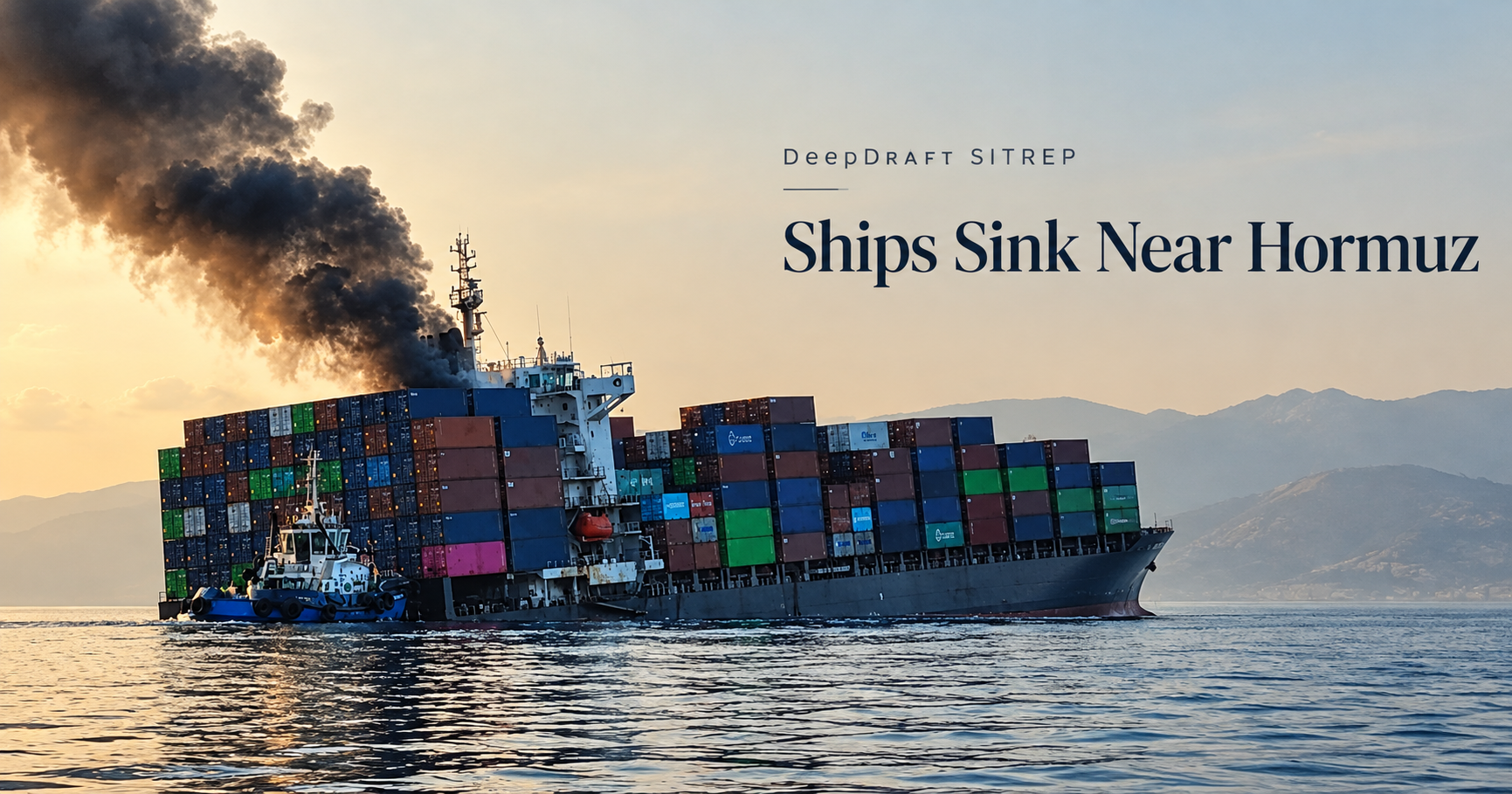
Two commercial ships have sunk near the Strait of Hormuz following separate attacks. Singapore confirms GFS PRIDE’s loss and a second container-ship casualty, while tanker sanctions and U.S. port-fee proposals add commercial exposure.
1. Strait of Hormuz: GFS PRIDE and CAPE DAO Confirmed Sunk
• Singapore-registered containership GFS PRIDE, IMO 9349045, was struck by an unknown projectile on October 13, sustaining damage and an onboard fire before subsequently sinking.
• Singapore’s Maritime and Port Authority (MPA) confirmed the vessel’s loss on October 14. All 21 crew members were safely evacuated, with no injuries reported.
• NAVAREA IX Warning 371/26 had earlier identified the casualty at 26°23.7’N, 056°23.6’E, approximately one nautical mile east of Ras Makhbuq, Oman, with the ship on fire and drifting.
• Antigua and Barbuda-flagged bulk carrier CAPE DAO has also sunk following damage sustained during a separate September 23 projectile attack near the Strait. One seafarer died in that earlier incident.
• Reuters reported the two sinkings as the second and third commercial vessel losses since the conflict began on February 28. CAPE DAO’s loss is a delayed casualty outcome, not a new October 14 strike.
• Iran’s Revolutionary Guard separately claimed that a commercial vessel had struck a naval mine while using an unauthorized route. The mine explanation and its connection to a named vessel have not been independently established.
2. GFS GISELLE Hit: Second Singapore Container Ship Damaged
• Singapore-registered containership GFS GISELLE was reportedly struck by an unknown projectile while transiting the Strait of Hormuz on October 14, Singapore time.
• The ship sustained hull damage but remained under propulsion and subsequently reached a safe anchorage.
• MPA confirmed all 22 crew members were safe, with no reported injuries. The authority remains in contact with the vessels’ management company.
• GFS PRIDE and GFS GISELLE establish two separate container-vessel incidents on consecutive days, reinforcing that the immediate threat to commercial shipping is not confined to crude and product tankers.
• With one containership sunk and another damaged, ship managers must account for potential casualty-area hazards, security exposure and emergency diversion capability before authorizing passage.
3. Tanker Market: Washington Considers Shadow-Fleet Sanctions Relief
• Reuters reported on October 15 that the United States is considering easing restrictions on certain previously sanctioned tankers to increase available shipping capacity and reduce elevated freight costs.
• The proposal concerns potential authorization for vessels historically associated with sanctioned Russian, Iranian and Venezuelan oil movements to transport permitted cargoes.
• U.S. companies would need Treasury Department authorization. The proposal does not constitute a general removal of vessel sanctions or automatic permission to employ designated tonnage.
• Fleet condition, classification, insurance availability, beneficial ownership and continuing UK or EU restrictions remain material obstacles to bringing previously sanctioned vessels into conventional trades.
• Charterers and brokers considering these ships must verify applicable authorizations, vessel identity, sanctions status, P&I arrangements and contractual representations before fixing.
4. U.S. Port Access: FMC Proposes $200,000 Spanish-Flag Vessel Fee
• The U.S. Federal Maritime Commission announced on October 14 that it is proposing a USD 200,000 per-voyage fee on Spanish-flagged ships following its investigation into restrictions affecting U.S.-flagged vessels at Spanish ports.
• The proposed remedies also include restrictions on selected Spanish imports, including cosmetics, oils and fats, ceramics, stone products and confectionery.
• The FMC has opened a public consultation process and will provide Spain an opportunity for a hearing. The proposed measures are not yet in force.
• Operators of Spanish-flagged tonnage calling U.S. ports should identify affected voyages, review flag-related commercial exposure and assess freight, charterparty and cargo-contract provisions if the measures proceed.
• Owners and charterers should distinguish the proposed flag-based fee from existing port tariffs and avoid pricing it as an enacted charge.
Strategic Summary & Actions Required
• Masters and bridge teams: Before any Hormuz transit, obtain the latest NAVAREA IX and relevant coastal-state warnings, review the GFS PRIDE casualty position, verify safe navigation arrangements and establish security and emergency-response contingencies.
• Ship managers and CSOs: Reassess vessel-specific risk assessments for container, bulk and tanker passages. Confirm crew-protection measures, damage-control readiness, emergency communications and company authorization against the latest incidents.
• Charterers and insurers: Reconfirm voyage permission, additional premiums, security exclusions, deviation arrangements and contractual allocation of delay or non-performance exposure before committing ships to affected Gulf routes.
• Tanker and compliance desks: Treat potential U.S. shadow-fleet sanctions relief as a proposal only. Obtain applicable authorization and complete ownership, flag, class, insurance and sanctions due diligence before fixture acceptance.
• Commercial operators: Review Spanish-flagged U.S. calls for potential FMC fee exposure, while distinguishing proposed regulatory measures from enforceable charges.
Operational Status
CRITICAL RED — Two Confirmed Hormuz Vessel Losses / Second Singapore Container Ship Damaged / Active Commercial Shipping Threat / Tanker Sanctions Uncertainty / Proposed U.S. Flag-Based Port Fees
Latest DeepDraft Analysis
The Strange Accommodation Fitting That Explains Shipping’s Real Efficiency Problem
Tsuneishi’s Fresh Air Intake System demonstrates how a 10°C intake-temperature reduction can deliver approximately 1% fuel savings, reinforcing the need to improve efficiency without sacrificing shiphandling capability.
Related DeepDraft Articles & Analysis
Sources
Maritime and Port Authority of Singapore, Reuters, Associated Press, NAVAREA IX, U.S. Federal Maritime Commission
This update is part of the DeepDraft SITREP series covering developing maritime operational situations.


Leave a Reply