
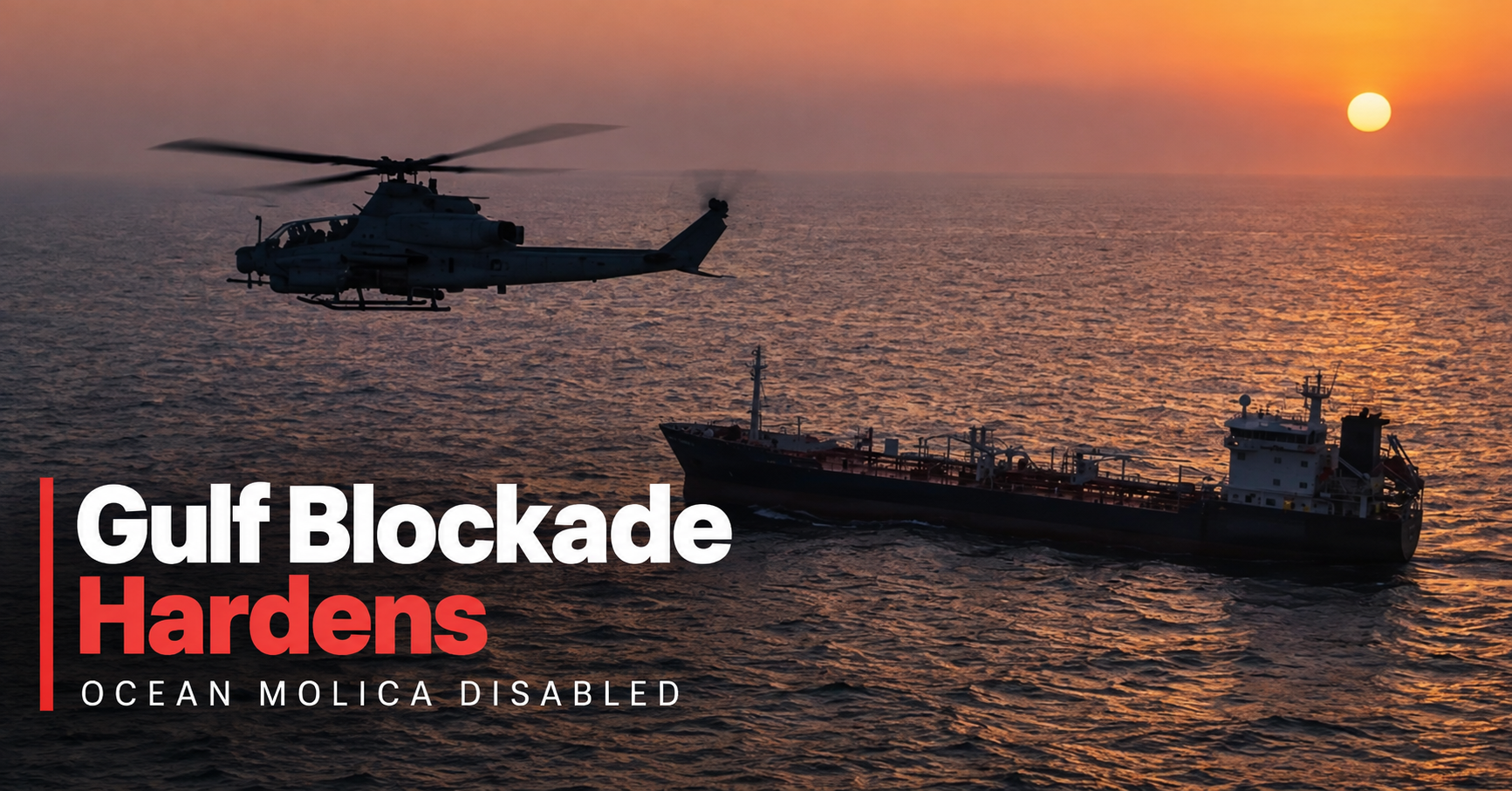
U.S. forces disabled M/V Ocean Molica / Arika Sun in the Gulf of Oman after the vessel allegedly attempted to run the Iran blockade.
Inside the same operating window, UKMTO reported a separate outbound tanker struck by an unknown projectile in the Strait of Hormuz, with fire onboard and crew reported safe.
1. Gulf of Oman / Hormuz Security Picture: Commercial Vessel Disabled, Tanker Fire Reported
• U.S. forces disabled Panama-flagged M/V Ocean Molica, also known as Arika Sun, in the Gulf of Oman after the vessel allegedly ignored repeated warnings during an attempted Iran-blockade breach.
• The vessel was struck at the stern, with propulsion reportedly fully disabled.
• No crew casualties were reported from the Ocean Molica disabling action.
• UKMTO Warning 162-26 separately reported an outbound tanker struck on the port side by an unknown projectile while transiting the Strait of Hormuz at 1920 UTC on October 10.
• The tanker reportedly caught fire, while crew were reported safe.
• Damage and environmental impact from the Hormuz tanker incident were not immediately confirmed.
2. Regional Vessel Safety Layer: UAE Reports 22 Crew Rescued From Oil Tanker Fire
• UAE National Guard reported the rescue of 22 Asian crew members after a fire broke out aboard an oil tanker in Arabian Gulf waters.
• The rescue followed a distress report from the tanker’s crew.
• The official UAE report did not identify the tanker.
• No confirmed link has been established between the UAE tanker-fire rescue and the UKMTO Hormuz tanker strike.
• The rescue adds a separate crew-safety and casualty-response layer to the Gulf operating picture.
3. Regional Escalation Layer: Riyadh Airport Strike Expands the Threat Picture
• A Houthi missile attack on King Khalid International Airport in Riyadh reportedly killed 12 people and injured more than 300.
• The strike hit aviation and civil infrastructure, not a maritime target.
• The incident sits inside the same 24-hour regional escalation window as the Ocean Molica disabling action and the UKMTO Hormuz tanker-fire report.
• The Riyadh attack widens the regional security picture, but does not overtake the vessel-centered Gulf of Oman / Hormuz maritime lead.
4. Commercial / Market Movement: Durban Congestion Fee and India-Gulf Service Split
• Maersk increased its Congestion Fee Destination for imports to Durban from Far East Asia, the Indian Subcontinent and the Middle East.
• The revised Durban congestion charge adds a liner-cost signal to South Africa-bound cargo flows.
• Global Feeder Shipping split its Colombo Cochin Gulf service into two separate loops focused on India’s eastern and western coasts.
• The GFS change separates east-coast and west-coast India coverage within the Colombo-Cochin-Gulf network.
• These are commercial and liner-network signals, not security leads.
5. Regulatory / Policy Layer: Malaysia Sensitive Area and Dutch Shadow Fleet Proposal
• Malaysia introduced controls in a new marine sensitive area near the Strait of Malacca and Singapore.
• Reported controls include bunkering restrictions, speed limits and restrictions affecting large cargo ships and oil tankers.
• The Dutch government proposed legal changes aimed at stronger action against Russia’s shadow fleet.
• These policy and compliance signals remain secondary to the Gulf of Oman / Hormuz security cluster.
Strategic Summary
• The day’s dominant maritime change is the convergence of direct blockade enforcement and a separate tanker strike/fire inside the Gulf of Oman / Hormuz operating area.
• Ocean Molica shifts the blockade file from clearance pressure into physical disabling action against a commercial vessel.
• UKMTO Warning 162-26 adds a separate vessel-strike signal inside the Hormuz transit environment.
• UAE’s tanker-fire rescue and the Riyadh airport strike widen the regional safety and escalation picture, but do not displace the maritime lead.
• Durban congestion pricing, GFS service restructuring, Malaysia’s sensitive-area controls and the Dutch shadow-fleet proposal form the lower-severity commercial and regulatory layer.
Operational Status
CRITICAL RED — Gulf of Oman Blockade Enforcement / Hormuz Tanker Fire / Regional Missile Escalation / Commercial Vessel Security Risk
Latest DeepDraft Analysis
Beards and SCBA on Merchant Ships: Face Seal and Firefighting Risk
Face-seal failure turns facial hair from a grooming issue into a firefighting exposure, affecting emergency readiness, SMS controls and onboard breathing-apparatus discipline.
Related DeepDraft Articles & Analysis
Sources
CENTCOM, UKMTO, Reuters, WAM, The DeepDraft
This update is part of the DeepDraft SITREP series covering developing maritime operational situations.



Leave a Reply