
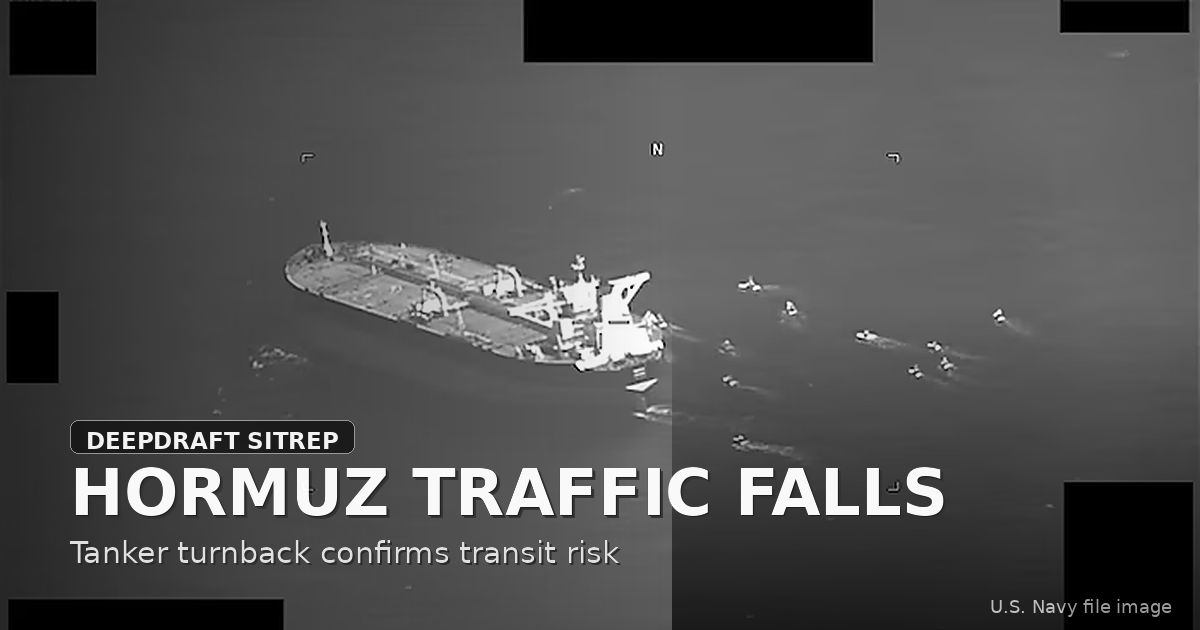
Hormuz is no longer only a strike and exclusion-zone story.
The fresh operational signal is measurable flow collapse, with one Saudi-loaded tanker turned back and VLCC exits halted.
1. Hormuz Traffic Collapse Becomes the Lead Operational Signal
• An average of 10 commodity ships per day transited the Strait of Hormuz over the past 10 days, the lowest level since May.
• The 10-day moving average fell from more than 15 ships on Friday to nearly 13 on Saturday and 10 on Sunday.
• Only two vessels passed through the strait on Saturday, while six passed on Sunday, mostly using the Iranian route.
• LSEG data showed a tanker carrying refined products loaded from a Saudi port attempted to exit Hormuz but was turned back.
• Kpler data showed no VLCC had exited the strait since Wednesday.
2. Restricted-Zone Threat Now Has a Flow Consequence
• Iran says it will announce a new restricted zone outside the Strait of Hormuz and a new shipping corridor through the waterway.
• Mohsen Rezaei said the zone would begin where the U.S. naval blockade starts and extend into parts of the Gulf.
• Rezaei said vessels entering the area with the intention of passing through Hormuz could be placed on Iran’s sanctions list.
• The coordinates, identification process and enforcement mechanism remain unpublished, leaving Masters and operators exposed to unclear routing, communication and compliance triggers.
• UKMTO reporting cited by Reuters now counts 27 projectile-strike incidents since July 6 involving damage to vessels operating in and around Hormuz.
3. Bunker and Oil Markets Move Into Voyage Economics
• Brent crude settled at USD 97.31 per barrel on Monday after touching USD 98.06, its highest level since July 24.
• Singapore VLSFO was reported just under USD 825 per metric tonne on September 1, up 76% since the Iran war began.
• Reuters reports fuel-oil stocks in Singapore, Amsterdam-Rotterdam-Antwerp and Fujairah are around 30% below three-year seasonal averages.
• Energy Aspects expects a Q3 fuel-oil deficit of 218,000 barrels per day, while Middle East fuel-oil exports were down 45% year on year in March-August.
• Higher bunker costs now sit directly inside Gulf voyage margins, deviation economics, speed decisions, ROB planning and charterparty cost allocation.
4. Panama Canal Water Risk Adds Separate Route-Capacity Pressure
• Panama Canal Authority Advisory A-29-2026 says May-August rainfall across the Canal watershed was 34% below historical average.
• Watershed inflows were 44% below historical average over the same period.
• For booking dates beginning September 4, ACP adjusted daily slot availability to 34 total slots, including nine Neopanamax slots.
• For booking dates beginning September 15, daily slot availability falls to 32 total slots, with Panamax Locks adjusted to 23 daily slots.
• ACP states a confirmed reservation remains the only mechanism that guarantees a transit date, making booking status central to voyage planning.
Strategic Summary & Actions Required
• Masters approaching Hormuz should confirm company, CSO, flag and P&I instructions before committing to transit, especially where routing, AIS posture or coastal-state communication may become contested.
• Bridge teams should preserve AIS, ECDIS, radar, ARPA, VDR, GMDSS, VHF and security-log evidence for any turnback, warning, overflight, escort instruction, projectile alert or route deviation.
• Charterers and operators should treat Gulf exit windows as uncertain and review laycan, cancellation, off-hire, deviation, war-risk, sanctions and unsafe-port wording before fixing or nominating cargo.
• Bunker desks should reprice Gulf-linked voyages using current VLSFO, ROB, speed, stem-port availability and deviation scenarios rather than assuming normal fuel-cost recovery.
• Canal users should verify ACP booking status, draft exposure, LoTSA position and alternative routing before relying on September or Q1 transits through Panama.
Operational Status
CRITICAL RED – Strait of Hormuz Traffic Collapse / Tanker Turnback / Restricted-Zone and Sanctions-List Risk / Bunker and Route-Capacity Pressure
Latest DeepDraft Analysis
Dark Transits in Hormuz: The Illusion of Disappearance
Excerpt: AIS silence in Hormuz is not invisibility. It shifts risk onto radar discipline, logged security decisions, STS controls and later proof for charterers, insurers and banks.
Related DeepDraft Articles & Analysis
Sources
Reuters, Panama Canal Authority, U.S. Central Command, UKMTO, The DeepDraft
This update is part of the DeepDraft SITREP series covering developing maritime operational situations.

Leave a Reply