
Iran says it will announce a new exclusion zone near the Strait of Hormuz.
For Masters, tanker desks and insurers, Strait transit is now a route-authority, sanctions and war-risk decision.
1. Iran Exclusion-Zone Threat Creates New Hormuz Transit Risk
• Mohsen Rezaei, secretary of Iran’s Supreme National Security Council, said Tehran plans to announce an exclusion zone outside the Strait of Hormuz.
• The proposed zone is expected to begin from the line of the U.S. naval blockade, extend toward the Strait of Hormuz and continue into the Persian Gulf.
• Rezaei said any ship entering the area with the intention of passing through Hormuz, once identified, would be placed on Iran’s sanctions list.
• The precise coordinates, enforcement mechanism and vessel-identification process have not yet been published, leaving Masters and operators exposed to unclear routing, clearance and communication triggers.
2. CENTCOM Tanker Strikes Escalate the Kinetic Layer
• U.S. Central Command said American forces struck three IRGC crude oil carriers on September 5 after Iran launched ballistic missiles toward two U.S. Navy warships.
• M/T Downy was permanently disabled off Kharg Island.
• M/T Stark 1 was permanently disabled near Jask.
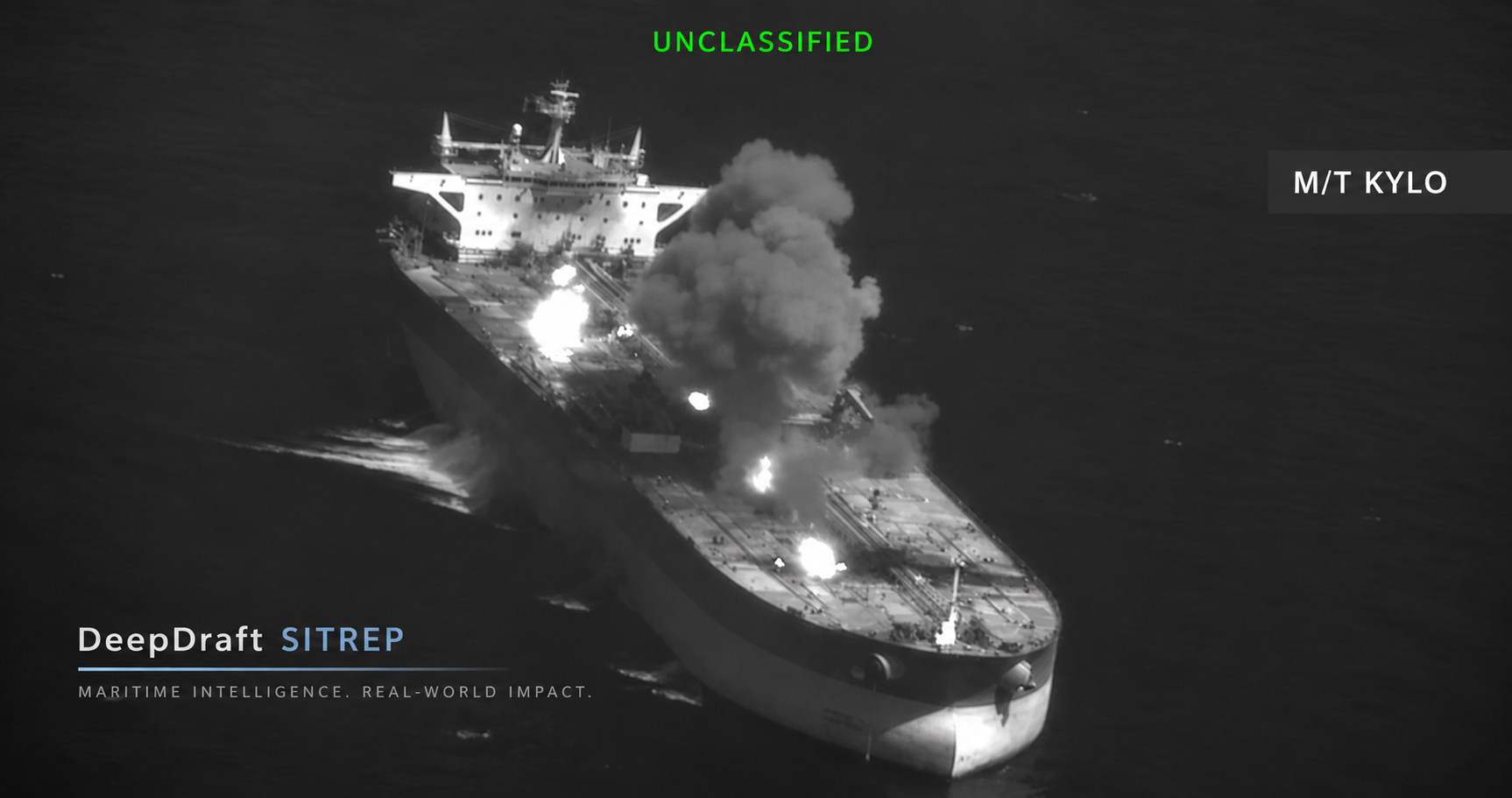
• M/T Kylo, also known as Noxen, was destroyed in the Gulf of Oman after the crew was directed to abandon ship.
Reading this as a maritime insider, seafarer, or enthusiast?
Subscribe to The DeepDraft for maritime analysis, daily SITREP updates, weekly briefings, and operational signals worth watching.
3. Oil-Market and Charterparty Exposure Widens
• Reuters reports OPEC+ kept October output policy unchanged while the Iran war continues to disrupt oil exports through the Strait of Hormuz.
• The producer group completed a phased rollback of a 1.65 million barrel per day supply cut in September, but physical delivery remains constrained by conflict risk.
• The operational issue for charterers is no longer only cargo availability. It is whether nominated barrels can safely transit, obtain cover, preserve laycan certainty and avoid sanctions-list exposure.
• Tanker fixtures through the Gulf should be reviewed for war-risk premiums, deviation, off-hire, unsafe-port wording, cancellation rights, sanctions clauses and Master’s authority if routing instructions conflict.
4. Black Sea Carrier Suspensions Add Separate Route-Risk Layer
• Container News reports Arkas and Akkon Lines have suspended calls to all Russian ports as Black Sea commercial-vessel risk escalates.
• The suspensions follow earlier Novorossiysk call suspensions by MSC and FESCO.
• Akkon’s decision followed the drone strike on the 1,100 TEU RMS Team while sailing toward Novorossiysk on August 21, after which the vessel caught fire, the crew abandoned ship and one seafarer was reported missing.
• Alternative cargo paths remain available through St. Petersburg rail links, Novorossiysk connections and Georgia, but direct Black Sea service reliability is now a booking and insurance file, not a routine schedule issue.
Strategic Summary & Actions Required
• Masters approaching Hormuz should obtain company, CSO and P&I confirmation before responding to any exclusion-zone, clearance, routing or coastal-state communication.
• Bridge teams should preserve AIS, ECDIS, radar, VDR, GMDSS, VHF and security-log records where any military warning, overflight, routing demand, boarding threat or transit challenge occurs.
• Ship managers and charterers should review Hormuz voyages for sanctions-list exposure, war-risk cover, deviation authority, unsafe-port arguments, off-hire exposure and cargo-performance obligations.
• Tanker desks should price the combined effect of disabled Iranian crude carriers, blockade pressure, disrupted export flows and unclear exclusion-zone enforcement into Gulf-linked fixtures.
• Operators with Russian port exposure should reconfirm Black Sea port calls, carrier acceptance, alternative gateways, cargo release instructions, insurance status and customer delivery windows.
Operational Status
CRITICAL RED — Strait of Hormuz Exclusion-Zone Threat / U.S.-Iran Tanker Strikes / Sanctions-List Transit Risk / War-Risk and Voyage Authorization Pressure
Latest DeepDraft Analysis
Dark Transits in Hormuz: The Illusion of Disappearance
AIS silence in Hormuz does not remove shipboard exposure; it shifts risk onto radar discipline, GNSS cross-checking, STS control and sanctions documentation.
Related DeepDraft Articles & Analysis
Sources
Associated Press, Reuters, U.S. Central Command, Container News, The DeepDraft
This update is part of the DeepDraft SITREP series covering developing maritime operational situations.

Leave a Reply