
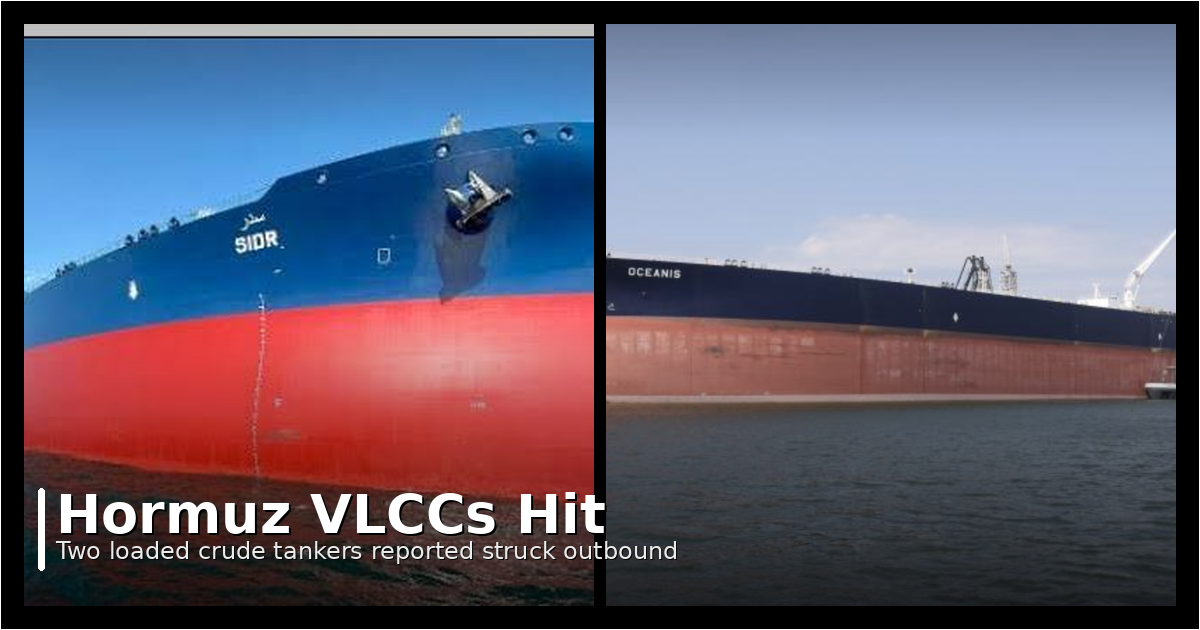
Two loaded crude VLCCs were struck by unknown projectiles while transiting outbound through the Strait of Hormuz.
1. SIDR and SENEGAL PROSPERITY Hit During Outbound Hormuz Transit
• The Saudi-flagged VLCC SIDR and Liberian-flagged VLCC SENEGAL PROSPERITY were reported struck by unknown projectiles while leaving the Strait of Hormuz.
• Reuters reported the attacks occurred within minutes of each other near Khasab, Oman, based on shipping intelligence and tracking data.
• Kpler data cited by Reuters showed both vessels had loaded Saudi crude at Juaymah terminal last week, with about 2 million barrels aboard each ship.
• No crew casualties were reported in the Reuters account, but the attack places approximately 4 million barrels of Saudi crude inside an active maritime strike envelope.
2. SENEGAL PROSPERITY Casualty Detail Hardens the Operational Picture
• JMIC Update 092 identified SENEGAL PROSPERITY as a tanker attack case under UKMTO 124-26 while transiting southbound through the Strait of Hormuz in territorial waters, 4 nautical miles from the coast of Oman.
• The CSO reported at 2200 UTC that SENEGAL PROSPERITY was hit by three rockets on the port-side engine room and ballast tank.
• JMIC reported all shipboard communications were lost, the vessel was dead in the water, listing to port and anchored at position 26°19’N 056°33’E.
• The crew were evacuated by local authorities, no casualties were reported and the vessel was listed as not under command.
3. Commercial, Charterparty and Insurance Impact
• The two VLCCs represent a major cargo-exposure event for Saudi crude moving through the Strait of Hormuz.
• Reuters separately reported Hormuz commodity-vessel transits remained in single digits, with preliminary Monday data showing five ships crossing and no liquid tankers in the observed flow.
• The attacks reset voyage-authorization pressure for Gulf loadings, war-risk approvals, owner consent, deviation rights, off-hire exposure, laycan reliability and cargo-delivery commitments.
• Charterers and operators should re-check whether Gulf liftings can be performed under existing charterparty wording, insurance approvals, terminal windows and emergency-routing instructions.
4. Wider Hormuz Security and Navigation Layer
• JMIC assessed the Strait of Hormuz threat level as severe, with recent attacks, navigation interference and mine-risk reporting still relevant within and adjacent to the TSS.
• The same JMIC update listed BURGAN as a separate tanker attack case, with the vessel hit on the starboard aft ballast tank by an unknown projectile and a tug dispatched to assist.
• A separate UKMTO advisory described an unnamed tanker ordered by military aircraft to reverse course in international waters off Oman, then stopped and left adrift pending instructions.
5. Secondary Maritime Signals
• Ukraine-linked drone activity reportedly caused a fire in the port area of Ust-Luga, keeping Baltic oil-export infrastructure inside the war-risk routing file.
• EU naval forces boarded MV SUN in the Mediterranean for flag verification, the sixth suspected Russian shadow-fleet boarding by EU operations in recent months.
• HD Hyundai Heavy Industries’ union launched a partial strike at Ulsan after wage talks failed, creating a shipbuilding delivery-risk watch item.
• APM Terminals broke ground on the Laldia Container Terminal in Chattogram, designed to handle vessels up to 6,000 TEU, more than double the port’s current approximate direct-call limit.
Strategic Summary & Actions Required
• Masters approaching Hormuz should raise bridge, engine-room, damage-control and security readiness before committing to the Strait risk envelope.
• Ship managers should require written voyage authority covering corridor use, AIS policy, emergency reporting, crew protection, citadel readiness and communication with military or coastal-state actors.
• Charterers and operators should reprice Gulf liftings against war-risk cover, owner consent, deviation options, laycan tolerance, demurrage exposure and cargo-delivery obligations.
• Insurers, P&I teams and legal desks should treat the SIDR and SENEGAL PROSPERITY attacks as a claims-notification, underwriting and evidence-preservation trigger.
• Fleet security teams should separate verified projectile strikes from corridor-control claims, but preserve all data where a vessel is stopped, warned, overflown, diverted or instructed to alter course.
Operational Status
CRITICAL RED — Strait of Hormuz Loaded-VLCC Attacks / Saudi Crude Exposure / Severe Navigation Threat / War-Risk and Voyage Authorization Pressure
Latest DeepDraft Analysis
Dark Transits in Hormuz: The Illusion of Disappearance
AIS silence does not make a tanker invisible. In Hormuz, it shifts identification, evidence and exposure across bridge teams, insurers, satellites and naval surveillance.
Related DeepDraft Articles & Analysis
Sources
Reuters, UKMTO/JMIC, Financial Times, APM Terminals, The DeepDraft
This update is part of the DeepDraft SITREP series covering developing maritime operational situations.


Leave a Reply