
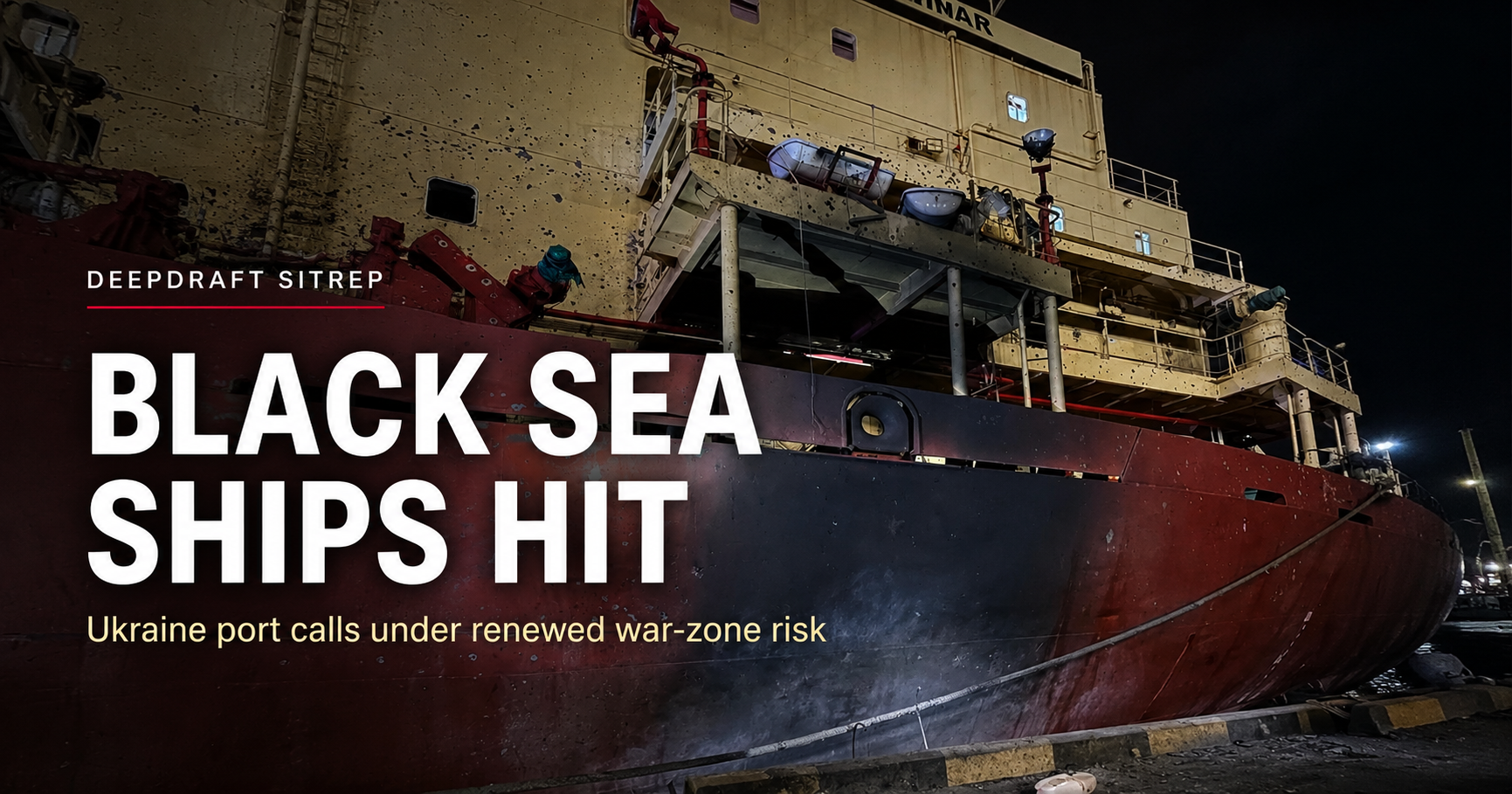
Russia says it struck five vessels across Ukraine’s Black Sea port system, including cargo ships and a tanker.
The claim is not independently verified, but it creates immediate port-call, crew-risk, cargo, insurance and war-zone routing exposure.
1. Black Sea Port Strike Claim: Five Vessels Reported Hit
• Russia’s Defence Ministry said its forces struck three cargo vessels and a tanker at the Black Sea port of Pivdennyi.
• The ministry also said another cargo vessel was hit at Odesa.
• Port infrastructure at Pivdennyi and Odesa, plus fuel storage facilities at Chornomorsk, were also listed in the Russian claim.
• Reuters could not independently verify the battlefield report, and vessel names, flags, cargoes, crew status and damage condition were not confirmed at drafting.
• The operating signal is still hard: Black Sea port calls now require renewed confirmation of berth status, terminal readiness, war-risk cover, crew exposure and departure-window security.
2. Gulf of Aden Piracy Layer: IMO Says More Than 90 Seafarers Held
• IMO Secretary-General Arsenio Dominguez demanded the immediate and unconditional release of more than 90 seafarers held captive by pirates and armed robbers.
• IMO said the latest escalation followed reports of SEAMULL being hijacked on 20 August 2026.
• The agency said a sixth vessel is now being held in the region.
• IMO called on flag and coastal states to ensure ships are prepared for security risk, including implementation of BMP Maritime Security and relevant IMO guidance.
• Gulf of Aden, Somali Basin and Red Sea routing should no longer treat piracy as a background watch item; the hostage count has returned it to active voyage-risk planning.
3. Panama Canal Market Signal: USD 5.3 Million Transit Auction
• A shipper bid a record USD 5.3 million to secure a Panama Canal transit.
• Reporting identified South Korea-based SK Gas as the company paying for the slot.
• The winning bid was tied to the LPG tanker G. Spirit, scheduled for northbound transit on 1 September.
• The new auction price broke the previous USD 4.6 million high set earlier in August.
• The premium reflects urgent canal access demand, longer waiting times for unreserved vessels and tighter slot availability heading into September.
4. Red Sea, Suez and Hormuz: Route Return Meets Compliance Friction
• MSC has decided to partially restore Suez Canal transits on a limited number of East-West services.
• The selected services include Asia-Mediterranean, Asia-North Europe and India-Mediterranean sailings, with voyage updates to be implemented service by service.
• MSC said contingency arrangements remain in place, allowing individual voyages to be adjusted if conditions require.
• OFAC’s updated Hormuz alert warns U.S. and non-U.S. persons of sanctions risk from engaging with Iranian passage demands, including services, guarantees or toll structures tied to PGSA, PGMIC or Hormuz Safe.
• The routing picture is fragmenting: some operators are testing Suez and Red Sea returns while Hormuz-linked voyages remain constrained by security, documentation and sanctions exposure.
Strategic Summary & Actions Required
• Masters and CSO teams with Black Sea port calls should demand current port, terminal, naval and war-risk guidance before arrival, anchoring, shifting or sailing.
• Charterers and operators should preserve voyage orders, laycan communications, war-risk notices, delay evidence, berth instructions and force majeure records for any Ukraine Black Sea fixture.
• Gulf of Aden and Somali Basin transits require refreshed BMP measures, citadel readiness, crew security briefings, reporting discipline and route-risk approval before entering the area.
• Panama Canal-linked cargoes should be re-costed against reservation availability, auction exposure, unreserved waiting time, cargo value, alternative routing and laycan penalties.
• Hormuz-linked voyages should separate navigational clearance from sanctions compliance, with any Iranian passage demand escalated to legal, P&I, flag and company management before response.
Operational Status
RED – Black Sea Port-Strike Claim / Gulf of Aden Piracy Escalation / Panama Canal Record Auction / Fragmented Chokepoint and War-Zone Routing Risk
Latest DeepDraft Analysis
Fire Wires on Tankers: The Safety Control That Became the Hazard
Fire wires remain a terminal checklist item in some tanker ports, but DeepDraft argues emergency tow-off capability must be engineered, drilled and proven, not imposed as routine crew handling.
Related DeepDraft Articles & Analysis
Sources
Reuters, International Maritime Organization, gCaptain/Bloomberg, MSC, U.S. Treasury/OFAC, The DeepDraft
This update is part of the DeepDraft SITREP series covering developing maritime operational situations.


Leave a Reply