
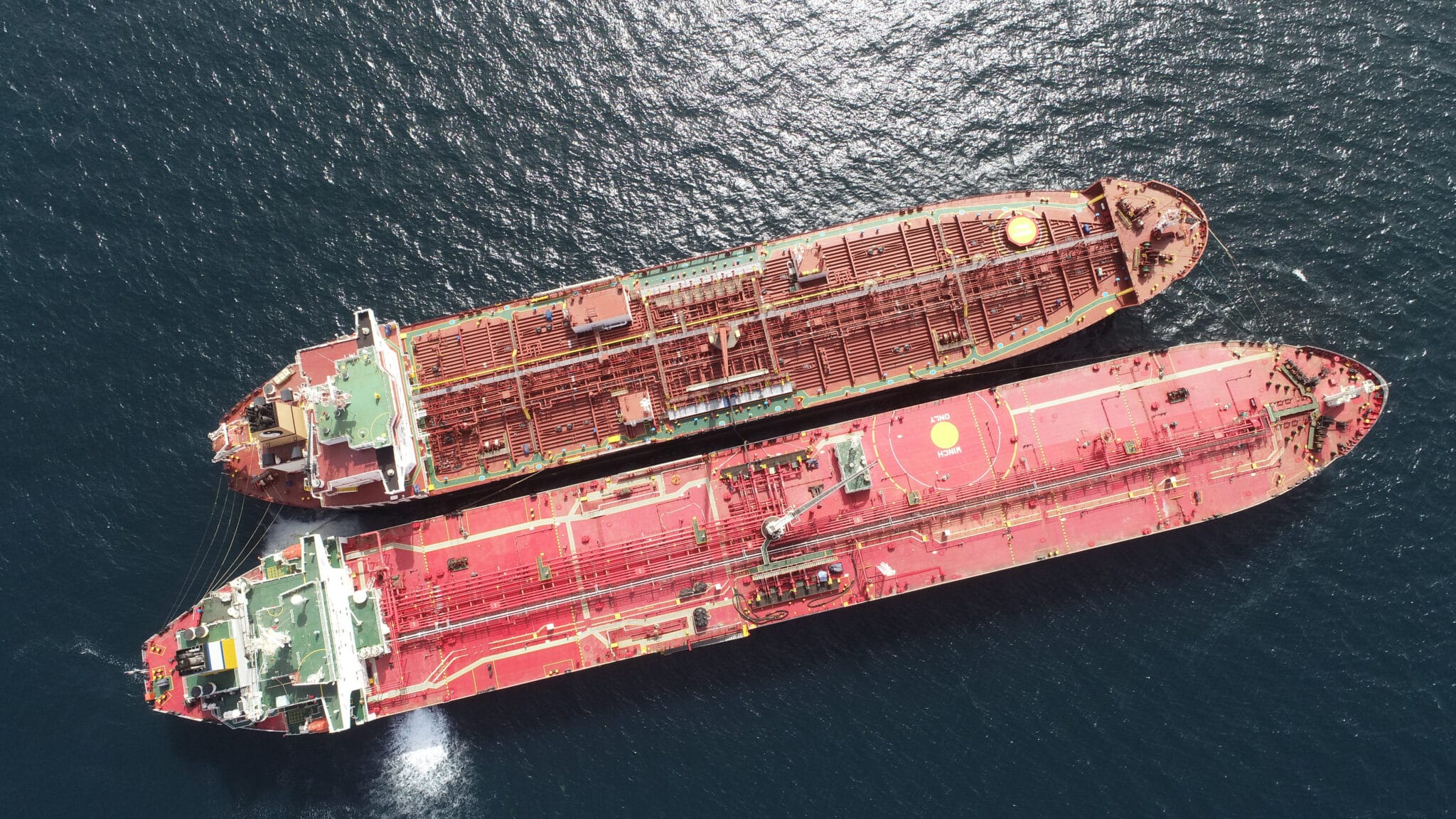
The industry keeps asking if ships can pass Hormuz. The better question is what happens before they try.
By the time a Master receives revised voyage instructions, the real decision has been made ashore. The cargo may have been swapped. The insurer may have retreated. The refinery may be pricing a different crude. A vessel drifting off Malacca or Singapore is merely the visible anchor of a commercial decision made far upstream.
A chokepoint does not need to close the sea lane. It only needs to contaminate the next decision.
This is no longer strictly a tanker story. Hormuz crossings have plummeted, and as Reuters noted on 21 May, Japanese auto exports to the Middle East collapsed in April because of it. Once finished vehicles, crude substitution, insurance appetite, and vessel employment all begin moving differently, the disruption is no longer geographic.
The chokepoint has already left the chart.

The Wrong Map
The U.S. Energy Information Administration tracks roughly 20 million barrels of oil flowing through Hormuz daily in 2024. Yet, their data shows Malacca carrying even more.
That is the geography. The operational reality is wider. DeepDraft has previously looked at how Gulf crude flows are being reshaped beyond the strait itself in UAE Leaves OPEC: From Quotas to Chokepoints in the New Gulf Crude Map.
For Japan, Hormuz is much more than a distant geopolitical headline. It sits inside refinery planning, freight math, and vessel employment. When Japan initiated a 36-million-barrel release from its national reserves this May to buy time while sourcing non-Middle East crude, it looked like a solution on paper.
But governments measure energy security in volume. Refiners measure it in yield.
Other Asian buyers are managing the same shock differently. China has larger inventories and a more diversified crude slate, giving it more room to draw, store, or redirect supply. South Korea has moved to secure crude through routes outside Hormuz, including Middle East barrels redirected through Red Sea export channels.
Japan’s exposure is different because its dependence on Middle East crude is deeper and its refinery slate is tighter. The same chokepoint therefore produces different operational behaviour across Asia.
In Japan’s case, a reserve barrel may fix a national spreadsheet, but it does not automatically fix a crude slate. A crude unit does not run on political reassurance but on exact chemistry – API gravity, sulphur limits, and residue behaviour. A cargo that looks available to a politician may be completely unworkable for the plant.
That friction is exactly where the voyage begins to change.

Reading this as a maritime insider, seafarer, or enthusiast?
Subscribe to The DeepDraft for maritime analysis, daily SITREP updates, weekly briefings, and operational signals worth watching.
From Route Risk to Cargo Risk
The first-order effect of a chokepoint is route risk. The second is cargo risk and the third is vessel employment.
A refinery cannot simply swap Middle East crude for any available barrel. A cargo that works on paper may fail in the tanks, the timing, or the margin. When Hormuz fractures, refiners do not buy “oil” in the abstract, they buy chemistry, timing, and optionality.
Alternative cargoes breed operational complexity. Sourcing a replacement barrel from the US Atlantic Coast may cut geopolitical exposure, but it adds sheer distance, arrival uncertainty, and entirely different refinery behaviour.
Ashore, the market sees this as a problem of price, freight, and availability.
Aboard, the ship sees it as delay, revised bunkering plans, fresh security instructions, and another ETA that will not survive the day.
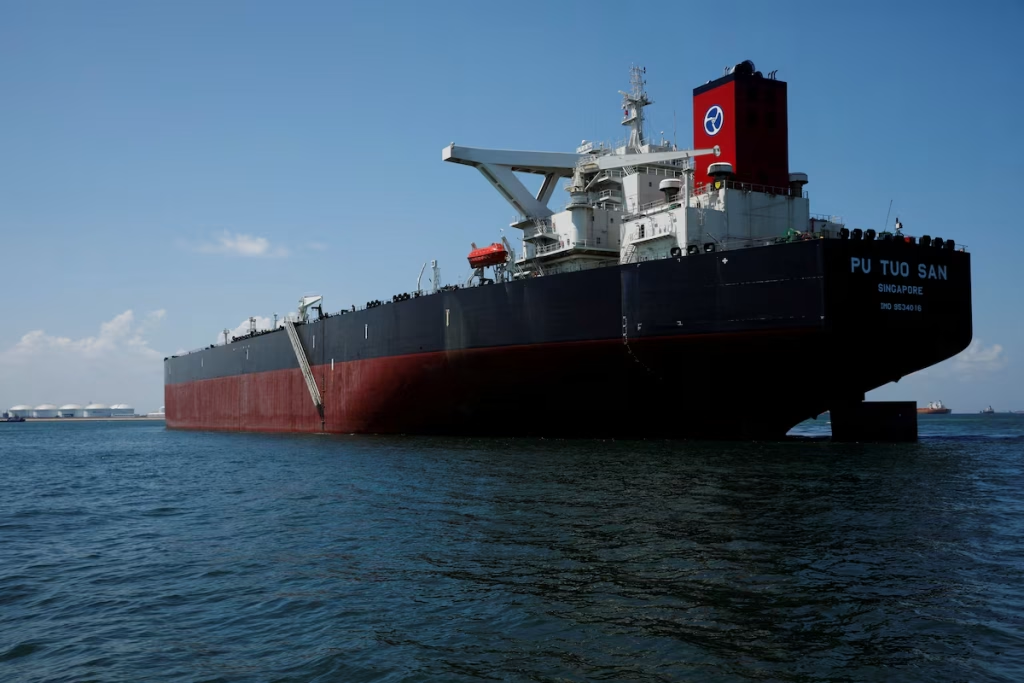
Malacca Is No Longer Only a Waiting Room
In a disrupted market, Southeast Asian waters become a waiting room for uncertainty. A vessel drifting off Malacca, Singapore, or the nearby approaches may simply be awaiting cargo confirmation, a revised destination, or a risk decision that has not yet matured.
But that is only the visible layer.
Parts of the Malaysia-Singapore approaches, especially waters around the Eastern Outer Port Limits off Johor, have become associated with sanctioned crude transfers, STS activity, cargo blending, and cargo-origin opacity. AP reporting, citing UANI, noted 42 STS transfers of Iranian oil in the EOPL area since late February.
Open-source imagery and vessel-tracking posts from late May also appeared to show Asia-bound crude movements using STS activity around the Malacca approaches. The vessels named in those posts included KISOGAWA, TAMBA, YOHO, ENEOS GLORY, and OLYMPUS. The imagery is useful because it shows the operational layer: waiting tonnage can become transfer tonnage. But it should not be pushed further than the evidence allows.
STS is a legitimate tanker operation when approved, documented, and properly controlled. The issue is not STS itself. The issue is that lawful cargo substitution, waiting tonnage, sanctions-risk opacity, and cargo-origin uncertainty now sit in the same wider geography.
This does not mean every tanker waiting off Malacca is involved in the sanctions trade. That is a lazy conclusion. Instead, the exact same waters now hold lawful waiting tonnage alongside cargo substitution, sanctions-risk exposure, and shadow fleet blending operations.
To the casual screen-watcher, a ship may only appear to be waiting. To the commercial desk, that waiting tonnage represents optionality. To regulators and insurers, that optionality is a risk.
AIS broadcasts position and supports situational awareness, but it does not prove commercial truth or intention. A transponder signal cannot tell whether a vessel is drifting for bunkers, preserving lawful optionality, awaiting orders, or concealing cargo origin. It gives the screen picture but not the commercial truth.
For the bridge-side limits of AIS and emerging digital navigation layers, see VDES and AIS: What Actually Changes on the Bridge.

Waiting Is Still an Operation
Waiting is treated ashore as a commercial pause. On board, waiting is an operation.
This is not shore-side spreadsheet waiting. The ship is still burning fuel, managing traffic, answering commercial messages, maintaining machinery readiness, monitoring weather, and preserving security posture. A drifting tanker off a busy waterway is inside a different risk envelope.
Near Malacca and Singapore, the bridge is never truly empty of consequence. Traffic density remains high, fishing craft move unpredictably, squalls change visibility, and engines must remain available. The bridge team keeps scanning, plotting, and reporting while answering questions from shore that often have no final answer.
When waiting turns into an approved STS operation, the crew is not resting. They are managing fenders, hoses, weather windows, traffic, communications, and pollution risk outside port limits. When waiting remains waiting, the burden is different but still real: provisions, freshwater, garbage capacity, slops, fuel, crew relief, and machinery readiness all become part of the Master’s endurance calculation.
Then comes the human part. The crew reads the news before the next formal circular arrives. Families ask questions before the company has final answers. Relief dates become less certain, and a voyage that looked routine becomes conditional. The Master must absorb this commercial uncertainty without allowing it to leak into discipline, fatigue, or bridge standards.
This is where geopolitics reaches the deck. No one on board needs to be near the missile, the blockade, or the negotiating table to feel the impact. The conflict has already entered the voyage when orders become provisional, risk circulars multiply, and the ship is told to remain ready without being told exactly for what. DeepDraft has also covered the bridge-level consequences of interference and degraded position confidence in GNSS Interference at Sea: Navigating GPS Spoofing in the Strait of Hormuz.
Any Master who has waited for final voyage orders near a major traffic corridor knows the truth – commercial uncertainty never stays ashore. It eventually reaches the bridge.

Ship Selection Becomes the Hidden Story
In normal trading, the question is whether the ship fits the cargo and the port. In a disrupted market, the question widens:
- Is the owner willing?
- Is the flag exposed?
- Is the trading history acceptable?
- Will the underwriters touch it?
- Can the refinery actually process the barrel?
- Can the Master execute the instruction without turning a commercial problem into a navigational, security, or fatigue hazard?
The Master receives the voyage instruction, but the voyage has already survived a gauntlet of commercial filters. War-risk premiums and underwriter appetites may never appear in the night order book, but they influence every line of it.
These filters change the ship’s day. One message delays departure. The next alters transit speed. Another shifts the bunkering port, mandates fresh security protocols, or simply orders the vessel to wait because the cargo, the charter, or the terminal has not settled.
Ashore, these are commercial adjustments. On board, this uncertainty has a different kind of pressure.
The DeepDraft View
The industry is not wrong to avoid Hormuz. No operator can simply ignore war exposure, sanctions, or insurance limits.
The mistake is treating risk avoidance as risk removal.
In a disrupted market, risk is never eliminated; it is converted. Route risk becomes cargo risk. Cargo risk dictates vessel selection. Insurance friction dictates waiting time. And waiting time is ultimately paid for in fuel, machinery hours, and bridge workload.
Ashore, a drifting vessel is just “preserving optionality.” Aboard, that optionality is a relentless operation. The ship remains a live system. The Master must hold the vessel in a state of suspended readiness, managing traffic, security, and crew endurance while waiting for a commercial decision to mature thousands of miles away.
This is what the modern chokepoint has become. It is no longer just a narrow stretch of water on a chart but a chain of consequences. It starts in geopolitics, passes through the refinery desk and lands on the bridge as an instruction to wait.
The ship may be drifting safely off Malacca. But the voyage is already inside Hormuz.
The chokepoint moved before the ship did.

Media Section
Sources
- Reuters, 21 May 2026, reduced Hormuz crossings and sharply lower vessel traffic.
- Reuters, 21 May 2026, Japanese auto exports to the Middle East falling sharply because of war-related shipping disruption.
- U.S. Energy Information Administration, Strait of Hormuz and World Oil Transit Chokepoints data.
- Reuters, April 2026, Japan oil reserve release and search for non-Middle East barrels.
- Argus Media, April 2026, Japan second oil reserve release of about 36 million barrels from May.
- UANI, May 2026, Iran War Shipping Updates on EOPL, Iranian-linked tankers, and STS activity.
- Associated Press reporting citing UANI, May 2026, on Iranian oil STS transfers in the EOPL area off Malaysia.
- Oilprice summary of UANI reporting on Iranian ship-to-ship activity near Malaysia.
- Dr. Hidenori Watanave / Open-Source Intelligence (OSINT) via X (@hwtnv), May 2026, live AIS tracking data mapping Japanese-linked crude tankers (KISOGAWA, TAMBA, YOHO, ENEOS GLORY) and the OLYMPUS executing STS operations at the Malacca anchorages.


Leave a Reply