
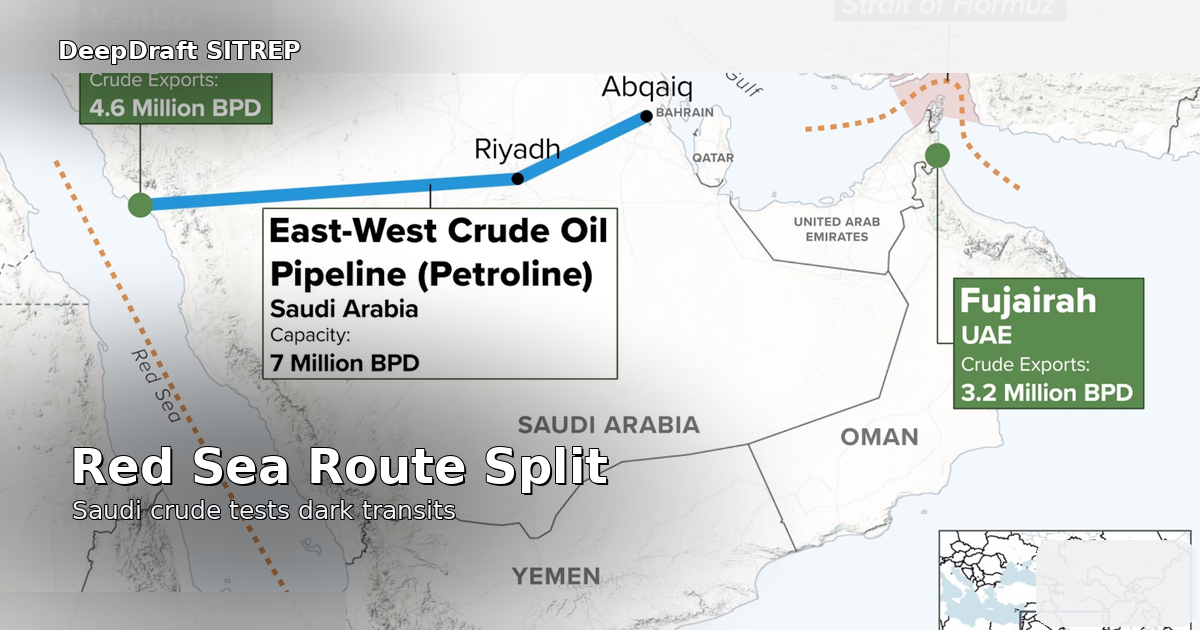
Saudi crude routing has split across the Red Sea security picture, with some tankers turning away from Aden while others crossed Bab el-Mandeb dark.
1. Saudi VLCCs Turn From Aden as Red Sea Routing Splits
• Six Saudi-flagged supertankers changed course in the Gulf of Aden in recent days and headed toward southern Africa after Houthi threats against Saudi shipping.
• The vessels were reported empty after returning from Asia, making the signal a ballast-routing and fleet-repositioning decision rather than a loaded-cargo loss.
• The diversion points to a widening operational split between vessels attempting Bab el-Mandeb passage and tonnage avoiding the southern Red Sea entirely.
• The route change creates immediate exposure for bunker planning, laycan control, insurance approval, deviation accounting and next-employment positioning.
2. AIS-Dark Saudi Cargoes Still Cross Bab el-Mandeb
• Reuters reported that the Suezmax Lesvos, carrying about 1 million barrels of Saudi crude, and the VLCC Desh Vaibhav, carrying about 2 million barrels, exited the Red Sea over the weekend.
• Both vessels were reported to have transited with AIS switched off.
• Desh Vaibhav was reported bound for Sikka, India, while Lesvos had no clear destination in the available reporting.
• Bab el-Mandeb commodity-vessel traffic fell from 28 vessels on Friday to 18 on Sunday, confirming reduced flow through the chokepoint.
• A Panama-flagged tanker carrying Russian naphtha also rerouted around Africa rather than using the Red Sea passage.
3. Yanbu Loading and Market Pressure Keep Red Sea Crude Moving
• Five VLCCs were visible at Yanbu’s oil-loading terminals on Saturday satellite imagery, making it potentially the port’s busiest day since Houthi threats escalated.
• Yanbu activity shows Saudi Red Sea exports have not stopped, but cargo movement is now being managed through selective loading, dark transit and diversion choices.
• Clarksons reported record first-half earnings and linked exceptional trading conditions partly to disruption from the Strait of Hormuz crisis and wider shipping dislocation.
• Chartering desks should now treat Red Sea exposure as a vessel-specific risk calculation, not a blanket open-or-closed route assumption.
4. Hormuz Corridor Talks
• Iran said it is negotiating with Oman over a temporary Strait of Hormuz shipping corridor.
• Iranian reporting described the proposed arrangement as a single two-way route rather than multiple separate lanes.
• Tehran also said the talks alone are not enough to reopen the Strait, keeping vessel-entry decisions dependent on political, security and operational clearance.
• GasLog Shanghai remains the latest DeepDraft-reported Hormuz damage signal, while the corridor talks now add a separate route-design and authorization issue for Gulf voyages.
5. Black Sea Feeder Suspension Extends Route Disruption Beyond the Gulf
• Hapag-Lloyd has temporarily suspended feeder connections to Chornomorsk, Odesa and Pivdennyi because of the deteriorating security situation in the Odesa region.
• The carrier said feeder operators have stopped vessel calls to those Ukrainian Black Sea ports until further notice.
• Cargo planned for those destinations may require alternative discharge, subject to operational feasibility and safety-security assessments.
• Reni is being considered as an alternative discharge option, shifting exposure toward inland routing, documentation, delivery windows and customer-notification obligations.
Strategic Summary & Actions Required
• Masters and CSO teams entering the southern Red Sea should treat Saudi link, cargo origin, charterer exposure, AIS posture and routing instruction as direct targeting-risk factors.
• Ship managers should refresh Red Sea security authorizations before entry, including AIS policy, emergency communications, citadel readiness, fire response and bridge-watch reinforcement.
• Charterers and operators should price Cape diversion, Bab el-Mandeb delay, off-hire exposure, deviation clauses, bunker consumption and war-risk premium into Saudi-linked fixtures.
• Gulf voyage desks should keep Hormuz corridor planning separate from Red Sea routing, because Tehran-Muscat talks do not yet equal an opened or normalized Strait.
• Liner and forwarding teams with Ukraine cargo should confirm whether Chornomorsk, Odesa or Pivdennyi bookings are accepted, suspended, rerouted or moved to alternative discharge.
Operational Status
CRITICAL RED — Red Sea Saudi Tanker Routing Split / AIS-Dark Bab el-Mandeb Transits / Cape Diversion Exposure / Parallel Hormuz Corridor Uncertainty
Latest DeepDraft Analysis
Bonding Is Not Insulation: The Cargo Transfer Checklist Trap
Cargo transfer safety depends on preserving the correct electrical barrier, not simply connecting metal. STS and terminal checks must prove isolation, continuity and controlled current paths.
Related DeepDraft Articles & Analysis
Sources
Reuters, Hapag-Lloyd, IRNA, gCaptain, The DeepDraft
This update is part of the DeepDraft SITREP series covering developing maritime operational situations.





Leave a Reply