
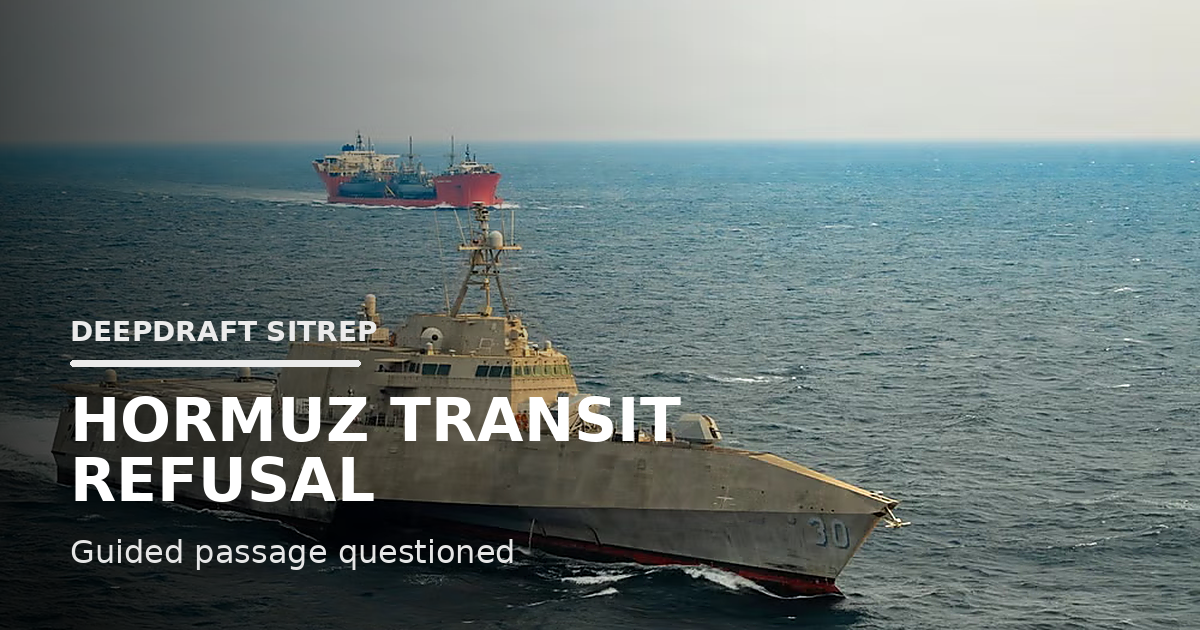
Shipping companies are avoiding U.S.-military-guided Hormuz transits after attacks in Omani waters exposed the limits of escort confidence.
1. Hormuz Transit Refusal Becomes the Lead Operational Signal
• Shipping companies are avoiding the U.S.-military-guided transit scheme through the Strait of Hormuz after a wave of Iranian attacks on vessels raised crew-safety concerns.
• Seven maritime security and shipping industry sources said the attacks have created doubts over whether the U.S.-assisted passage scheme can safeguard commercial vessels.
• Five ships have been attacked in Omani waters since July 7, including three crude supertankers, one LNG tanker and one container ship.
• The traditional Traffic Separation Scheme through the middle of the Strait has been disrupted by mine risk, forcing vessels toward makeshift routes close to the Iranian or Omani coast.
• More than 100 vessels coordinated directly with the U.S. military over the past seven days, according to a U.S. defence official cited by Reuters, but transit volumes remain below pre-war levels.
2. Blockade-Eve Traffic Shows Dark-Transit and Route-Control Pressure
• Windward recorded 41 Hormuz transits on July 14 before the reimposed U.S. blockade on Iranian shipping took effect at 2000 UTC.
• The traffic split was 23 inbound and 18 outbound transits, with all inbound vessels using the Northern Corridor.
• Nine inbound vessels and one outbound vessel went fully dark, while the remainder stayed AIS-visible.
• 37 Iran-flagged tankers and cargo vessels over 100 metres as high-probability blockade-breaker risks before enforcement began.
• Imagery showed nine dark tankers converging on Bandar Abbas roughly 12 hours before enforcement, consistent with a rush to complete Iran-linked transits before the blockade deadline.
Reading this as a maritime insider, seafarer, or enthusiast?
Subscribe to The DeepDraft for maritime analysis, daily SITREP updates, weekly briefings, and operational signals worth watching.
3. Sanctions, Insurance and Charterparty Exposure Widens
• OFAC expanded sanctions against Mohammad Hossein Shamkhani’s shipping and sanctions-evasion network on July 14.
• Treasury said the action covered more than 50 individuals, entities and vessels, bringing the total under Shamkhani patronage to more than 200 sanctioned persons, entities and vessels.
• The network is described by Treasury as a major force behind Iran’s oil exports, with activity extending into containerized shipping and commodities trading.
• Sea Lead Shipping entities, We Freight Shipping, Volta Shipping Services and multiple vessel-owning companies were included in the sanctions action.
• Voyage desks should now treat Iran-linked cargo, ownership, management, charterer, STS history, AIS behavior and port-call history as linked clearance, insurance and sanctions-screening triggers.
4. Luni Casualty Adds Bandar Abbas Safety and Salvage Layer
• Safety4Sea reported that the bulk carrier Luni split in two and partially sank off Bandar Abbas on July 14.
• All 23 crew members were rescued safely.
• The 32-year-old vessel was anchored in the northern section of the Strait of Hormuz when it reportedly suffered water ingress before breaking apart and partially submerging.
• Local reporting cited by Safety4Sea said Luni had allegedly sustained hull damage in a collision several days earlier, but the cause has not been officially confirmed.
• The casualty is not currently linked to military operations, but it adds anchorage, salvage, pollution-watch and port-approach risk near one of the most stressed maritime zones in the Gulf.
Strategic Summary & Actions Required
• Masters approaching Hormuz should not treat “open Strait” statements as voyage clearance. Confirm company authority, route option, naval-contact protocol, UKMTO/JMIC reporting and abort criteria before entering the approach.
• Ship managers should issue written transit authority covering crew-risk acceptance, communications discipline, AIS/GNSS logging, evidence preservation, emergency steering, damage control and post-incident reporting.
• Charterers and operators should review war-risk clauses, deviation authority, off-hire exposure, unsafe-port arguments, sanctions warranties, force majeure language and laycan consequences for Gulf-linked fixtures.
• Compliance teams should rescreen Iran-linked cargoes, ship managers, beneficial owners, charterers, STS histories, AIS gaps and port-call records against the expanded Shamkhani sanctions network.
• Vessels near Bandar Abbas should verify anchorage status, casualty position, salvage activity, pollution warnings and local port instructions after Luni partially sank in the northern Strait area.
Operational Status
CRITICAL RED — Hormuz Transit Refusal / U.S.-Guided Passage Confidence Loss / Dark-Transit and Sanctions Exposure / Bandar Abbas Casualty Layer
Latest DeepDraft Analysis
When Bridge Windows Look the Wrong Way
City of Rotterdam’s SSS-BOW case shows how off-axis bridge windows can corrupt visual reference, turning design approval into pilotage, VTS and bridge-team risk.
Related DeepDraft Articles & Analysis
Sources
Reuters, Windward, U.S. Treasury / OFAC, Safety4Sea, The DeepDraft
This update is part of the DeepDraft SITREP series covering developing maritime operational situations.

Leave a Reply