
Off-Axis Bridge Windows: The Collision Risk Hidden in Modern Ship DesignA bridge window is not passive glass. It shapes how the watchkeeper reads heading, bearing, movement, and risk.
I first noticed the shape during coastal passage off Japan.
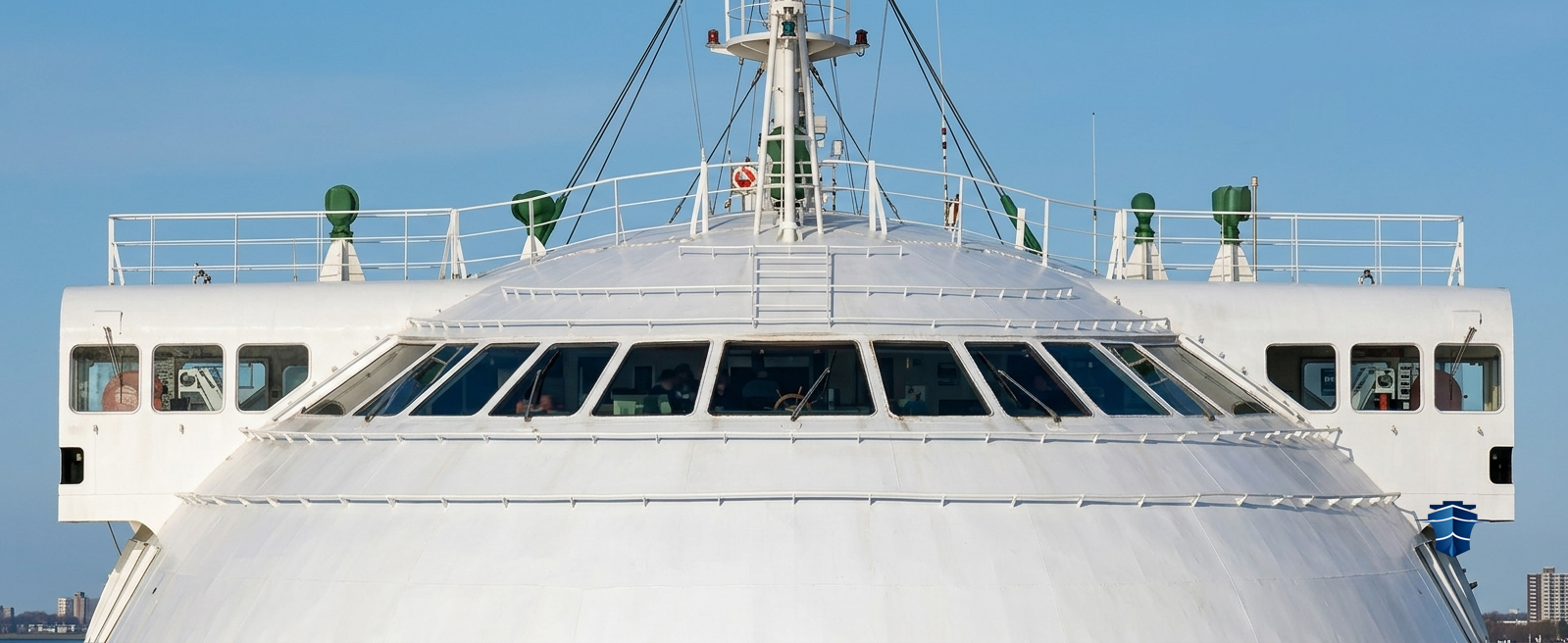
Ahead of us was a small coastal container ship with a rounded forward superstructure, the bridge and accommodation carried right into the bow. From outside, it looked clever, efficient, and almost futuristic, the kind of ship that makes you stop and look twice.
It was not one detail that caught my eye, it was the whole arrangement.. The vessel looked different from the conventional bridge-and-bow arrangement most seafarers are used to. It raised a simple operational question: when ship form changes that much, how does the bridge team’s visual reference change with it?
That curiosity led me into Kyokuyo’s SSS-BOW concept, then to Natori, and eventually to a much larger vessel with the same futuristic design language: City of Rotterdam. That is where my curiosity stopped being about looks and became about navigation.
City of Rotterdam collided with Primula Seaways on the River Humber in 2015. The UK MAIB later found that the pilot became disoriented after looking through an off-axis bridge window, creating a relative motion illusion.
The age of the case matters less than the design question it left behind.

What the Collision Exposed
The collision itself is well documented in the MAIB report. The value of the case today lies in the design risk it exposed.
The pilot was doing what pilots normally do. He was looking out, communicating by VHF, assessing another vessel, and judging relative movement. The bridge gave him a false frame for judging what he was seeing
MAIB also placed the accident inside a wider bridge-team chain. The pilot’s error escalated because intervention by City of Rotterdam’s Master came too late, and challenges from Primula Seaways’ bridge team and Humber VTS were insufficiently robust. Bridge layout does not remove bridge-team responsibility. It changes the conditions under which challenge must happen.
The bridge front glass sloped the wrong way for normal bridge visibility practice. Top-in rather than top-out. SOLAS bridge-visibility requirements expect front windows to incline top-out between 10 and 25 degrees to reduce internal reflections. City of Rotterdam created the opposite condition. The glass, console, and night reflections all worked against the navigator’s visual reference.
The problem went beyond reflection. A conventional bridge gives the eye physical alignment cues: bow tip, forecastle line, centreline, or forward mast. On City of Rotterdam, the rounded bow form removed that natural reference from the lower field of view. The pilot believed he was reading the ship’s movement. In reality, he had mentally aligned the ship with the window’s direction.
That is what makes this more than a lookout failure. It is a failure of visual-reference integrity inside a bridge team system.

Source – MAIB
Visibility Is Not Visual Reference
The shipping industry has long understood bridge visibility. SOLAS and IMO guidance address field of vision, blind sectors, window arrangements, bridge wings, and conning positions. IMO ergonomic guidance was developed to support reliable and efficient bridge operation through user-centred layout and equipment design.
But seeing out is only half the question.
Visibility asks: can the officer see out?
Visual reference asks: can the officer correctly interpret what he sees?
Electronic aids can support the traffic picture, but the final close-quarters judgement still returns to what the bridge team can confirm visually. In restricted waters, if the window corrupts the immediate visual frame, the primary close-quarters reference is already compromised.
On City of Rotterdam, the VHF position pulled the pilot away from the centreline and placed him at the off-axis window, where the window view could become his perceived heading. The main issue was an operational layout of the window that allowed a working position to distort the navigator’s frame of reference.
The MAIB ergonomics work described the effect directly. Standing at an off-axis window can cause the observer to lose orientation relative to the ship, with objects appearing to move as though the ship were headed in the direction of that window. The simulation evidence made the failure harder to dismiss as individual error. Experienced Humber pilots placed in the same simulated bridge view also accepted the false picture. When the vessel’s movement looked wrong, they read it as set or drift
The brain blamed the sea before it blamed the architecture.

The Jugaad Proved the Design Gap
One small detail in the MAIB report deserves more attention. During observations on the sister vessel, the VHF handset lead had been extended so the radio could be used while standing on the centreline.
No one understands workarounds better than seafarers. In Hindi, this is jugaad. A cord, a painted mark, an extension lead, a label, a taped instruction. These are the small corrections crews make when an approved design does not quite meet real operation.
In this case, the workaround was already part of the operation. During the MPX, the Master had pointed out the centreline cord and advised the pilot where to stand. Here, the workaround was telling. The crew had to alter the communication arrangement so the operator could remain in a safe geometry.
After the accident, Fairmont Shipping installed a bow tip marker ahead of the centre bridge window, increased VHF handset wire length so radios could be used from the forward centreline conning position, posted warnings about relative motion illusion, and added references to spatial awareness into the SMS and pilot information card.
Those fixes are important because they confirm the nature of the problem. The solution was a stronger spatial reference.

Reading this as a maritime insider, seafarer, or enthusiast?
Subscribe to The DeepDraft for maritime analysis, daily SITREP updates, weekly briefings, and operational signals worth watching.
The Correction Proved the Point
The SSS-BOW concept was an efficiency idea, intended to reduce wind resistance above the waterline without sacrificing cargo capacity or accommodation volume.
The important comparison is Natori. MAIB noted that Natori, another Kyokuyo vessel with a hemispherical bow, was fitted with SOLAS-compliant sloping bridge windows on the direction of the Japanese flag administration.
City of Rotterdam shows the weakness in the approval path. Natori shows that the design could be fixed safely when the window arrangement was brought back into SOLAS-compliant design.
The safer arrangement still depended on specific flag-state direction rather than a design category that automatically identified visual-reference risk.
The lesson is simple, unconventional bridge fronts need a human-factors test from the navigator’s actual working position before delivery.
Innovation can continue. The unsafe visual compromise cannot.

The Rule Gap
The MAIB saw the regulatory problem clearly. IACS Recommendation 95 already provides guidance on bridge design, equipment arrangement, and conning positions, but it remains non-binding. It also warned that freedom of interpretation in applying bridge ergonomic principles can allow innovative designs to create unintended human-performance risks.
The uncomfortable point is that this was an approved design path. The bridge-window arrangement was recognised at build stage and accepted through exemption from SOLAS V/22.1.9.1. The risk entered the vessel at design approval stage, before any pilot, Master, or officer ever stood on that bridge.
Approval, exemption, audit, and inspection all existed, but none of them treated visual-reference integrity as a distinct hazard. Natori makes that gap clearer: the safer window arrangement was not technically difficult, but it still depended on specific flag-state direction rather than a dedicated class trigger.
ABS’s 2024 bridge design guide requires an adequate conning position close to the forward centre window, with relevant information readable from that position. That is useful, but the language remains general.
From the publicly available IACS and class material reviewed for this article, there does not appear to be a dedicated category for Non-Standard Bridge Geometry or Visual Reference Integrity.
Class societies should treat unconventional bridge fronts as a specific assessment category. A Non-Standard Bridge Geometry notation, or equivalent review, should require:
- a permanent physical centreline reference in the forward field of view
- essential communications usable from the centreline conning position
- explicit identification of off-axis visual hazards
- simulator or desktop assessment from the actual working positions used in pilotage
The test should be simple: can the officer correctly judge what he sees from where he actually stands?

DeepDraft View
City of Rotterdam was corrected at ship level. The deeper question is whether the industry corrected the design category.
The accident showed that bridge geometry can alter the navigator’s frame of reference. The ship-level fixes acknowledged the hazard, yet regulatory language still appears stronger on visibility than on visual-reference integrity.
This matters because shipping is entering a phase of rapid design change: wind-assist systems, compact superstructures, visibility trade-offs, and efficiency-led forms. Every such change must be tested from the navigator’s actual working position, not only from autocad.
Decarbonisation will bring more wind-assist equipment, compact superstructures, forward accommodation ideas, altered sightlines, and unusual bridge-front forms. Each may make sense on a performance table, but the bridge is where efficiency becomes operational reality.
A rotor, rounded bow, compact accommodation block, or bridge-front shape may save fuel. But if it changes sightlines, blind sectors, or visual reference, that effect belongs in the design assessment before delivery.
A ship only earns her efficiency if she can be safely navigated to the berth.
There is no efficiency in a collision.

Media Section
Sources
- UK MAIB, City of Rotterdam / Primula Seaways, Investigation Report 3/2017.
- MAIB Annexes, ergonomic assessment of off-axis windows and relative motion illusion.
- IMO MSC/Circ.982, Guidelines on Ergonomic Criteria for Bridge Equipment and Layout.
- IACS Recommendation 95, Bridge Design, Equipment Arrangement and Procedures.
- ABS, Guide for Bridge Design and Navigational Equipment/Systems, 2024.
- Kyokuyo Shipyard, SSS-BOW, City of St Petersburg, and Natori technical briefs.


Leave a Reply