
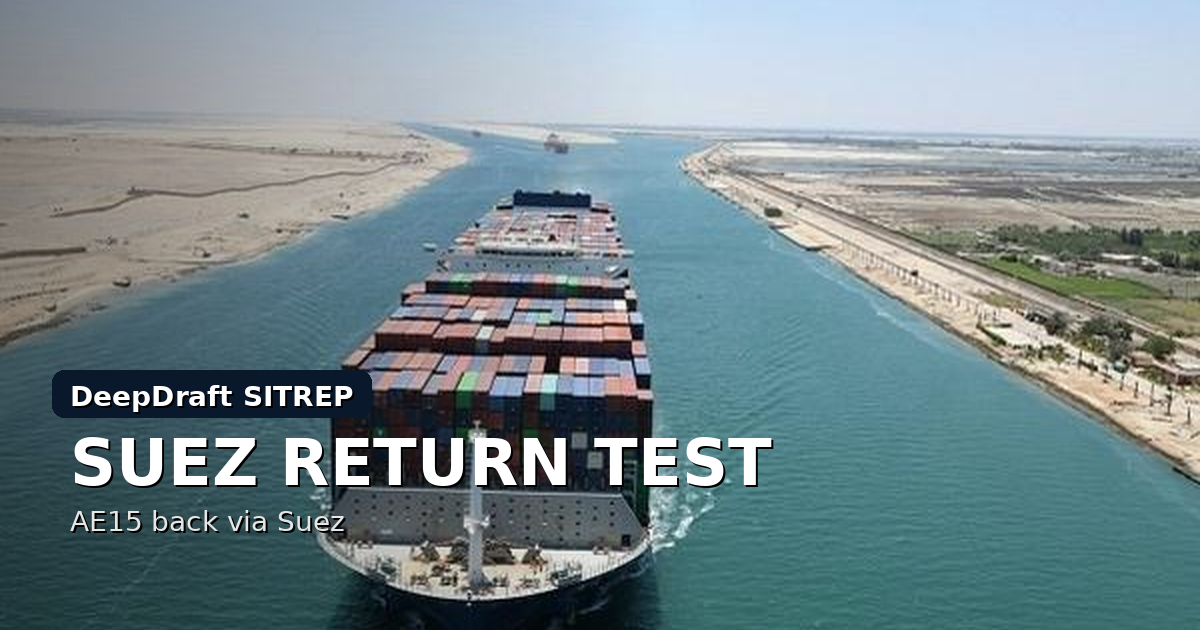
Maersk and Hapag-Lloyd are restoring AE15 through Suez under Gemini Cooperation. The move is a controlled route test, not a full Red Sea normalization signal.
1. AE15 Suez Return Becomes the Lead Operational Signal
• Maersk and Hapag-Lloyd will resume selected Suez Canal sailings under their Gemini Cooperation network.
• The first revised service is AE15, linking Asia, the Mediterranean and Europe.
• The change moves AE15 away from Cape of Good Hope routing and back toward the Suez / Red Sea corridor.
• Hapag-Lloyd said the revised routing will reduce passage duration by about four weeks.
• Maersk said the decision followed security assessment of the Red Sea area, with any future Gemini changes dependent on continued regional stability and absence of escalation.
2. Red Sea Security Remains the Separate Operating Constraint
• The Suez / Red Sea route remains the fastest corridor between Europe and Asia, but it has not returned to routine operating status.
• Most major container operators shifted away from the corridor after Red Sea attacks forced Cape of Good Hope diversions.
• The July 6 DeepDraft SITREP already covered the Hodeidah armed-skiff attack, so that incident should remain context only, not today’s lead.
• Masters and CSO/DPA teams should treat Red Sea passage as selective authorization requiring current threat assessment, BMP review, company route approval and clear diversion triggers.
• Operators should not treat one service restoration as fleet-wide clearance for all Suez / Red Sea exposure.
3. Freight and Tariff-Window Pressure Stay in the Commercial Layer
• Reuters reported Maersk shares down 5.8% and Hapag-Lloyd down 2.7% after the Suez return announcement, reflecting market concern over freight-rate pressure.
• A faster Suez route can release voyage time, improve schedule recovery and reduce the vessel absorption created by Cape diversions.
• Drewry’s World Container Index rose 9% to USD 4,530 per 40ft container on July 2, driven by Transpacific and Asia-Europe rate increases.
• Shanghai to New York rose to USD 7,149 per 40ft container, while Shanghai to Los Angeles increased to USD 5,750 per 40ft container.
• Tariff-window cargo pressure remains a booking and rolling-risk issue, but it is secondary to today’s operational route decision.
4. Panama Canal Draft Reduction Adds a Separate Route-Planning Signal
• The Panama Canal’s maximum authorized draft for Neopanamax Locks will decrease to 14.94 m, or 49.0 ft TFW, from July 24.
• The limit will reduce again to 14.78 m, or 48.5 ft TFW, from August 15.
• The adjustment is tied to Gatun Lake water-level management and expected El Niño pressure in the canal watershed.
• Gatun Locks maintenance will also reduce Panamax booking slots on July 21 and July 22.
• Operators should review cargo intake, booking windows, arrival draft, stowage plans and alternative routing where Neopanamax margins are already tight.
Strategic Summary & Actions Required
• Masters on Suez / Red Sea-linked voyages should obtain written route authority, current threat assessment, BMP alignment, communication plan and diversion triggers before committing to the corridor.
• Ship managers should treat AE15 as a controlled service restoration, not general Red Sea clearance. Review war-risk cover, crew-risk procedures, charterparty routing language and emergency response plans.
• Charterers and operators should recheck laycan, ETA, demurrage, deviation, customer-delivery commitments and freight exposure where Suez routing changes voyage time by weeks.
• Container desks should keep tariff-window pressure and spot-rate movement in the commercial file, but avoid allowing rate urgency to override security clearance or Master’s assessment.
• Panama Canal users should verify authorized draft, booking slot status and cargo intake before finalizing Neopanamax transit plans for late July and August.
Operational Status
RED – Selective Suez / Red Sea Return / AE15 Route Test / Panama Draft Reduction / Security and Cargo-Planning Controls Required
Latest DeepDraft Analysis
Similar-Size VLCC STS: The Risk After All Fast
Similar-size VLCC STS is a controlled-risk operation where timing, relative motion and abort discipline decide whether two large hulls remain manageable.
Related DeepDraft Articles & Analysis
Sources
Reuters, Drewry, Kuehne+Nagel, Safety4Sea, The DeepDraft
This update is part of the DeepDraft SITREP series covering developing maritime operational situations.

Leave a Reply