
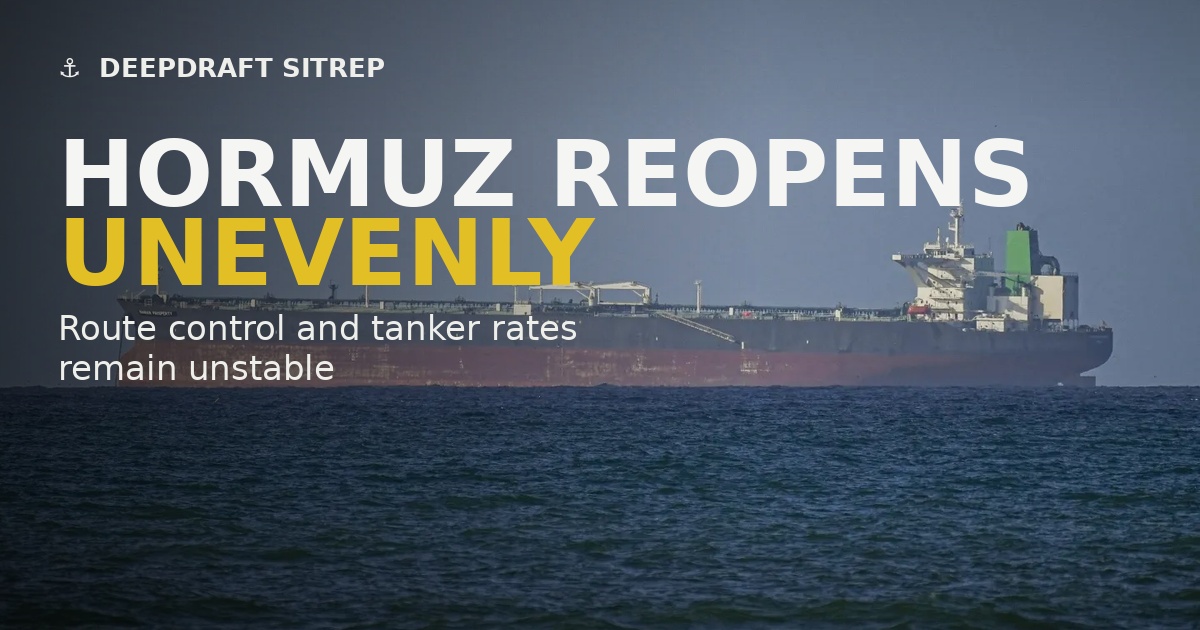
Hormuz traffic is rebuilding, but the operating picture has not normalized. Tankers are returning while route authority, Iranian fleet movement and charterparty exposure remain live.
1. Hormuz Flow Rebuilds Before Cargo Normalizes
• Reuters reports tanker traffic through Hormuz is partially recovering after the sharp post-strike slowdown.
• Around 24 commodity vessels crossed the Strait on Monday, while several supertankers re-entered the Persian Gulf.
• Returning oil-tanker capacity was reported at about 11 million barrels, signalling renewed owner and charterer appetite for Gulf loading.
• Cargo recovery remains incomplete, with reported volumes still below pre-conflict levels and operators pricing the reopening as fragile rather than normal.
2. Route-Control Fight Hardens After EVER LOVELY Strike
• Iran warned that only Iranian-designated Hormuz transit routes were authorized and that vessels must maintain contact with Iranian naval authorities during passage.
• EVER LOVELY was later struck while using the Omani / UKMTO-supported southern route, turning the route dispute into a direct operational risk for owners, Masters, charterers and insurers.
• PGSA-linked statements warned that vessels outside designated routes would not receive safe-passage guarantees and that consequences would fall on the owner, operator and vessel commander.
• Oman has clarified that any corridor arrangement must preserve freedom of navigation under international law and that Hormuz transit fees are not supported as a standing passage condition.
3. Iranian-Flagged Fleet Redeployment Moves Toward EOPL and Asian Routes
• UANI reports that at least 35 Iran-flagged tankers have reached Southeast Asian waters bound for the Eastern Outer Port Limits anchorage off Johor since the conflict began.
• SONIA I transited the Malacca Strait toward EOPL laden with Iranian crude, following DIONA and HERO II after the lifting of the U.S. blockade.
• UANI also reports that at least 42 Iran-linked tankers reporting empty have begun attempts to return to Iran from the Malaysian EOPL area and Southeast Asian sea lanes.
• At least 30 Iranian-flagged cargo ships have departed Iranian waters, including reported sailings toward India, Sri Lanka, China and Malaysia.
4. Tanker Market Reset: VLCC Earnings Fall as Ballast Tonnage Returns
• Reuters reported VLCC Middle East-China earnings falling to about USD 287,000, down from more than USD 500,000.
• The rate move shows vessel supply returning faster than confirmed Gulf export volumes.
• Charterers are beginning to price recovery, but the gap between tanker repositioning and actual cargo flow keeps laycan, demurrage, war-risk and deviation exposure active.
• Tanker desks should avoid treating the lower freight print as full normalization until loading reliability, insurance appetite and route-clearance conditions are confirmed.
5. Container and E-Commerce Logistics Stay Under Disruption Pressure
• Maersk raised full-year 2026 guidance after sustained spot-rate strength and strong demand, especially from the Far East.
• The carrier now expects underlying EBITDA of USD 8 billion to USD 10 billion and underlying EBIT of USD 2 billion to USD 4 billion.
• The guidance confirms that Red Sea avoidance, Gulf disruption, early peak-season movement and vessel-supply imbalance remain commercially material for liner operators and shippers.
• The EU’s fixed EUR 3 customs duty on low-value consignments below EUR 150 takes effect on July 1, 2026, adding customs-declaration, classification and billing exposure for e-commerce cargo entering Europe.
Strategic Summary & Actions Required
• Masters transiting Hormuz should maintain enhanced bridge readiness, preserve AIS, VDR, VHF and routing evidence, and escalate any clearance, fee or route instruction before compliance.
• Ship managers should treat the reopening as controlled-risk transit, not normalization, with war-risk cover, P&I guidance, voyage orders and emergency triggers confirmed before Gulf entry.
• Charterers and tanker operators should price the VLCC rate correction cautiously, with laycan, deviation, demurrage, sanctions and off-hire language reviewed against fragile loading recovery.
• Compliance teams should screen Iran-linked voyages, EOPL movements, ship-to-ship exposure, ownership links and cargo documentation before accepting fixtures or cargo instructions.
• Forwarders, NVOCCs and liner customers moving EU e-commerce cargo should verify customs classification, IOSS handling, customer billing and delivery-window commitments under the new EUR 3 duty.
Operational Status
RED — Hormuz Partial Recovery / Contested Transit Authority / Iranian Fleet Redeployment / Tanker Rate Reset / Customs and Liner Disruption Pressure
Latest DeepDraft Analysis
Slime or Barnacles? Why Ships Foul Differently in Hormuz
https://thedeepdraft.com/2026/06/29/slime-or-barnacles-why-ships-foul-differently-in-hormuz/
Hormuz delays are creating different hull-fouling outcomes across ships, depending on coating history, idle exposure, water conditions and remaining antifouling margin.
Related DeepDraft Articles & Analysis
Sources
Reuters, UANI, Al Jazeera, gCaptain, The DeepDraft
This update is part of the DeepDraft SITREP series covering developing maritime operational situations.

Leave a Reply