
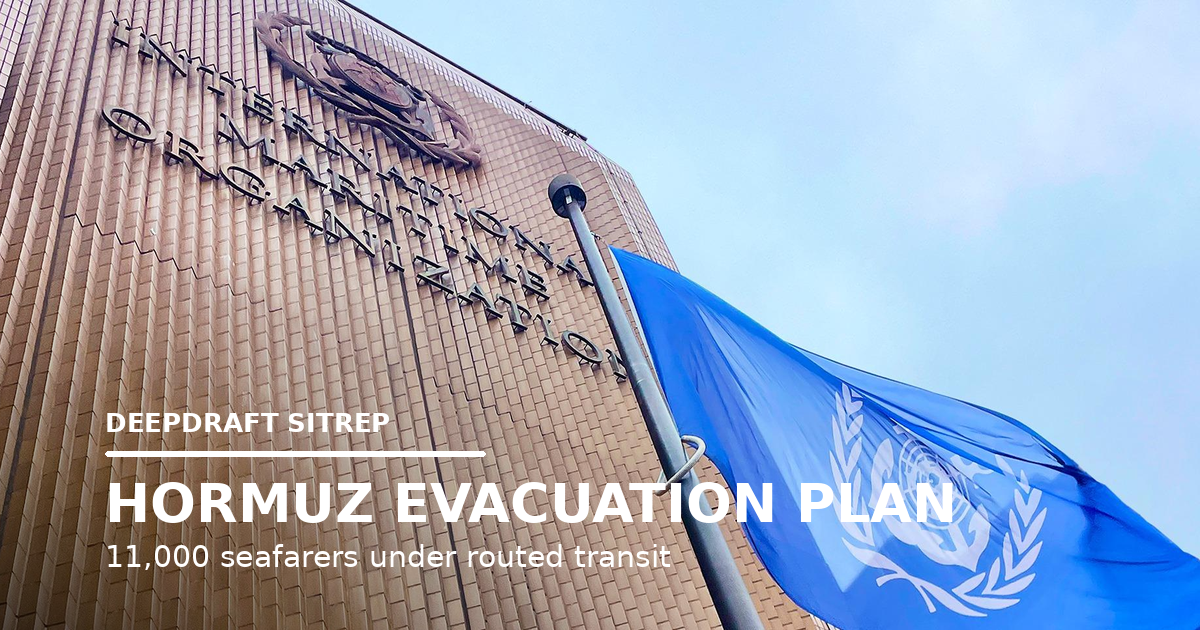
IMO has moved the Hormuz crisis from waiting risk into controlled evacuation.
Hundreds of ships now face allocated passage, temporary routing and shore-authorized transit control.
1. Hormuz Evacuation Plan: IMO Starts Contacting Stranded Ships
• IMO has announced an evacuation plan for ships and seafarers trapped inside the Persian Gulf, with the operation linked to safe passage through the Strait of Hormuz.
• Reuters reports the plan covers hundreds of vessels and about 11,000 seafarers, with ships to be contacted individually and assigned phased transit days.
• Oman’s notice framework makes the existing Hormuz Traffic Separation Scheme unsafe for routine use and moves passage toward temporary north and south routing under coordinated control.
• Masters remain responsible for independent risk assessment, AIS and LRIT discipline where applicable, VHF compliance and coastal-authority instructions during the evacuation window.
2. LNG and VLCC Movement: Energy Ships Resume Selective Passage
• Reuters vessel-tracking data shows three previously stranded supertankers and seven empty Qatar-linked LNG carriers transited Hormuz as traffic restarted cautiously.
• MarineLink, carrying Reuters reporting, identifies Al Hamra and Mubaraz as having completed two AIS-dark voyages out of Hormuz since the war began.
• The flow signal is selective, not normal. Reuters reports broader Hormuz traffic remains materially below pre-war daily crossing levels.
• LNG and crude desks should treat every Gulf voyage as a controlled transit file requiring route authority, insurance approval, sanctions screening and bridge-team execution discipline.
Reading this as a maritime insider, seafarer, or enthusiast?
Subscribe to The DeepDraft for maritime analysis, daily SITREP updates, weekly briefings, and operational signals worth watching.
3. Commercial Layer: Oil Eases While Container Space Stays Tight
• Brent settled at USD 77.08 and WTI at USD 73.21 on June 23 as traders priced improving Hormuz flows, U.S.-Iran talks and a temporary sanctions waiver.
• Reuters also reported Brent was tracking an 8% weekly fall after the Israel-Hezbollah ceasefire and easing supply anxiety, although Hormuz permission risk remained part of the price structure.
• Green Worldwide’s Week 25 freight update says Trans-Pacific and India-to-U.S. markets remain firm into July, with Pacific Northwest, U.S. East Coast, U.S. Gulf and transshipment-dependent routings under the most pressure.
• The same update says most U.S. East Coast and U.S. Gulf sailings remain fully booked through end-June, keeping cargo-roll, allocation and delivery-window exposure active for shippers.
4. Ras Laffan Safety Layer: Restart Accident Hits Qatar Gas Hub
• Qatar’s Ras Laffan / Barzan gas facility explosion killed 13 people and injured 66, according to Reuters and AP reporting.
• The incident occurred during restart operations after a maintenance shutdown, and Qatar’s energy minister described it as an accident rather than sabotage or hostile action.
• Qatar said LNG exports, Ras Laffan port and wider logistics operations were not affected, but the casualty reinforces restart-risk exposure at critical energy infrastructure.
• Ship managers and LNG desks should separate terminal-export continuity from facility-safety exposure, crew-transfer risk, port-call verification and local emergency-response constraints.
5. Alternative-Fuel and Technical Layer: Ammonia and Hydrogen Milestones Advance
• Fortescue and CMB.TECH signed a charter agreement for up to 12 ammonia-capable Newcastlemax bulk carriers of 210,000 dwt each.
• Up to three vessels are expected with dual-fuel ammonia engines by end-2026, while nine are planned as ammonia-ready for later conversion.
• Lloyd’s Register issued the first Type Approval Certificate for BeHydro’s 100% hydrogen-fuelled, spark-ignited marine engine, confirming safety, performance and reliability compliance for marine use.
• These are not today’s highest-risk signals, but they matter for technical managers because alternative-fuel readiness is moving from concept into chartered tonnage, class approval and crew-competence planning.
Strategic Summary & Actions Required
• Masters assigned Hormuz passage should treat the transit as a controlled evacuation, not a routine TSS crossing, and verify route allocation, AIS/LRIT status, VHF instructions, passage plan amendments and abort criteria before movement.
• Ship managers, DPA/CSO teams and insurers should require documented voyage authority for every Gulf exit, including coastal-state instructions, war-risk cover, P&I position, charterer approval and emergency communication chains.
• Charterers and operators should price Hormuz voyages against delayed evacuation slots, AIS-dark risk, routing limits, sanctions exposure, off-hire language and market volatility rather than assuming restored free-flow traffic.
• LNG, tanker and container desks should separate energy-flow restart from full normalization, while also managing Trans-Pacific roll risk, end-June space constraints and delivery-window exposure.
• Technical managers should record Ras Laffan restart-risk lessons and alternative-fuel approval milestones inside fleet safety, fuel-transition and crew-training planning.
Operational Status
CRITICAL RED – Hormuz Evacuation / Temporary Routed Transits / TSS Unsafe / Crew, Energy-Flow and Insurance Authorization Required
Latest DeepDraft Analysis
Ajay Pant’s Smyrtos charge turns shadow-fleet enforcement into a command-risk warning, where sanctions exposure, flag doubt and shipboard records can reach the Master personally.
https://thedeepdraft.com/2026/06/22/the-shadow-fleets-human-firewall/
Related DeepDraft Articles & Analysis
Sources
IMO, Reuters, MarineLink, Green Worldwide Shipping, AP, Lloyd’s Register
This update is part of the DeepDraft SITREP series covering developing maritime operational situations.

Leave a Reply