
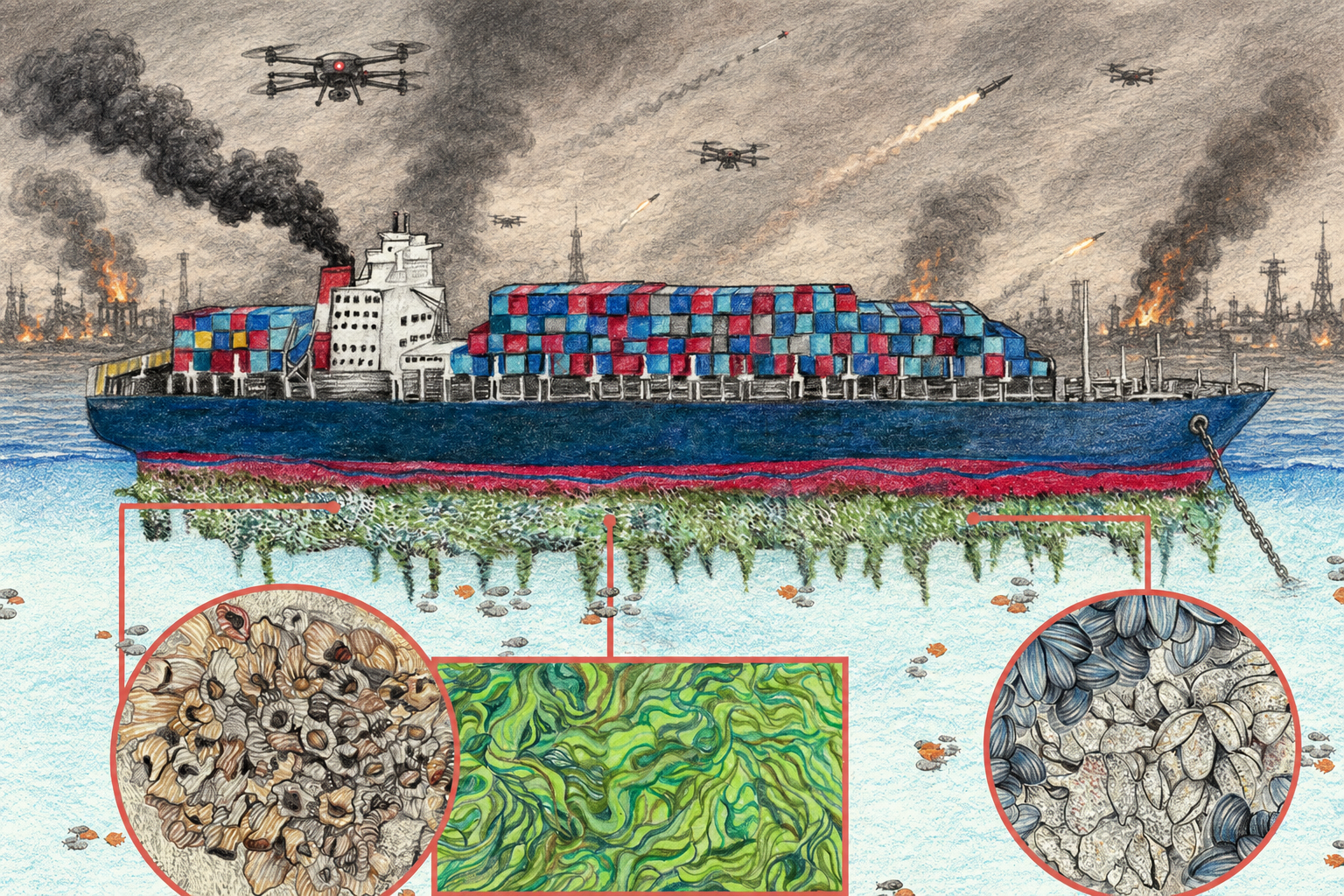
My first serious encounter with biofouling was at Teluk Semangka, Indonesia, where my vessel, a modern VLCC, was deployed as a storage tanker for 1.5 months. On paper, it was a straightforward operation with maintain position, change anchors every 15 days, perform routine maintenance, and resume normal service when required. The crew planned on enjoying shore leave and local Luwak coffee, but the anchorage had other plans.
The fouling we experienced was phenomenal, with a thick, calcified crust across the hull that far exceeded the light growth seen during normal trading. Up close, the organic decay carried that unmistakable, pungent stench of rotting marine life. Fully crewed, classed, and insured on paper, she was still no longer the same vessel beneath the waterline.
Editor’s note: A follow-up analysis is now available on why some ships in the same waters report only slime while others develop barnacles.
Read Part 2: Slime or Barnacles? Why Ships Foul Differently in Hormuz.
This experience now has direct relevance to the Hormuz standoff. Reuters reported on 27 May that around 20,000 seafarers remained aboard vessels in the Gulf, while daily transits had fallen from a pre-crisis average of 125 to 140 to about 11 in late May. While the commercial market asks when ships will move, a Master must ask: what condition will they be in when ordered to move?
This is the underwater consequence of the same Hormuz transit risk examined earlier in HORMUZ STRAIT – Routing Shift, Mine Risk, and the Cost of Transit in 2026.

The Gulf Is Not a Neutral Waiting Room
A ship waiting at anchor is not static. She is constantly interacting with an aggressive operating environment. The Persian Gulf provides a harsh combination of high water temperature, high salinity, and prolonged stagnation. This environment can quickly turn a microscopic slime layer into algae, barnacles, tubeworms, and heavy calcareous growth.
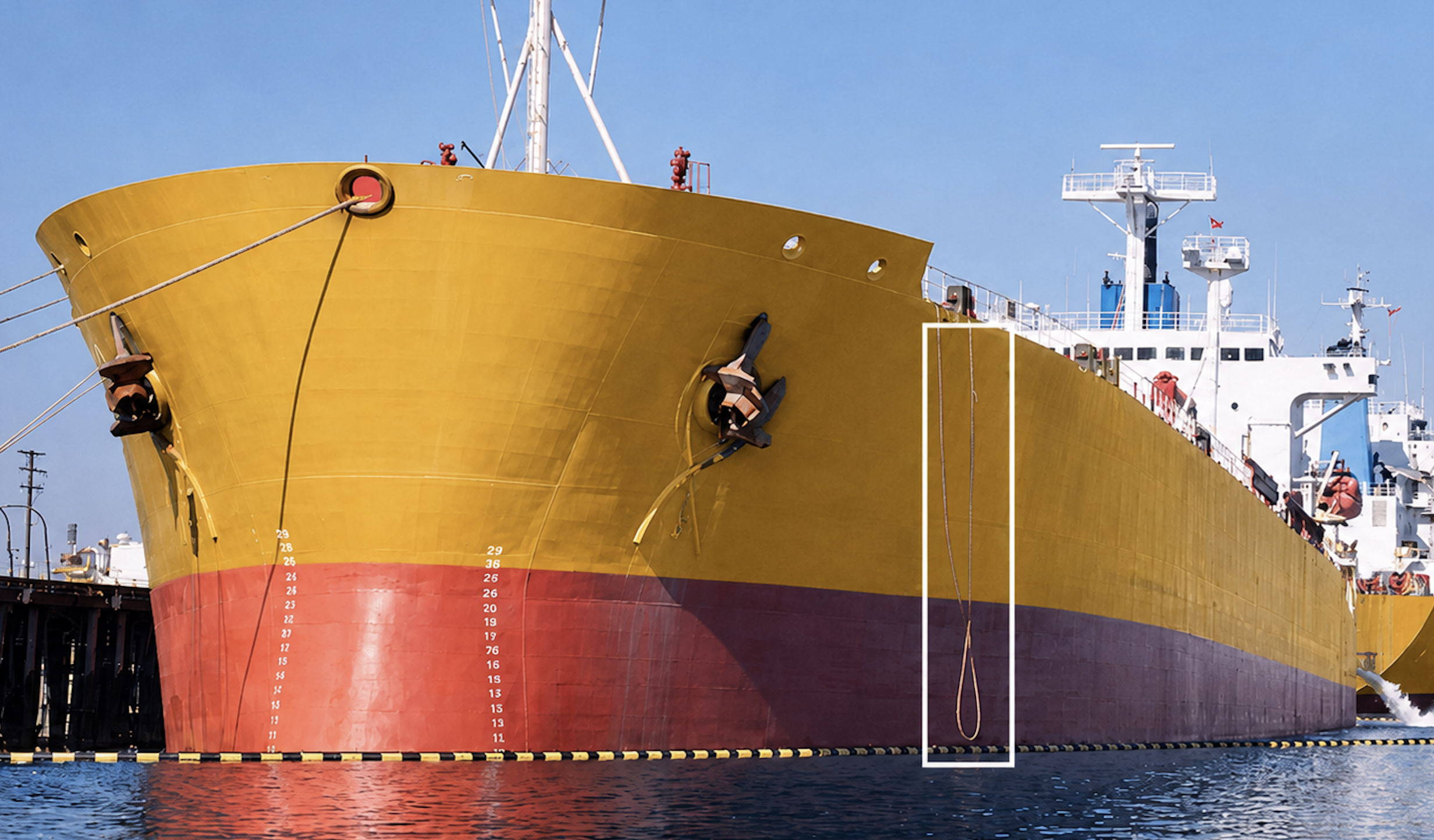
Antifouling coatings are engineered around operating profiles. Many depend on regular movement and water flow across the hull to reduce settlement or help shed organisms. When a ship remains stationary for weeks, the coating is no longer working in the conditions it was selected for, and the fouling risk rises sharply.
The IMO’s 2023 Biofouling Guidelines recognise idle time as a fouling risk and use performance loss as a warning sign. For some ships, a 1% to 3% speed loss or a 3% to 9% fuel-consumption increase may indicate light biofouling, while higher losses may signal greater fouling risk.

The Hydrodynamic Penalty
Biofouling corrupts the energy equation of a ship. Roughness increases frictional resistance, driving up shaft power, fuel burn, and CO₂ emissions. A fouled hull is no longer just a shipyard maintenance item. It becomes a threat to speed, bunker planning, emissions performance, and charter-party confidence.
Hydrodynamic research confirms the scale of this penalty. Tadros, Vettor, Ventura and Guedes Soares modelled hull roughness over ten years of operation by coupling NavCad and Matlab. Their study found that fuel consumption in calm water can increase by around 20% after ten years of operation, depending on hull roughness level, while route-weather modelling showed a 10% increase compared with a clean hull. DNV gives the operational range even more sharply: light slime can increase fuel consumption by up to 20%, while heavy calcareous fouling can drive it up by as much as 85%.
These figures should not be applied blindly to every stranded vessel. But they confirm the direction. Once macrofouling takes hold, clean-hull assumptions no longer stand.
The ship may still sail. The problem is that she may no longer sail as described.

Propeller Fouling and the Loss of Response
If hull fouling increases drag, propeller fouling degrades the quality of thrust. That distinction matters on the bridge.
A fouled propeller may still turn normally, but the ship may not deliver the same speed or acceleration for the same RPM. The feedback becomes duller. The vessel can feel heavy, slower to gather way, and less responsive during manoeuvring. Vibration may also appear at certain RPM bands, forcing both bridge and engine room to work around a narrower operating envelope.
Research into combined hull and propeller roughness demonstrates why both must be evaluated together. Hull roughness has the dominant overall effect due to surface area, but adding propeller roughness produces an additional 1% to 4% increase in the engine loading ratio and a 2% to 4% fuel penalty. CFD studies also show that propeller fouling degrades thrust, torque, and open-water efficiency.
When Hormuz transits resume, crews will not be returning from rest. They will be coming out of weeks of war-risk anxiety, uncertain orders, restricted movement, and watchkeeping under pressure. Most vessels will simply heave up anchor and proceed under the Master’s command into a traffic pattern that may reopen gradually but remain dense, controlled, and commercially urgent. In that situation, a ship that no longer gives the expected speed, acceleration, vibration profile, or engine margin becomes harder to read.
That is where technical degradation becomes a human-factor risk.

Reading this as a maritime insider, seafarer, or enthusiast?
Subscribe to The DeepDraft for maritime analysis, daily SITREP updates, weekly briefings, and operational signals worth watching.
The Sea Chest Is the Real Worry
The hull gets immediate attention from shore-side fuel optimisation teams because fuel loss is easy to plot on a dashboard. The sea chest deserves more respect from an operational safety standpoint. Internal seawater systems are the ship’s life-support network, cooling the main engine, generators, and heat exchangers. When marine growth restricts these intakes, the issue moves quickly from commercial underperformance to machinery limitation.
Technical literature identifies sea chests, inlet gratings, and internal seawater systems as vulnerable niche areas where macrofouling can restrict critical seawater flow. Research published in Frontiers in Marine Science confirms that organisms and larval stages can enter these systems and accumulate, particularly when normal flow conditions are reduced during stationary periods.
A restricted seawater intake narrows the engine-room margin. Strainers may load faster, sea suctions may need to be changed, filters may require repeated cleaning, differential pressures must be watched closely, and RPM may need to be reduced to keep cooling temperatures under control.
A ship that cannot cool herself cannot safely deliver power.
Before any stranded vessel heaves up anchor, the primary question cannot simply be, “How dirty is the hull?” The team onboard must verify whether sea chest gratings are clear, whether sea strainers are loading faster than normal, whether MGPS remains effective, whether main engine and auxiliary cooling temperatures are stable under load, and whether abnormal vibration appears at normal service RPM.
That is the line between a ship that can turn her shaft and a ship that can safely perform.

Charter Party Reality and the Forensic Trail
The commercial market understands that biofouling can alter a vessel’s performance description. BIMCO’s Hull Fouling Clause 2019 specifically addresses extended idling in Tropical and Seasonal Tropical zones, with a default 15-day threshold if the parties have not agreed otherwise. For vessels waiting inside the Gulf, weeks of stationary exposure may make pre-crisis speed and consumption assumptions unreliable until the underwater condition is verified.
This shifts the conflict from opinion to evidence. Masters and Chief Engineers cannot rely on verbal explanations once underperformance claims begin. Every commercial defence will require a defensible data trail.
When lawyers, owners, charterers, and technical managers review the case later, the vessel’s position will stand or fall on noon reports, fuel-change records, RPM against actual speed, calculated slip, strainer-cleaning frequency, cooling-water temperatures, cooler differential pressures, vibration records, diver inspection reports, ROV footage, and Letters of Protest where required.
The fouling problem begins below the waterline, but the second battle will be fought through paperwork.

Cleaning and the Double Blockade
When the Strait reopens, the first queue will be for safe physical passage. The second queue may form below the waterline.
Some vessels will look for underwater inspection and cleaning support near regional bunkering and repair hubs. Many others will clear Hormuz and proceed toward worldwide destinations carrying a mature fouling penalty across normal trade lanes. That wider spread of chokepoint risk into downstream routing was the subject of Hormuz to Malacca: How Chokepoint Risk Reaches the Bridge.
Technical managers will be chasing divers, ROV units, hull condition reports, and cleaning slots at the same time owners seek performance evidence, charterers protect their position, and destination ports ask harder biosecurity questions.
Cleaning is no longer a simple matter of sending divers down with brushes. IMO treats biofouling as a major pathway for the transfer of invasive aquatic species, and its 2023 guidelines place stronger emphasis on biofouling management, inspection, cleaning, capture, and disposal. This is part of the wider compliance map discussed in MEPC 84 Outcomes: New ECA and Carbon Framework Delays, where environmental rules increasingly become operational restrictions for ships.
Poorly controlled underwater cleaning can damage coatings and release biological debris or paint residue into local waters. That is why strict jurisdictions will matter. Ports in places such as Australia, New Zealand, and California are unlikely to treat heavy fouling as a harmless operational inconvenience. Depending on local rules and observed hull condition, vessels may face inspection, controlled cleaning, offshore action, or additional biosecurity evidence before normal port operations continue.
A ship that escapes the geopolitical blockade may still meet an environmental blockade at destination.
Escaping the Gulf does not automatically restore normal operation.

The DeepDraft View
The barnacle issue should not be exaggerated or sensationalised; doing so only weakens the operational argument. Most ships stranded for weeks will not suddenly become helpless hulks. The accurate assessment is more useful: the industry may inherit a fleet whose underwater condition no longer matches the performance assumptions on which voyage plans, charter-party terms, bunker estimates, and port schedules were built.
For Masters, the safe assumption is operational degradation until proven otherwise. Do not treat departure as a return to normal sea passage. Build up engine load carefully, compare RPM, speed, slip, vibration, and fuel against known clean baselines, and keep the evidence tight. Every abnormality should be recorded before it becomes an argument ashore.
For Chief Engineers, the immediate priority is inward. Sea suctions, strainers, MGPS condition, cooling-water temperatures, heat-exchanger performance, and auxiliary cooling stability matter before the vessel commits herself to a restricted traffic environment. A ship that cannot cool herself cannot be driven as though she is clean.
For owners, managers, and charterers, the commercial position should be settled before the anchor is aweigh. Arrange underwater inspection, certified cleaning capacity, and diver or ROV evidence early. Treat pre-crisis speed and consumption figures with caution until the hull, propeller, rudder, and sea chests are verified.
Ports and regulators should also understand the risk properly. This is not only a biosecurity issue. It is also a safety issue involving delayed vessels whose cooling margins, propulsion response, and underwater condition may not match the clean profile in the paperwork.
Hormuz may eventually reopen through diplomacy, security guarantees, and insurance approvals. But the fleet will only truly return to normal service when its underwater reality allows it.
Media Section
Sources Reviewed
Current disruption and vessel movement
Reuters reporting on seafarers stranded in the Gulf, IMO concerns, and reduced Hormuz vessel movement.
Marhelm Data AIS-based traffic context and visual reference.
Biofouling regulation and industry guidance
IMO 2023 Biofouling Guidelines, MEPC.378(80).
IMO biofouling management and in-water cleaning guidance.
BIMCO Hull Fouling Clause for Time Charter Parties 2019.
DNV guidance on biofouling, fuel consumption, emissions impact, and niche-area fouling.
Technical references
Tadros, Vettor, Ventura and Guedes Soares, 2022, Assessment of Ship Fuel Consumption for Different Hull Roughness in Realistic Weather Conditions.
Tadros, Ventura and Guedes Soares, 2023, Effect of Hull and Propeller Roughness during Assessment of Ship Fuel Consumption.
Zinati, Ketabdari and Zeraatgar, 2023, research on propeller fouling and hydrodynamic performance.
Davidson et al., 2021, research on biofouling in ships’ internal seawater systems.
Research support
Project Harrison was used for literature discovery and screening on hull roughness, propeller fouling, fuel penalty, sea chest risk, and cooling-system biofouling. Primary conclusions were checked against IMO, BIMCO, DNV, Reuters, and published technical literature.


Leave a Reply