
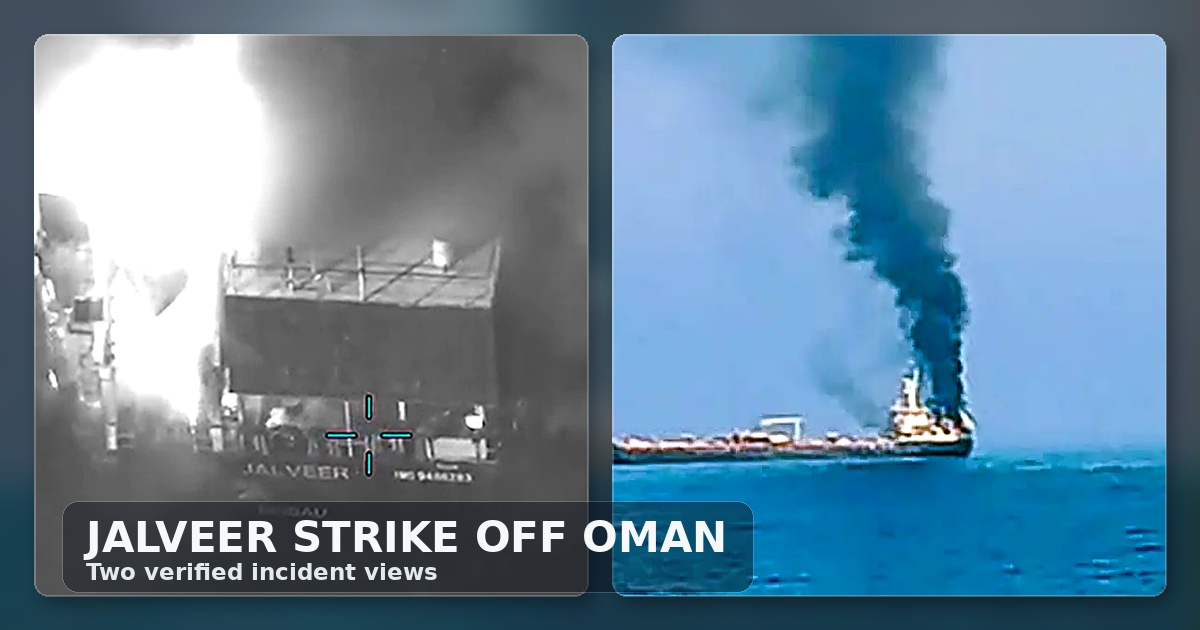
U.S. Gulf enforcement has moved from interdiction risk into fatal crew exposure.
M/T Jalveer is now the third Indian-crewed tanker disabled this week, while India confirms three Settebello seafarers are dead.
1. Jalveer and Settebello: Gulf Enforcement Becomes a Crew-Fatality File
• U.S. Central Command said U.S. forces disabled an oil tanker in the Gulf of Oman at 2320 ET on June 10 after the vessel allegedly violated the blockade against Iran by attempting to transport Iranian oil.
• The vessel has been identified in regional and maritime reporting as M/T Jalveer, a Guinea-Bissau-flagged tanker with 20 Indian crew members onboard. Indian reporting says the crew were safe and evacuation was under way.
• The Jalveer action follows the earlier strike on M/T Settebello, where India has now confirmed that all three missing Indian seafarers are dead. Reuters reports India summoned the U.S. chargé d’affaires and demanded an immediate halt to attacks on ships.
• CENTCOM says Settebello failed to comply with U.S. directions and was carrying Iranian oil. The ship manager denies any Iran link and has demanded an international investigation, creating direct legal and evidence-preservation exposure for owners, managers, charterers and insurers.
The Settebello manager disputes CENTCOM’s account, denying any Iran-linked cargo or voyage breach and challenging whether proper warnings were issued before the strike; treat this as a live evidence-preservation issue for VDR, AIS, VHF, cargo papers, voyage orders and charterparty instructions.
2. Hormuz Movement Continues Under Dark-Transit and Stand-Down Uncertainty
• Reuters reports Lebrethah, Rasheeda and Marigold exited the Strait of Hormuz with transponders off, adding fresh LNG movement to an already distorted Gulf traffic picture.
• Lebrethah and Rasheeda are QatarEnergy-controlled LNG tankers, while Marigold is managed by ADNOC. Reported destinations include Pakistan, Southeast Asia and India.
• Reuters says these movements bring the number of LNG cargoes that have passed through Hormuz since the conflict began to 12, confirming that energy cargoes are moving but under degraded transparency.
• Diplomatic claims of a possible U.S.-Iran settlement remain operationally unproven. Iranian officials have reportedly disputed that any final decision has been made, so Masters should not treat political statements as a stand-down order.
Reading this as a maritime insider, seafarer, or enthusiast?
Subscribe to The DeepDraft for maritime analysis, daily SITREP updates, weekly briefings, and operational signals worth watching.
3. Panama Draft Cut Adds El Niño Routing and Stowage Pressure
• The Panama Canal draft signal is now a separate routing issue for operators already exposed to Gulf uncertainty.
• Reporting based on Panama Canal Authority action says the Neopanamax draft limit will be cut to 49.5 feet / 15 meters from July 1 as a precaution linked to water levels and El Niño risk.
• The restriction creates immediate planning exposure for container, LNG, LPG, dry bulk and vehicle-carrier desks using Panama as a U.S. East Coast, Gulf, Caribbean or Asia routing option.
• Operators should check booking windows, stowage plans, arrival draft, canal reservation terms, alternate routing economics and charterparty language before locking July transits.
4. BIMCO Biofuel Clause Adds Charterparty Fuel-Handling Control
• BIMCO’s biofuel clause work is directly relevant to time-charter fixtures where owners and charterers need clearer allocation of risk around blended fuels.
• BIMCO says the clause is intended to address definitions, blending, safety, technical requirements and industry feedback for biofuel use under time charter parties.
• Ship & Bunker reports the proposed clause sets ISO-aligned fuel standards and practical rules for sampling, testing, storage and handling.
• Technical managers should review bunker procurement, fuel-changeover instructions, tank segregation, sampling records, stability management and engine-maker limits before accepting biofuel stems under time-charter employment.
5. China Vehicle Export Surge Tightens Ro-Ro and Container Demand Signals
• China’s passenger car exports jumped 73% year-on-year in May to about 809,000 vehicles, according to AP reporting on industry data.
• New-energy vehicle exports more than doubled to about 435,000 units, adding pressure to Ro-Ro capacity, containerized auto-parts flows, port yard planning and tariff-frontloaded shipping demand.
• The export surge is not today’s dominant operational risk, but it matters for carriers, terminals, forwarders and charterers already managing Gulf disruption, Panama draft pressure and volatile long-haul routing.
Strategic Summary & Actions Required
• Masters and CSO/DPA teams with Gulf, Oman or Hormuz exposure should treat blockade enforcement as a live crew-safety threat, not only a sanctions issue, and preserve AIS, VDR, VHF, voyage orders and cargo documents.
• Ship managers and crewing departments using Indian seafarers should review crew-location exposure, emergency contact protocols, evacuation arrangements, flag reporting and family-notification chains for Gulf voyages.
• Charterers, operators and insurers should screen Iran-linked cargo, ownership, routing, payment and port-call history before fixing or continuing voyages through Oman, Hormuz or Gulf approaches.
• LNG, tanker and container desks should separate political de-escalation claims from operational proof and require verified naval, flag, insurer or port instructions before resuming normal routing assumptions.
• Panama-bound vessels should recalculate July draft, cargo intake, canal booking risk and alternate routing economics before final stowage or charterparty performance commitments.
Operational Status
CRITICAL RED – Gulf of Oman tanker strikes / Indian crew fatalities / Hormuz dark-transit risk / Panama draft restriction / Active voyage, legal and crew-safety exposure
Latest DeepDraft Analysis
Prolonged Gulf delay can turn hull fouling into speed loss, fuel penalty, manoeuvring degradation and charterparty exposure once vessels resume service.
Related DeepDraft Articles & Analysis
Sources
CENTCOM, Reuters, India Ministry reporting, Panama Canal Authority reporting, BIMCO, AP, The DeepDraft
This update is part of the DeepDraft SITREP series covering developing maritime operational situations.


Leave a Reply