
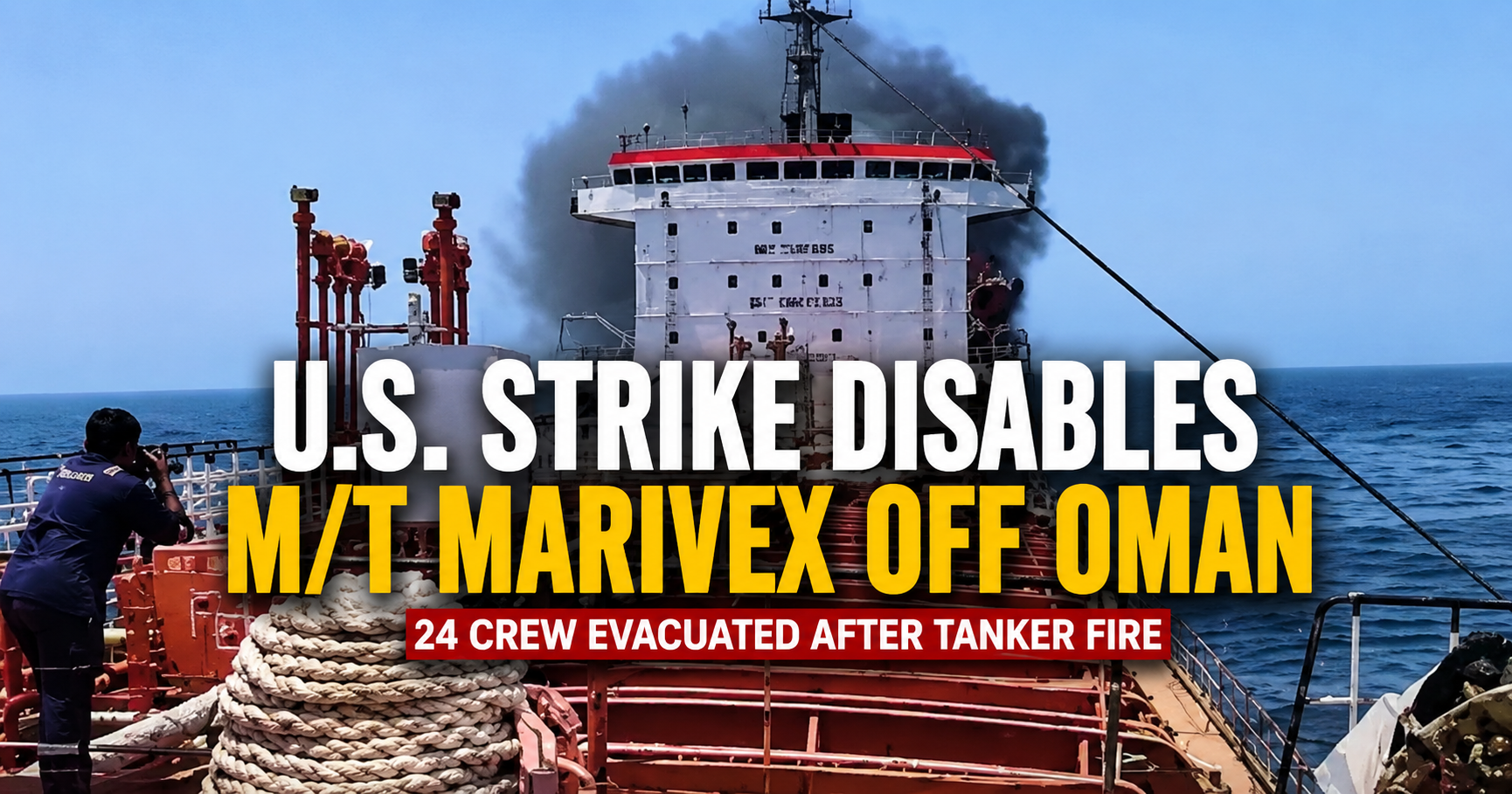
A fire aboard the sanctioned tanker M/T Marivex triggered a full crew evacuation off Oman, adding a fresh casualty and emergency-response dimension to Gulf security risk. The incident places vessel readiness, sanctions exposure and evacuation capability back into focus for operators trading in the region.
1. U.S. Forces Disable Marivex Off Oman
Safe bullet:
• U.S. forces disabled the Palau-flagged M/T Marivex in the Gulf of Oman after reporting that the tanker was moving toward an Iranian port in violation of the blockade.
• The vessel later reported fire off Oman, with all 24 Indian crew evacuated safely.
• UKMTO classified the incident as suspicious, placing the burning vessel about 15 nautical miles northeast of Masirah.
2. Red Sea Threat: Houthis Declare Israeli-Linked Shipping Ban
• Yemen’s Houthis announced a ban on Israeli maritime navigation in the Red Sea.
• The threat increases targeting and misidentification exposure for vessels with Israeli ownership, management, chartering, cargo or port-call links.
• Red Sea transits now require renewed screening before accepting routing, fixture or cargo exposure.
• Operators should treat Red Sea passage as a legal, insurance and security authorization issue, not only a routing decision.
3. Sanctions / Dark Fleet Exposure: LPG Screening Tightens
• OFAC-linked reporting identified new sanctions against entities and LPG vessels accused of moving Iranian-origin LPG.
• The compliance exposure extends to cargo origin, beneficial ownership, AIS history, STS activity and documentary consistency.
• LPG, product and shadow-fleet fixtures require deeper counterparty, cargo and vessel-history checks.
• Charterers should preserve due-diligence records before nomination, fixture approval or port entry.
4. Port-Security Layer: Constanta Drone Detonation Raises Black Sea Berth Risk
• A Ukrainian naval drone detonated at Romania’s Constanta port after being found caught in a pollution-control boom.
• The explosion threw debris into the port area and triggered an investigation into how the drone reached a berth zone near critical maritime infrastructure.
• Constanta handles major Black Sea liquid bulk and grain flows, making terminal-interface security directly relevant for port calls.
• Vessels calling Black Sea ports should verify berth security, boom condition, small-craft exclusion, terminal notices and local naval or port-authority instructions before arrival.
Strategic Summary & Actions Required
• Masters near Oman, Masirah and Gulf approaches should maintain heightened fire, evacuation and security readiness, with suspicious activity logged and escalated immediately.
• Ship managers must verify evacuation capability on high-risk passages, including lifeboats, muster discipline, helicopter transfer readiness and emergency communications.
• Charterers and operators should re-screen Gulf and Red Sea exposure for sanctions, ownership links, cargo origin, Israeli nexus, Iran nexus and dark-fleet indicators.
• DPA, CSO, legal and P&I teams should refresh passage approvals before Red Sea or Gulf transits involving sanctioned, Israeli-linked or Iran-linked exposure.
Operational Status
CRITICAL RED – Gulf of Oman tanker fire / crew evacuation / Red Sea targeting escalation / sanctions-screening exposure
Latest DeepDraft Analysis
The Barnacle Problem Waiting Behind Hormuz
https://thedeepdraft.com/2026/06/08/the-barnacle-problem-waiting-behind-hormuz/
Excerpt: Prolonged Gulf delay can turn hull fouling into speed loss, fuel penalty, manoeuvring degradation and charterparty exposure once vessels resume service.
Related DeepDraft Articles & Analysis
Sources
UKMTO, Reuters, The Maritime Executive, Times of India, Safety4Sea
This update is part of the DeepDraft SITREP series covering developing maritime operational situations.

Leave a Reply