
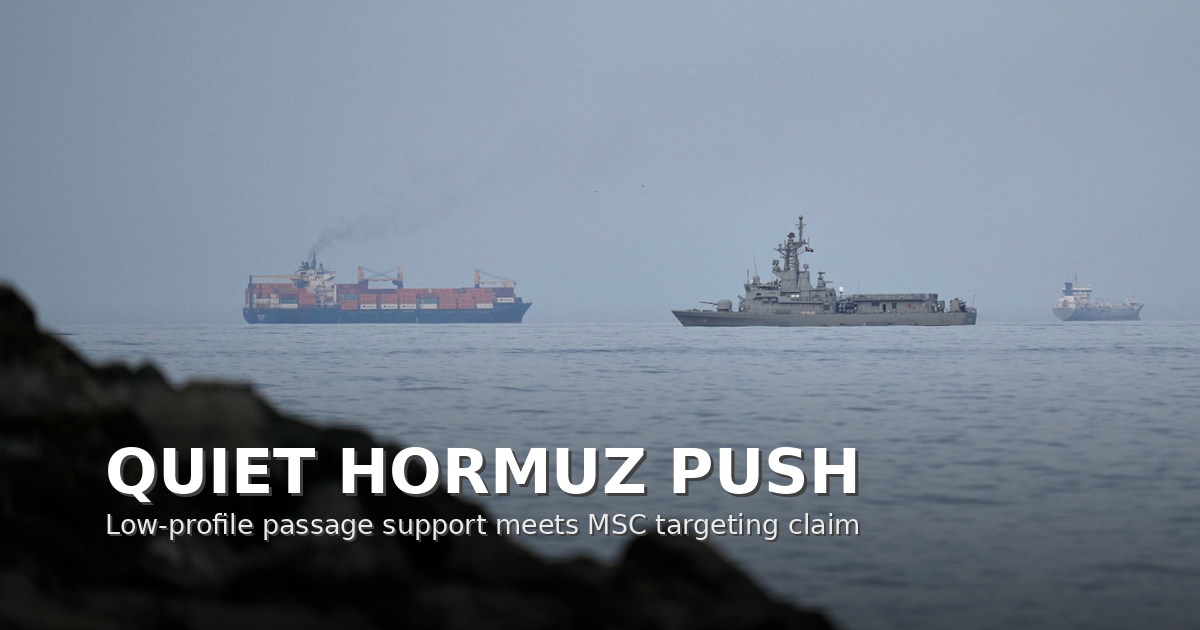
The U.S. is reported to be pursuing a quieter Hormuz reopening model while Iran claims a second MSC-linked container vessel was targeted.
The day’s operating picture now separates into four hard signals: low-profile passage support, liner targeting claims, trapped Gulf tonnage and container detention relief.
1. Quiet Project Freedom: U.S. Moves Toward Low-Profile Hormuz Reopening
• Bloomberg-linked reporting says the U.S. is pursuing a quieter version of Project Freedom, shifting from public convoy signaling toward direct coordination with shipping companies.
• The reported model is lower profile than a visible naval escort operation, with routing support handled through ship-company channels rather than public transit announcements.
• Reporting also describes some vessels moving closer to Oman’s coast during high-risk passages, while others limit AIS visibility during sensitive movements.
• For operators, the change matters because Hormuz passage may now depend less on declared convoy membership and more on voyage-specific coordination, insurance approval, and Master-company communication discipline.
2. Iran Claims Second MSC Targeting: Panaya Adds Liner-Security Pressure
• Reuters reported that Iran’s IRGC said it targeted a vessel identified as Panaya with missiles during its latest regional strike cycle.
• Seatrade Maritime identified the vessel as MSC Panaya, adding a second MSC-linked liner-security signal after the confirmed MSC Sariska V projectile strike at Umm Qasr.
• No MSC confirmation equivalent to the Sariska V statement has been located, so the Panaya case should remain framed as an Iranian claim pending operator, flag, UKMTO or port-state confirmation.
• The claim is operationally relevant because it suggests container shipping is now being used as a signaling target inside the wider Gulf-Hormuz enforcement environment, even where damage or impact remains unverified.
Reading this as a maritime insider, seafarer, or enthusiast?
Subscribe to The DeepDraft for maritime analysis, daily SITREP updates, weekly briefings, and operational signals worth watching.
3. Gulf Fleet Trap: Hundreds of Vessels and 20,000 Seafarers Remain Inside
• Reuters reports hundreds of vessels and about 20,000 seafarers remain stuck inside the Gulf as Hormuz movements remain constrained.
• V.Group said it has 13 vessels caught inside the region, including tankers, and linked safe exit to the need for stronger international guarantees.
• The Bahamas Maritime Authority reported 14 Bahamas-flagged vessels with more than 900 seafarers still inside the Gulf.
• The exposure has moved beyond transit delay into crew endurance, stores, medical support, safe-port planning, war-risk authority, charterparty performance and emergency routing.
4. Commercial / Charterparty Impact: Maersk Adds Jebel Ali-Oman Free-Time Relief
• Maersk’s Hormuz Disruption Update 6 applies from June 4, 2026.
• Merchant-haulage cross-border export shipments where the empty container is picked up at Jebel Ali and loaded out of Salalah or Sohar now receive total free time of 15 days.
• The extension applies automatically where customers have less contracted free time than the 15-day relief period.
• The measure confirms Hormuz disruption is now affecting inland container timing, empty release, gate-in planning, load-port cut-offs, detention exposure and customer delivery commitments.
Strategic Summary / Master Advice
• Masters inside or approaching the Gulf should treat Hormuz as a controlled security transit, maintain strict VHF discipline, preserve VDR/AIS records and escalate any routing, inspection or coastal-state demand before action.
• Ship managers should verify crew endurance, medical access, stores, emergency port options, flag-state position, war-risk cover and safe exit authority before accepting commercial pressure to sail.
• Charterers and operators should review off-hire, deviation, war-risk premium, detention, demurrage, port-closure, force-majeure and non-performance exposure on Gulf-linked voyages.
• Container teams using Jebel Ali-Oman routing should apply Maersk’s 15-day relief to affected bookings and recheck empty pick-up dates, export loading windows and customer delivery terms.
• Owners and insurers should treat the claimed MSC Panaya targeting as a live warning signal, but not as confirmed vessel damage until operator, authority or port-state confirmation is available.
Operational Status
RED — Low-Profile Hormuz Reopening / Claimed Second MSC Targeting / Gulf Fleet Stranding / Container Free-Time Relief / Crew and Charterparty Exposure
Latest DeepDraft Analysis
Sources
Reuters, Bloomberg, Seatrade Maritime, Maersk, MSC, The DeepDraft
This update is part of the DeepDraft SITREP series covering developing maritime operational situations.

Leave a Reply