
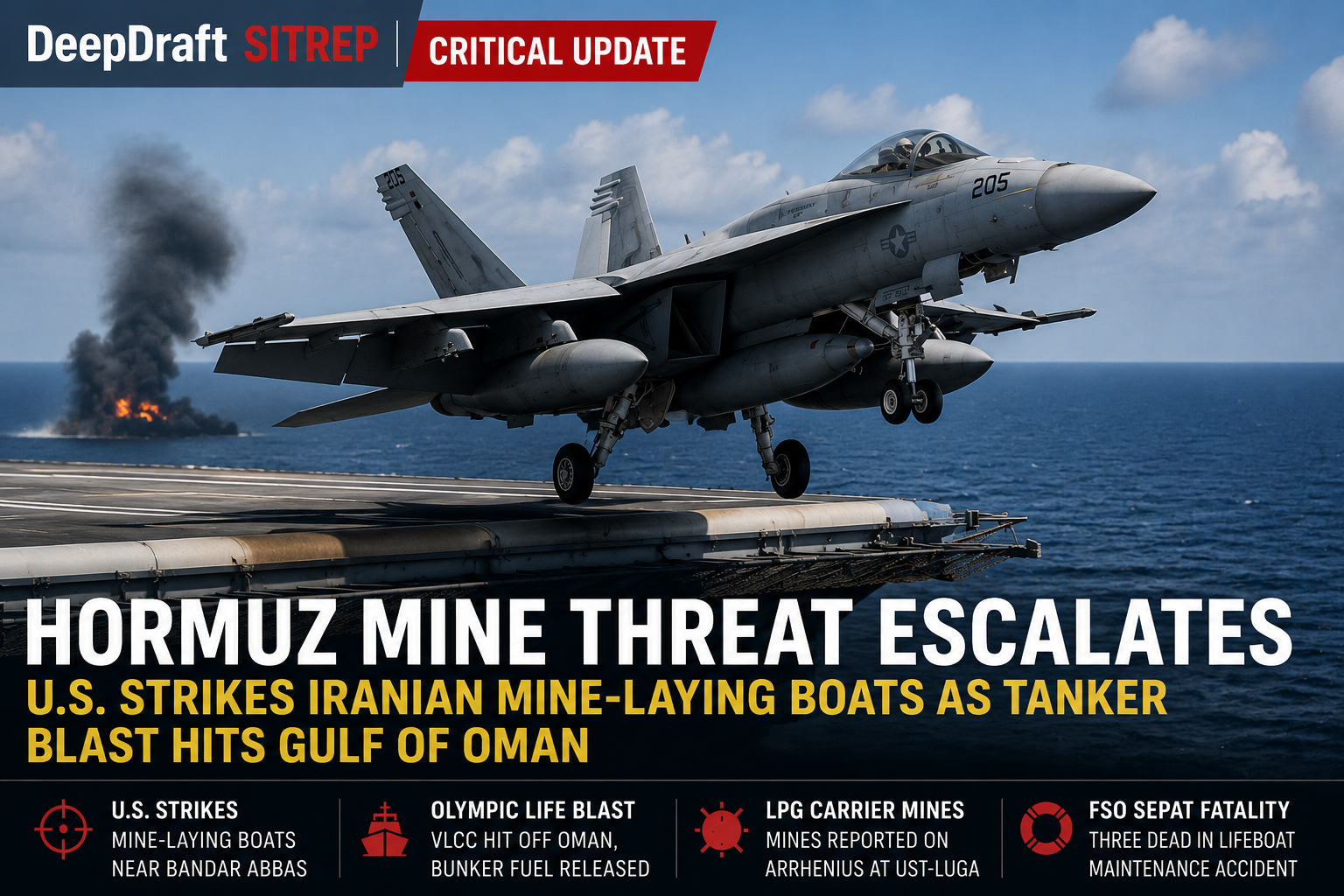
U.S. strikes on Iranian mine-laying boats and missile launch sites have moved Hormuz risk back from permission friction to kinetic navigation threat.
The same 24-hour cycle produced a named VLCC explosion off Oman, a Baltic LPG mine claim and a Malaysian lifeboat fatality.
1. Hormuz Mine Threat: U.S. Strikes Iranian Boats and Missile Sites
• U.S. Central Command said it carried out defensive strikes in southern Iran against boats attempting to lay mines and missile launch sites.
• Reuters reported the strikes took place on May 25 and were described by CENTCOM as action to protect U.S. forces from Iranian threats.
• Seatrade reported the strike area was near Bandar Abbas, placing the development directly inside the Hormuz operating theatre.
• The operational shift is immediate: Gulf transit risk now includes reported mine-laying activity, not only permissioning, toll exposure or clearance delay.
2. Gulf of Oman Tanker Incident: Olympic Life Hit Near Waterline
• UKMTO reported tanker Olympic Life suffered an external explosion on the port side near the waterline about 60 nm off Muscat.
• Reuters reported the crew and vessel were safe, but bunker fuel was discharged into the sea.
• Springfield Shipping said the vessel was struck by an unidentified object at about 0920 GMT, remained stable and operational, and suffered damage to one bunker tank.
• MarineTraffic data cited by Reuters showed the Greek-owned VLCC was not carrying cargo and was sailing out of the Gulf of Oman.
3. Baltic Mine Signal: Arrhenius Explosive Devices Reported at Ust-Luga
• Russia’s Investigative Committee said magnetic mines were found attached to the hull of tanker Arrhenius at Ust-Luga.
• Reuters reported the Liberia-flagged vessel had arrived from Antwerp to load LPG and was managed by UAE-based Maple Mariner Holding.
• Russian officials said the mines were deactivated and claimed they could not have been attached inside Russian territorial waters.
• NATO denied mining any tanker; the claim should be handled as a serious port-security and underwater-inspection signal with contested attribution.
4. Commercial / Market Impact: Oil and Freight Risk Reprice
• Reuters reported Brent settled at USD 99.58/bbl, up USD 3.44 or 3.6%, after renewed U.S. strikes in Iran damaged expectations of near-term de-escalation.
• Higher Gulf risk keeps bunker, freight, insurance and charterparty exposure elevated for owners, charterers and voyage desks.
• Drewry’s World Container Index rose 6% to USD 2,712 per 40 ft container on May 21, led by Asia-Europe rate pressure.
• Drewry also reported Shanghai-Rotterdam up 15% to USD 2,773 per 40 ft and Shanghai-Genoa up 10% to USD 4,082 per 40 ft.
5. Safety Layer: Three Dead in FSO Sepat Lifeboat Accident
• PETRONAS confirmed three contractor personnel were killed and one injured during lifeboat maintenance work on FSO Sepat off Terengganu.
• Reuters reported the accident occurred at about 1250 hrs on May 24.
• The unit is a floating storage and offloading vessel operated by PETRONAS.
• The incident requires immediate fleet review of lifeboat maintenance controls, permit-to-work discipline, stored-energy isolation and contractor supervision.
Strategic Summary (For Masters & Ship Managers)
• Gulf passages now require mine-risk awareness, not only clearance management, with additional attention to waterline impact, drifting objects and suspicious small-craft activity.
• Masters should preserve VDR, ECDIS, AIS, radar, engine-room and deck logs during Gulf of Oman and Hormuz approaches.
• Ship managers should confirm BMP-style watchkeeping, UKMTO reporting, emergency steering readiness, SOPEP response and damage-control checklists before transit.
• Charterers and operators should price possible deviation, war-risk escalation, bunker volatility, delay, off-hire and non-performance exposure into Gulf-linked fixtures.
Advice / Actions Required
• Masters transiting Hormuz, the Gulf of Oman or approaches to Bandar Abbas should maintain enhanced bridge watch, radar plotting, visual lookout and UKMTO reporting discipline.
• Ship managers should issue immediate fleet guidance on mine-threat awareness, waterline damage response, bunker-tank isolation and post-blast evidence preservation.
• Chartering and operations desks should review Gulf voyage orders, war-risk clauses, deviation authority, port-call instructions and insurance notifications.
• Offshore and tanker operators should review lifeboat maintenance permits, contractor work controls, fall-prevention safeguards and crew exclusion zones.
Operational Status
CRITICAL RED — Hormuz Mine Threat / Gulf of Oman Tanker Explosion / Baltic Hull-Mine Claim / Oil and Freight Risk Repricing
Latest DeepDraft Analysis
Sources
Reuters, UKMTO, CENTCOM, Seatrade Maritime, Drewry, PETRONAS, The DeepDraft
This update is part of the DeepDraft SITREP series covering developing maritime operational situations.



Leave a Reply