
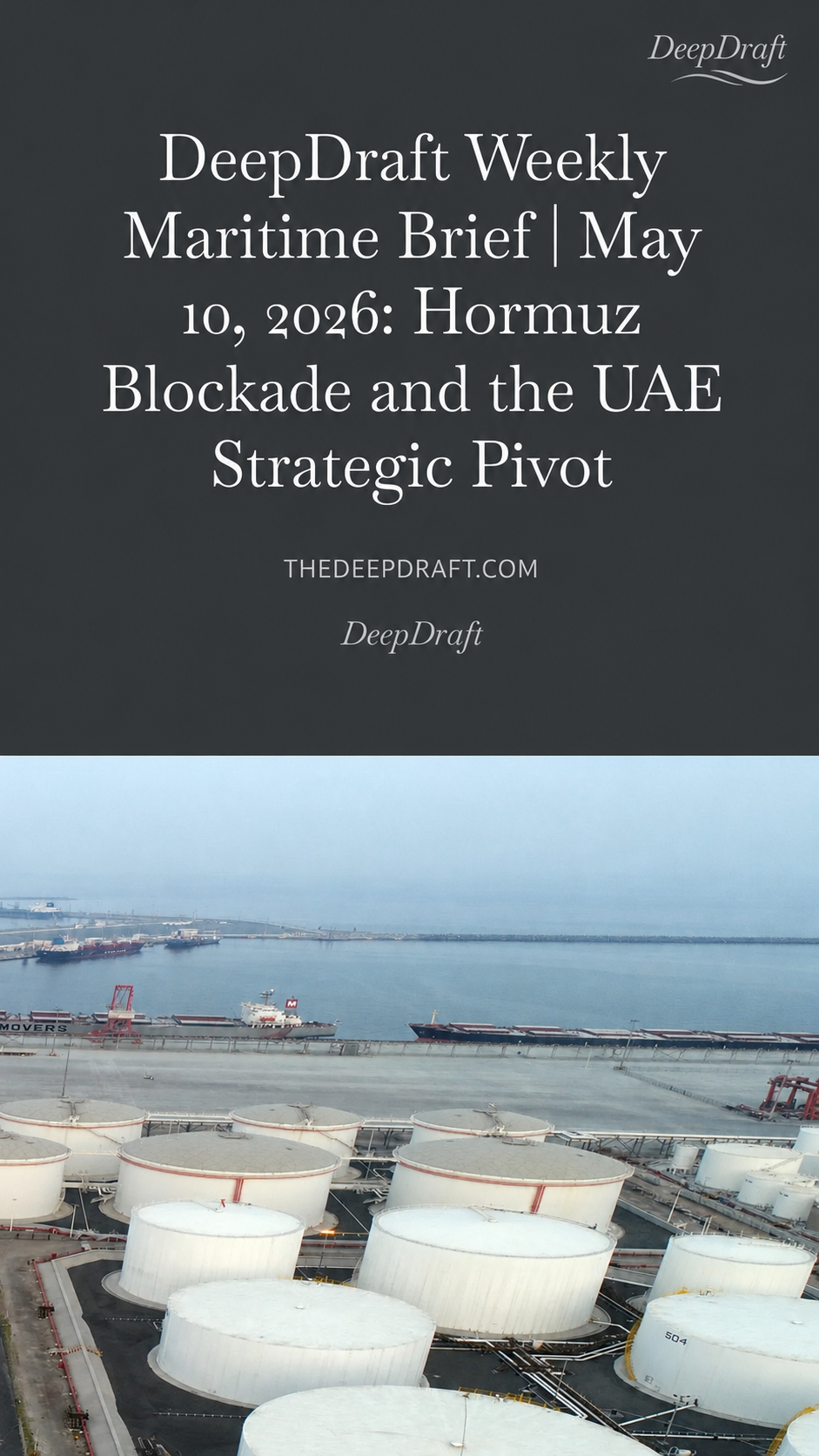
Hormuz is approaching a blockade condition.
This week, the Strait entered a “zero crossing” phase, with more than 1,500 vessels trapped, waiting, or unable to secure safe passage. Kinetic attacks, GNSS degradation, mine risk, and clearance uncertainty have turned Gulf transit into a systemic logistics failure.
At the same time, the UAE’s strategic pivot away from OPEC+ constraints and toward non-Hormuz export resilience has become more significant. Fujairah is becoming the central operational question in Gulf crude logistics.
This week’s brief examines that intersection: a chokepoint entering blockade risk while a major Gulf producer repositions its export strategy around bypass capacity, independent production, and tanker-route resilience.
Weekly Analysis
The primary analysis, UAE Leaves OPEC+ Gulf Crude Map, Fujairah, Hormuz and Tanker Routes, examines how the UAE’s move away from OPEC+ discipline changes the regional crude map.
The decision carries direct maritime consequences. By increasing the strategic importance of Fujairah and non-Hormuz export infrastructure, the UAE is positioning itself around resilience rather than dependence on a single chokepoint. In a period where Hormuz transit has become uncertain, that distinction matters.
For tanker operators, charterers, and energy traders, the implication is direct. Crude availability, loading strategy, voyage planning, and VLCC deployment will increasingly be shaped by access to terminals outside the immediate Hormuz risk envelope. Fujairah-based exports and East Coast infrastructure give the UAE a structural advantage if Persian Gulf transit remains restricted or unstable.
Fujairah itself has already entered the regional threat picture, which keeps the risk real. Even so, the operational balance is changing. The UAE’s export strategy is moving toward redundancy, while much of the Gulf remains exposed to chokepoint closure, insurance escalation, and clearance uncertainty.
The long-term result is a revaluation of Gulf logistics. Tanker routes, port calls, crude flows, and commercial exposure will be judged increasingly by whether cargo can move through resilient export infrastructure outside a contested maritime chokepoint.
This Week in Maritime: Timeline of Escalation
May 5 — Project Freedom and the Armed Extraction Zone
Kinetic strikes around Fujairah and maritime claims by armed groups widened the Gulf risk picture. Hormuz moved from a contested transit corridor toward an armed extraction environment, requiring tighter coordination between commercial operators, naval forces, and security providers.
May 6 — UN Draft on Transit Access and Iranian Risk
International focus shifted to a UN draft addressing the legality of Iranian toll demands, mine threats, and safe-passage conditions. The issue moved into sanctions exposure, payment legality, and the legal defensibility of “pay-to-pass” arrangements.
May 7 — CMA CGM San Antonio Strike and GNSS Collapse
The strike on CMA CGM San Antonio coincided with a collapse in GNSS visibility across the region. The combination of kinetic threat and electronic degradation created a bridge-level operating environment where conventional position monitoring and transit assurance became increasingly unreliable.
May 8 — Dark Tanker Runs and UAE Blockade Testing
Approximately 6 million barrels of crude reportedly moved through high-risk corridors using AIS-dark tanker runs. These movements tested whether manual navigation, reduced visibility, and controlled extraction could keep crude flowing despite interception risk and degraded maritime surveillance.
May 9 — Hormuz Zero Crossing Crisis
The situation deteriorated into a zero-crossing condition, with more than 1,500 vessels trapped, delayed, or waiting for transit clearance. The crisis shifted from congestion to blockade risk, marking a critical breakdown in Gulf maritime logistics.
Full Live Wire coverage for the week:
https://thedeepdraft.com/category/wire/
The coming phase will determine whether Fujairah and other non-Hormuz export routes can absorb sustained pressure as GNSS degradation, insurance escalation, and physical blockade risk push Gulf logistics toward prolonged structural strain.
This report is part of the DeepDraft Weekly Maritime Brief series tracking operational, regulatory, and security developments across global shipping.



Leave a Reply