
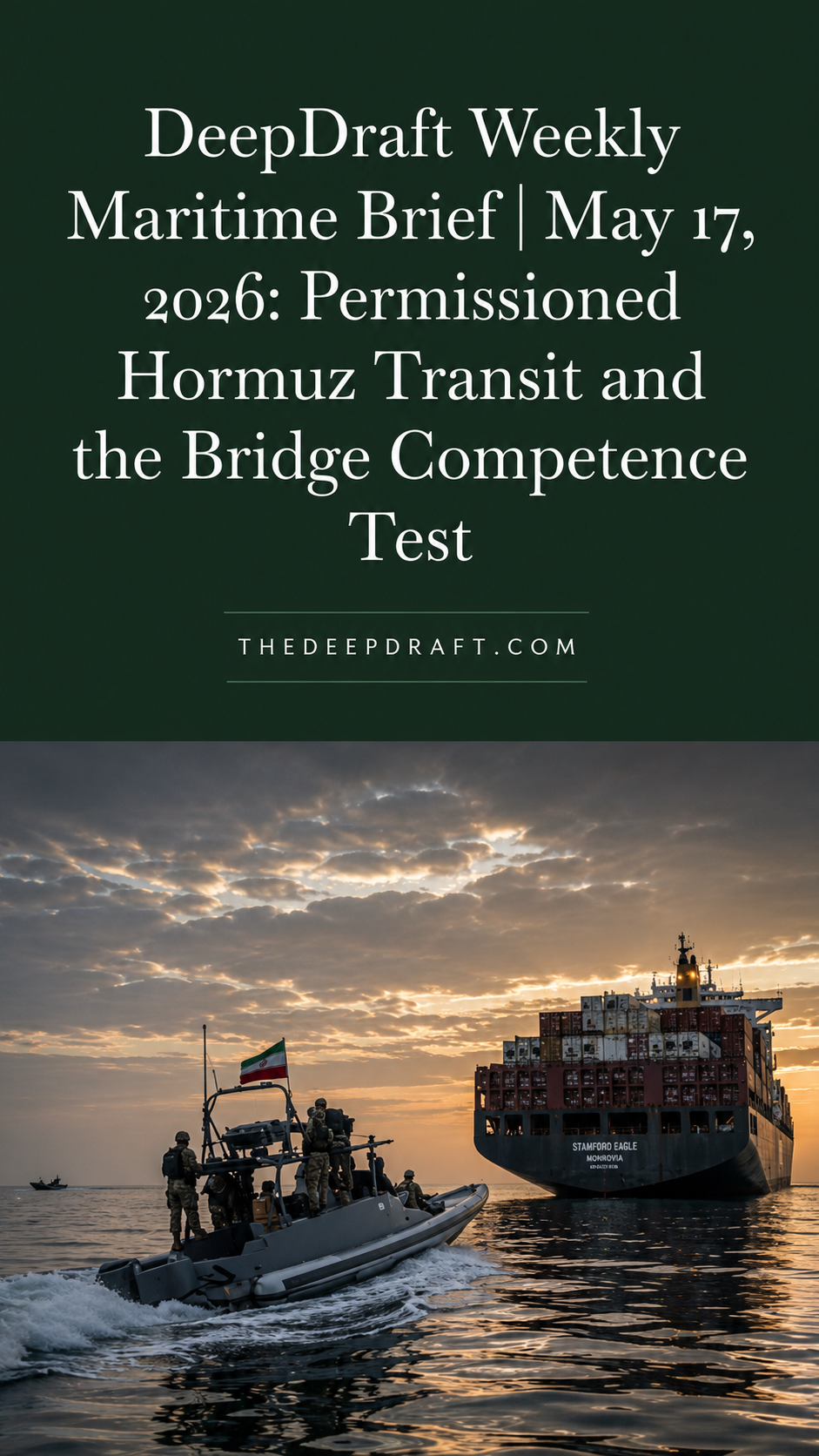
Hormuz has moved into a permissioned transit phase.
This week, the Strait shifted from high-risk passage to naval-coordinated access, with commercial vessels now operating under expanded Iranian control measures, tighter clearance expectations, and rising insurance uncertainty.
LNG movements, VLCC departures, Gulf of Oman boardings, and Fujairah bypass pressure all point to the same operating reality: transit through the Gulf is becoming less predictable, more political, and increasingly dependent on permission.
That matters because the bridge team remains the final control point.
When ships are pushed into constrained routes, degraded GNSS environments, high-density traffic patterns, and politically managed corridors, paper compliance provides limited operational comfort. ECDIS certification may satisfy the file, but the practical question is whether the watchkeeper can detect errors, challenge assumptions, and manage the system when the route stops behaving normally.
This week’s brief connects those two pressures: permissioned transit outside the ship, and bridge competence inside the ship.
Weekly Analysis: ECDIS Certification Is Not ECDIS Competence
The primary analysis, ECDIS Certification Is Not the Same as ECDIS Competence, examines one of the most persistent weaknesses in modern bridge operations: the gap between certified training and real operational proficiency.
ECDIS is now central to route monitoring, passage planning, position verification, and navigational decision-making. Yet certification alone does not prove that an officer can manage chart settings, safety contours, route checks, alarm configuration, sensor inputs, scale awareness, or system anomalies under pressure.
That gap becomes more serious during geopolitical disruption. When vessels are rerouted, delayed, compressed into alternative traffic flows, or required to operate under degraded GNSS conditions, weak ECDIS competence becomes an operational exposure.
The problem sits in uneven human-system understanding across the fleet.
For ship managers, the lesson is direct. Bridge competence must be verified through scenario-based assessment, type-specific familiarity, and practical operational checks. A certificate confirms that training was completed. It does not confirm that the officer can safely manage the bridge system during abnormal routing, electronic interference, or high-workload transit.
For masters, the issue is equally practical. The bridge team must be able to cross-check, challenge the display, and maintain navigational control when external conditions degrade. In a permissioned Hormuz environment, that competence is part of operational readiness.
Full analysis available on DeepDraft:
This Week in Maritime: Timeline of Escalation
May 12 — Hormuz LNG Transit Risks Escalate
LNG transits through the Strait of Hormuz came under heightened monitoring as regional military posture shifted.
Operators began tightening bridge protocols and security assessments around one of the most sensitive energy flows in global shipping.
May 13 — Iran Expands Hormuz Control Zone Following Qatar Drone Strike
After a drone strike in Qatari waters, Iran expanded its maritime control zone within the Strait of Hormuz.
The move widened transit risk across Gulf shipping and placed unilateral corridor control at the center of the operating picture.
May 14 — Yuan Hua Hu Exits Hormuz Amid U.S.-China Toll Dispute
The VLCC Yuan Hua Hu exited Hormuz with approximately two million barrels of crude as a U.S.-China toll dispute escalated around transit access.
The movement showed that passage remained possible for selected vessels, while clearance, environmental exposure, and political alignment continued to shape the corridor.
May 15 — Hui Chuan Boarded off Fujairah as Gulf of Oman Security Deteriorates
The boarding of Hui Chuan off Fujairah expanded the threat picture beyond the Strait itself.
The Gulf of Oman became part of the same security equation, forcing operators to reassess vessel protection, routing confidence, and exposure around UAE waters.
May 16 — Hormuz Transit Becomes Permissioned Under Navy Coordination
Iran finalized directives requiring commercial vessels to coordinate passage through the Strait of Hormuz with naval authorities.
The shift formalized permissioned transit and accelerated attention on Fujairah bypass capacity as operators looked for ways to reduce direct exposure to the Strait.
Full Live Wire coverage for the week:
https://thedeepdraft.com/category/wire/
Strategic Summary
The coming phase will test whether permissioned Hormuz transit can stabilize commercial movement, or whether clearance friction, insurance volatility, and bridge-level competence gaps turn controlled passage into another layer of operational risk.
For ship managers, this is now a combined security, routing, insurance, and bridge-readiness problem.
For masters and bridge teams, the operational priority is clear: maintain navigational control when external systems, corridor rules, and traffic assumptions degrade at the same time.
This report is part of the DeepDraft Weekly Maritime Brief series tracking operational, regulatory, and security developments across global shipping.


Leave a Reply