
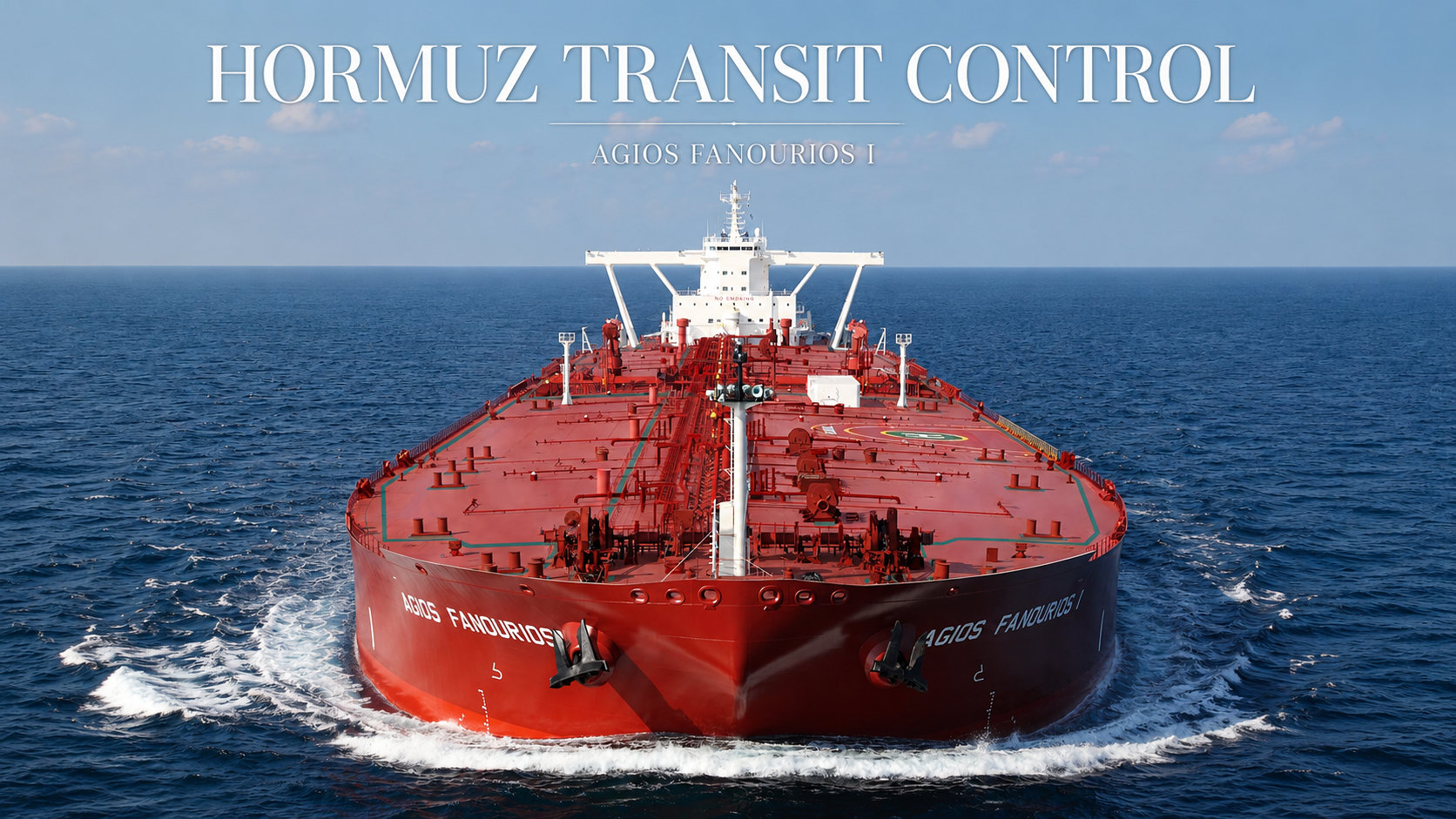
Hormuz remains permissioned, not normalized.
A reported VLCC movement, postponed U.S. strike and Iranian fee mechanism confirm that passage now depends on clearance, naval posture and commercial risk tolerance.
1. Hormuz Transit Control: Agios Fanourios I Shows Passage Remains Managed
• Maltese-flagged VLCC Agios Fanourios I is reported moving toward Vietnam with Iraqi crude for the Nghi Son refinery.
• The vessel’s movement is operationally significant because it occurred inside the current Hormuz control environment, not because it represents a full reopening.
• Reuters reported only 12 ships crossed Hormuz in the previous 24 hours, confirming restricted traffic against normal pre-war flow.
• Clarksons indicated shipping confidence remains weak, with crude traffic still limited through a route previously carrying about one-fifth of global energy supply.
2. Strike Pause Freezes the Theatre, Not the Strait
• President Donald Trump said he was holding off a planned Tuesday strike on Iran after requests from Gulf allies.
• U.S. forces remain ordered to stay ready for a large-scale assault if talks fail.
• Iranian state TV reported Qeshm Island air-defense systems activated late Monday, with the situation described as under control.
• Turkey’s foreign minister said the immediate negotiation concern is keeping the Strait of Hormuz open, while nuclear terms remain central.
3. Freight and Routing Impact: West Asia Costs Reprice Around Restricted Passage
• India’s shipping ministry reported West Asia-bound container freight rising from $203/TEU to $2,000/TEU.
• LPG freight increased from $94/tonne to $207/tonne as of May 15.
• Crude freight rose from $14/tonne to $28.6/tonne.
• Average monthly shipping services from Indian ports to West Asia reportedly fell from 444 vessels to about 125, confirming capacity withdrawal rather than routine volatility.
4. Iran’s Fee Mechanism Converts Transit Risk Into Compliance Exposure
• Ebrahim Azizi, chairman of Iran’s parliamentary national security committee, said Tehran has prepared a professional mechanism to manage Hormuz traffic along a designated route.
• The mechanism includes fees for specialized services provided under the system.
• Azizi said only commercial vessels and parties “cooperating with Iran” would benefit.
• For owners, charterers and insurers, this creates sanctions, payment, voyage-order and charterparty exposure if transit requires interaction with an Iranian-controlled mechanism.
5. Strategic Bypass Signal: Fujairah Capacity Becomes Part of the War-Risk Map
• The UAE is accelerating bypass infrastructure to reduce exposure to Hormuz disruption.
• The project reinforces Fujairah’s role as the Gulf’s strategic outlet outside the Strait.
• Saudi Arabia’s East-West pipeline has already been described by Aramco leadership as a critical lifeline, with capacity ramped to 7 million bpd during the crisis.
• Bypass capacity does not solve vessel access inside the Gulf, but it changes crude-routing assumptions for charterers, refiners and terminal planners.
Strategic Summary (For Masters & Ship Managers)
• Treat Hormuz as a permissioned transit zone. Do not assume normalization from isolated vessel movements.
• Masters should verify routing authority, naval instructions, AIS policy, insurance clearance and company approval before committing to Strait passage.
• Ship managers must review sanctions clauses, voyage orders, payment exposure and charterparty wording where any fee-based or Iranian-managed transit mechanism is involved.
• Charterers and operators should price West Asia fixtures against constrained capacity, higher freight, possible delays, rerouting and off-hire exposure.
Operational Status
CRITICAL RED — Hormuz Permissioned Transit / Limited Crossings / Fee-Based Access Risk / Freight and Naval Escalation Active
DeepDraft Weekly Analysis
MEPC 84 deferred the Net-Zero Framework to December 2026 while advancing the North-East Atlantic ECA, turning regulation into fuel, documentation and PSC exposure.
Sources
Reuters, Associated Press, Anadolu Agency, Times of India, The DeepDraft
This update is part of the DeepDraft SITREP series covering developing maritime operational situations.



Leave a Reply