
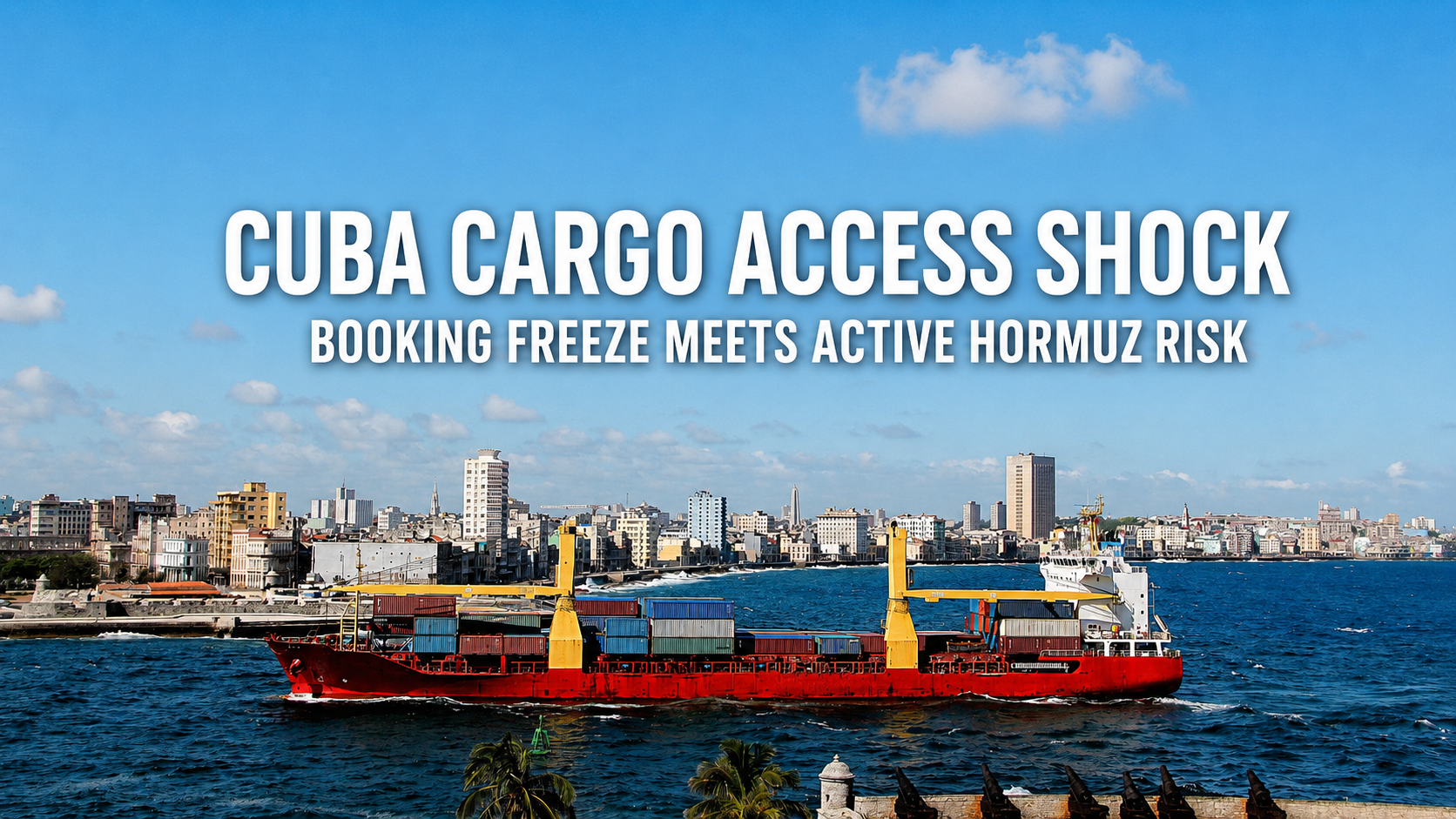
Two major liner operators have stopped Cuba bookings while Hormuz remains under reduced-transit security pressure.
The day’s operating picture is mixed-sector: cargo access, sanctions screening, Gulf transit permission and bridge readiness.
1. Cuba Booking Freeze Becomes the Lead Commercial Signal
• CMA CGM and Hapag-Lloyd suspended all bookings to and from Cuba until further notice, with both carriers citing a May 1 U.S. executive order.
• Reuters reported the suspension could affect up to 60% of Cuba’s shipping volume, creating immediate exposure for cargo owners, forwarders, NVOCCs and liner customers.
• The impact is expected to be strongest on shipments from China, Northern Europe and the Mediterranean.
• Cargo already planned through affected networks must be checked for booking validity, transshipment status, container positioning, release instructions and delivery-window commitments.
2. Hormuz Code Signal: 40-Point PGSA Declaration Turns Transit Into Permissioned Passage
• Iran’s Persian Gulf Strait Authority has introduced a permission framework for Hormuz transit, with vessels required to submit detailed transit information before passage.
• Reports describe a 40-plus field vessel declaration covering ship identity, cargo, ownership, routing and voyage details before Strait clearance.
• Iran’s toll and routing plan reportedly includes registration, routing permission and a commercial fee structure, creating a direct compliance issue for operators, insurers and charterers.
• Masters should treat any PGSA email, VHF demand or clearance instruction as controlled communication requiring shore-side legal, P&I and company authorization before response.
3. Commercial / Market / Routing Impact
• Cuba-linked bookings now require immediate review for carrier availability, sanctions exposure, delivery obligations, cargo acceptance and transshipment alternatives.
• Shippers with Cuba cargo should confirm whether freight is already accepted, suspended at origin, held at hub, rolled, cancelled or blocked from new booking release.
• Contract teams should review demurrage, detention, storage, cancellation, sanctions, force majeure and customer-notification clauses on Cuba-linked shipments.
• Hormuz-linked fixtures require separate review for routing authority, payment exposure, war-risk cover, off-hire, deviation and non-performance language.
4. Gulf Security and Bridge Risk Layer
• UKMTO/JMIC reports Strait of Hormuz traffic remains significantly reduced, with two security-related incidents reported in the last 48 hours.
• UKMTO Warning 057/26 reported suspicious activity involving a vessel taken by unauthorized personnel while at anchor northeast of Fujairah, UAE.
• UKMTO Warning 058/26 reported an attack on an Indian-flagged livestock carrier.
• JMIC also reports mine risk near the TSS and sporadic GNSS interference across Hormuz approaches, the Gulf of Oman, the Arabian Gulf, the central Red Sea and Suez approaches.
5. Wider Gulf Secondary Signal: Qatar Drone Strike Confirms Risk Beyond the Strait
• Qatar reported that a commercial cargo vessel northeast of Mesaieed Port was targeted by a drone attack on May 10.
• The vessel was arriving from Abu Dhabi and caught fire after being struck, according to Qatar’s Ministry of Defense.
• Reuters reported vessels in the area were advised to transit with caution.
• The incident confirms that Gulf security exposure is not confined to Hormuz and remains relevant for vessels operating near Qatar, UAE approaches and Gulf feeder routes.
Strategic Summary (For Masters & Ship Managers)
• This is a mixed-sector operating day: Cuba creates the strongest fresh cargo-access disruption, while Hormuz remains an active permission, security and bridge-risk signal.
• Masters in Gulf waters should maintain enhanced watchkeeping, GNSS cross-checking, VHF discipline and full logging of any clearance, routing or coastal-state communication.
• Ship managers should separate Cuba cargo compliance from Gulf security planning, but treat both as live authorization issues requiring shore-side clearance.
• Charterers and operators should avoid assuming normal performance on Cuba-linked cargo or Gulf-linked voyages until booking acceptance, insurance position and routing authority are confirmed.
Operational Status
RED — Cuba Booking Suspension / Hormuz Permissioned Transit / Compliance Screening Required / Cargo Rerouting and Gulf Security Exposure
DeepDraft Update
Excerpt: Hormuz transit now requires permission as clearance friction, insurance volatility and bridge-level competence gaps reshape routing, security and voyage authorization.
https://thedeepdraft.com/2026/05/17/deepdraft-weekly-maritime-brief-may-17-2026-hormuz-transit-now-requires-permission/
Sources
Reuters, UKMTO/JMIC, The Guardian, Qatar Ministry of Defense, The DeepDraft
This update is part of the DeepDraft SITREP series covering developing maritime operational situations.


Leave a Reply