
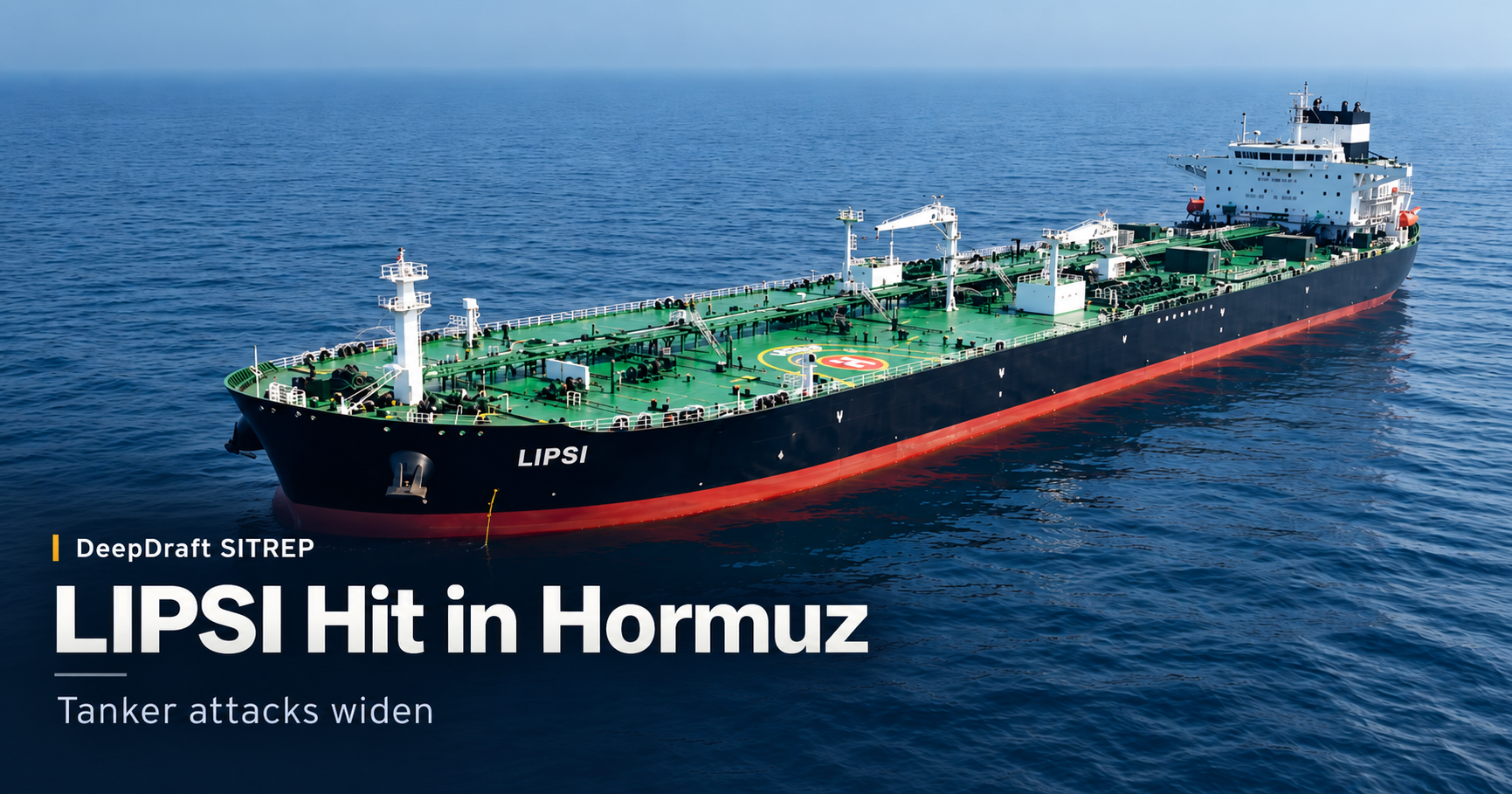
A fresh tanker strike in the Strait of Hormuz has pushed the Gulf attack count higher as energy flows recover into the risk corridor.
A second tanker reported explosions south of Bab el-Mandeb, widening the operating picture from Hormuz to the Red Sea approach.
1. LIPSI Strike Extends Hormuz Tanker Attack Pattern
• The latest Hormuz strike was reported against LIPSI, identified by Maritime Executive as a brand-new LR2 tanker linked to a Greek operator and Chinese owner.
• The vessel was reported hit by an unknown projectile in the Strait of Hormuz, with engine-room damage reported and no crew casualties or pollution confirmed in the initial reporting.
• The incident adds a fresh named-vessel strike to the recent Hormuz file after DeepDraft already reported the KAZIMAH III strike on October 3 and the Al Ruwais, Mersin Prosperity and Sinbad strikes on October 2.
• Masters transiting Hormuz should treat propulsion-space damage, emergency steering readiness, fire boundary checks, AIS policy, voyage orders and post-incident evidence preservation as immediate passage-planning issues.
2. Bab el-Mandeb Tanker Attack Adds Red Sea Approach Risk
• A separate tanker reported multiple explosions in close proximity about 60 nautical miles south of Mokha, Yemen, near the Bab el-Mandeb approach.
• UKMTO reported the crew safe and authorities investigating, with no immediate environmental impact reported in available incident summaries.
• The incident follows renewed military movement in Yemen, where Saudi-backed government forces launched an operation against Houthi-held territory after reports that Houthis cut a key route to Taiz.
• Red Sea and Gulf of Aden passages now require a separate threat review from Hormuz, with CSO escalation, BMP discipline, speed/route planning, citadel readiness and war-risk notification checked before transit.
3. Gulf Flows Recover While Tanker Freight Becomes a Cost Shock
• Reuters reported that Middle East crude exports rose above pre-war levels on four of the seven days in the final week of September despite vessel attacks around Hormuz.
• The seven-day moving average for crude exports was reported at 18.5 million bpd on October 1, increasing the number of loaded and ballast energy voyages exposed to the Gulf security corridor.
• UKMTO has reported at least one attack per day in the Strait of Hormuz or Gulf of Aden since October 2, according to Reuters-linked reporting.
• Poten reported VLCC rates at about USD 1.3 million per day, turning freight, war-risk cover, laycan exposure and voyage economics into active refinery and chartering constraints.
4. Oman Transit Controls Add Documentation and AIS Exposure
• Oman’s Maritime Security Centre has introduced new requirements for foreign-flagged vessels transiting or anchoring in Omani territorial waters.
• The requirements include navigation licence applications through an agent at least three days in advance, valid flag registration, valid insurance and P&I documentation, and continuous AIS operation.
• The rule set matters operationally because Hormuz traffic, Gulf of Oman waiting areas, STS movements and emergency diversion planning may now intersect with stricter coastal-state documentation and visibility requirements.
• Operators should confirm licence responsibility, agent filing timelines, AIS instructions, P&I documentation, contingency anchoring limits and any charterparty exposure before vessels approach Omani territorial waters.
Strategic Summary & Actions Required
• Masters transiting Hormuz should verify propulsion readiness, emergency steering, fire response, bridge evidence preservation, VDR retention and company reporting lines before entering the Strait.
• CSO, DPA and operations teams should separate Hormuz and Bab el-Mandeb into two active threat files, not one generic Middle East security note.
• Charterers and operators should price the combined effect of strike risk, AIS exposure, route delay, war-risk cover, possible deviation, off-hire and freight escalation before fixing Gulf or Red Sea-linked voyages.
• Tanker desks should treat recovered Gulf export flows as higher exposure, not lower risk, because more tonnage is again moving through or around the threatened corridor.
• Vessels using Omani waters should confirm licence filing, P&I documentation, AIS compliance and agent instructions before arrival, drift, STS planning or emergency anchoring.
Operational Status
CRITICAL RED — Hormuz tanker strike / Bab el-Mandeb attempted attack / recovered Gulf export flows under attack pressure / tanker freight and routing exposure
Latest DeepDraft Analysis
Rumpon and Rope: Indonesia’s Hidden Propeller Fouling Hazard
DeepDraft examines how Indonesian rumpon and submerged ropes create propeller-fouling, machinery, delay and charterparty exposure for drifting vessels awaiting orders.
Related DeepDraft Articles & Analysis
Sources
UKMTO, Reuters, Maritime Executive, Associated Press, The DeepDraft
This update is part of the DeepDraft SITREP series covering developing maritime operational situations.




Leave a Reply