
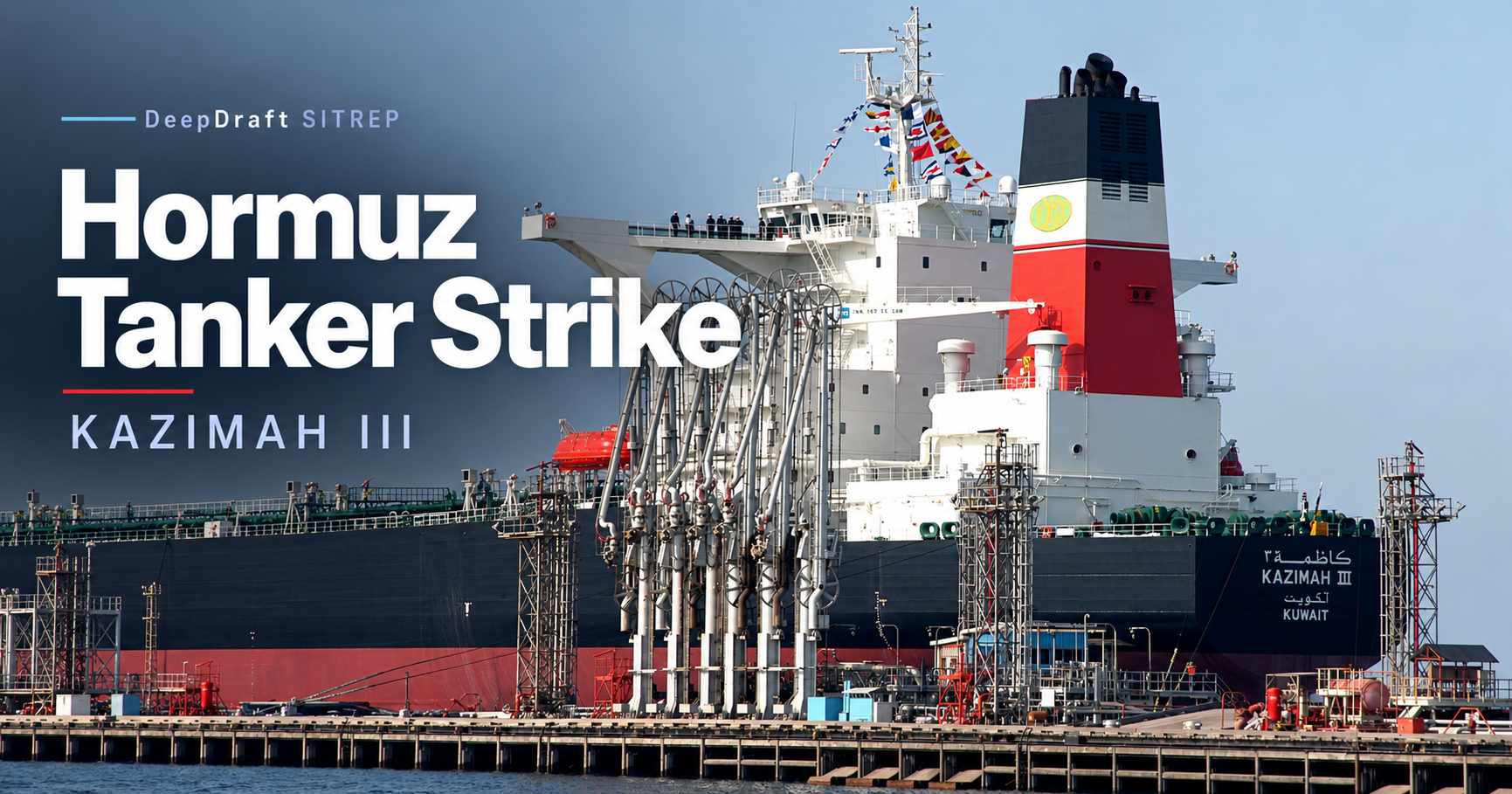
A Kuwait-flagged crude tanker was struck near Oman, adding a fresh named-vessel incident to the Hormuz projectile pattern.
The new strike moves the operating picture from isolated tanker attacks into repeated voyage-level exposure for Gulf crude and LNG traffic.
1. KAZIMAH III Strike Adds Fresh Named-Vessel Risk Near Oman
• UKMTO reported that a crude oil tanker was struck by an unknown projectile about 4 nautical miles east of Oman, with authorities assessing the incident and no immediate environmental impact reported.
• Indian reporting identified the vessel as the Kuwait-flagged MT Kazimah III and said five Indian seafarers were rescued after the tanker was hit in the Strait of Hormuz.
• The Embassy of India in Muscat said it coordinated the rescue of five Indian nationals from the Kuwait-flagged tanker.
• The incident follows DeepDraft’s October 2 SITREP on Al Ruwais, Mersin Prosperity and Sinbad, which had already placed AIS-dark tanker transits at the centre of the Hormuz operating risk.
2. Hormuz Strike Pattern Widens to Six Vessels in One Week
• Maritime Executive reported that two more tankers in Hormuz had reported strikes, bringing the weekly total to six vessels.
• The report identified Kazimah III as a 317,250 dwt Kuwait Oil Tanker Co. crude oil tanker struck while transiting the Strait of Hormuz on October 1.
• The pattern now includes multiple tanker types and operators, creating direct exposure for route planning, convoy timing, AIS policy, bridge watchkeeping and war-risk review.
• Masters transiting Hormuz should treat projectile reports as active navigation and security events, not background geopolitical noise.
3. LNG and Tanker Flows Continue Despite Strike Exposure
• Reuters reported that September LNG shipments through Hormuz reached their highest level since the start of the U.S.-Iran war, showing that cargo movement is recovering while security risk remains live.
• Reuters-linked shipping data indicated that LNG transits accelerated in the second half of September and could recover to roughly 25% of pre-war levels if the pace continues into October.
• The recovery in LNG movement makes the strike pattern commercially important because more loaded or ballast energy carriers may now be re-entering the risk area.
• Charterers, operators and insurers should price Hormuz exposure as a live voyage variable covering delay, deviation, escort, AIS discipline, off-hire, cargo timing and crew-risk clauses.
4. Cuba Fuel Interdictions Add Separate Sanctions and Pollution Layer
• The U.S. Coast Guard reported the interdiction of M/V Grace, a Cuba-bound fuel shipment stopped in September in the Caribbean between Cuba and Mexico.
• U.S. and Mexican authorities said large quantities of fuel were found in the vessel’s ballast tanks after boarding and inspection.
• The Coast Guard also confirmed an earlier summer interdiction of Jaira Provider, a smaller vessel allegedly carrying fuel to Cuba.
• The enforcement signal is separate from Hormuz but relevant to tanker compliance desks because concealed fuel carriage, ballast-tank contamination and sanctions exposure can create detention, pollution and insurance consequences.
Strategic Summary & Actions Required
• Masters on Hormuz transits should review latest UKMTO reporting, maintain enhanced bridge teams, preserve VDR/AIS/radar evidence and log all projectile, drone, naval, VHF or escort-related observations.
• Ship managers and CSO/DPA teams should reassess Hormuz transit instructions where vessels are AIS-dark, under escort, carrying energy cargo or moving through Oman approaches and Gulf traffic separation areas.
• Charterers and operators should update voyage-risk pricing for delay, deviation, war-risk premium, off-hire, unsafe-port arguments, crew-risk obligations and laycan exposure on Gulf crude, product and LNG movements.
• Insurers and P&I teams should treat the sixth reported strike as a pattern-confirmation event and review notification discipline, hull-war terms, cargo exposure and evidence preservation after any near-miss or impact.
• Compliance teams should keep Cuba fuel enforcement separate from the Hormuz file but review dark-fleet screening, ballast-tank misuse, sanctions clauses and pollution-response exposure on fuel-linked fixtures.
Operational Status
CRITICAL RED — Hormuz tanker projectile pattern / KAZIMAH III strike near Oman / Six-vessel weekly incident count / Active crude and LNG transit exposure
Latest DeepDraft Analysis
Rumpon and Rope: Indonesia’s Hidden Propeller Fouling Hazard
Indonesia’s rumpon fishing gear creates a hidden propeller-fouling hazard, turning drifting, night navigation and low-speed coastal passages into machinery and manoeuvring risks.
Related DeepDraft Articles & Analysis
Sources
Reuters, UKMTO, Embassy of India Muscat, Maritime Executive, U.S. Coast Guard
This update is part of the DeepDraft SITREP series covering developing maritime operational situations.


Leave a Reply