

Iran’s Persian Gulf Strait Authority has expanded its non-compliance list to 81 ships and warned charterers against ordering vessels through Hormuz without Iranian approval.
The same operating cycle includes reported warning-shot enforcement as physical crude flows through the Strait rebound sharply.
1. Hormuz Blacklist Reaches 81 as Charterer Exposure Widens
• Iran’s Persian Gulf Strait Authority added four entries to its Non-Compliance List, increasing the total from 77 to 81 vessels as of September 28.
• The additions include Sinokor-linked VLCCs ALGERIA PROSPERITY and OCEAN LOYALTY, bulk carrier ANNA-META, and Bahri-linked SILVER SHINE, which appears as ARSAN on the latest list.
• PGSA warned that charterers pressing Masters to transit Hormuz without completing Iranian declaration, approval and transit procedures could themselves be blacklisted, with associated vessel transits restricted.
• Vessels placed on the non-compliance list may face future passage restrictions including fines, detention or confiscation, according to PGSA.
• The development creates a direct voyage-order conflict because the U.S. Treasury has designated PGSA and warned that cooperation with the authority, including provision of information or payment connected with Strait passage, may create U.S. sanctions exposure.
2. Reported Warning Shots Move Route Enforcement Into the Armed Layer
• Iranian state-aligned reporting, citing Fars News Agency, said Iranian naval forces fired warning shots at seven foreign vessels after they allegedly ignored radio warnings and attempted to use unauthorized routes through the Strait.
• The same reporting claimed that 12 vessels had been engaged under similar circumstances during the previous night. Vessel identities and flag states were not disclosed, and the claims have not been independently confirmed.
• Separately, the IRGC said on September 27 that it had seized another U.S. autonomous underwater vehicle operating in Hormuz. Independent reporting describes this as Iran’s second U.S. underwater-vehicle seizure claim this month, while U.S. authorities had not publicly confirmed the latest seizure at the time of reporting.
• Today’s reporting that eight U.S. Marines were injured in a missile strike does not constitute a new September 28 attack. U.S. officials cited by NBC-linked reporting said the incident occurred on September 14, so it is treated as newly disclosed background rather than today’s lead operational event.
3. Hormuz Crude Flows Rebound to About 7.4 Million BPD
• Reuters reported that crude exports from major Middle East producers are running at approximately 12.8 million barrels per day in September, the highest level since the U.S.-Israel war with Iran began in February, based on preliminary Kpler data.
• Exports moving through the Strait of Hormuz are set to reach roughly 7.4 million bpd this month as Saudi Arabia and the UAE increase shipments.
• Regional exports remain about 6 million bpd below February’s 18.8 million bpd level, showing that the physical recovery remains substantial but incomplete.
• The higher physical flow now coincides with tighter Iranian compliance enforcement, meaning tanker nominations must be tested simultaneously against route authority, Master’s authority, sanctions screening, war-risk cover and any Iranian clearance demand.
4. BLUE CARRIER 2 Fire Remains an Active Salvage and Stability File
• Firefighting remained active aboard Greek ro/ro cargo vessel BLUE CARRIER 2 on September 27, two days after the fire began north of Mykonos.
• The vessel was moved under salvage arrangements to a sheltered position southwest of Tinos, where five tugs were operating around the casualty.
• The Hellenic Coast Guard said active fire hotspots remained aboard, while the response continued to focus on full extinguishment and maintaining vessel stability.
• All 28 crew members and one truck driver were evacuated safely after the September 25 fire. The vessel had been carrying 166 trucks and 29 cars.
• The Tinos Port Authority is conducting the preliminary investigation. For ro/ro operators, the casualty remains relevant to garage fire detection, cargo screening, fixed firefighting effectiveness, heat management, stability after prolonged boundary cooling and salvage access.
Strategic Summary & Actions Required
• Masters approaching Hormuz should not execute conflicting routing or clearance instructions solely on commercial pressure. Preserve charterer orders, company authorization, VHF traffic, AIS status, bridge logs, VDR data and all communications concerning transit approval.
• Charterers and operators should review voyage-order authority, safe-port and safe-route obligations, war-risk clauses, deviation rights, sanctions warranties, off-hire exposure and cancellation provisions before instructing a Hormuz passage.
• Compliance, legal, DPA and CSO teams should treat PGSA interaction as a two-sided exposure: failure to follow Iranian requirements may create detention or blacklist risk, while cooperation with the U.S.-designated authority may create sanctions exposure.
• Tanker desks should not interpret the recovery toward 7.4 million bpd of Hormuz crude flows as normalization. Higher physical throughput is occurring while route enforcement, military interaction and authorization risk remain active.
• Ro/ro fleet managers should circulate BLUE CARRIER 2 as a fire-response and stability case, with particular attention to vehicle-deck cargo controls, fixed suppression readiness, boundary cooling, accumulated firefighting water and post-fire entry procedures.
Operational Status
CRITICAL RED — Hormuz Non-Compliance List at 81 / Charterer and Fleet Restriction Threat / Reported Armed Route Enforcement / Sanctions and Voyage-Authorization Conflict
Latest DeepDraft Analysis
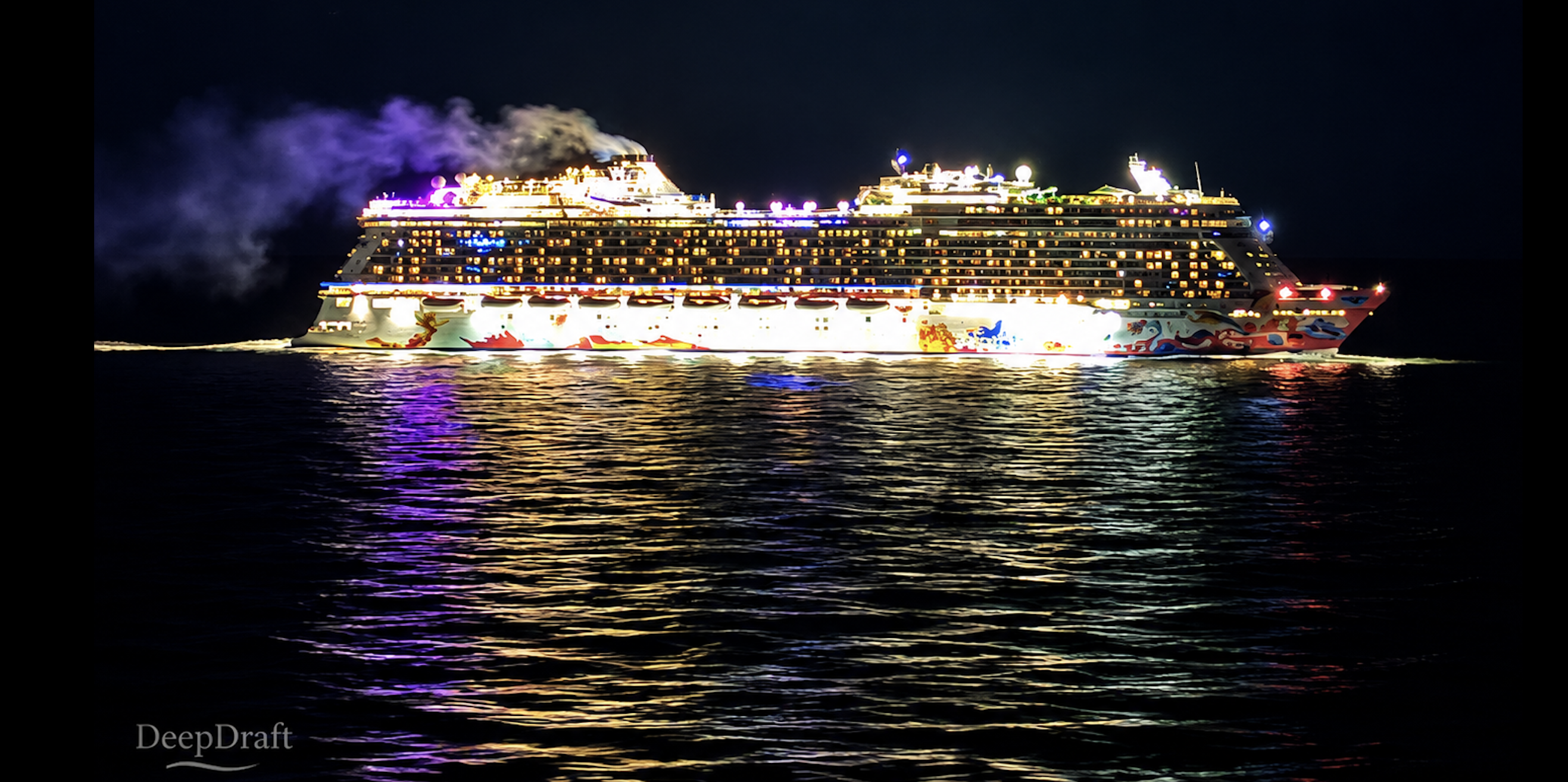
Navigating in a Sea of Visual Pollution
Excessive working, accommodation and security lighting can overwhelm prescribed navigation lights, degrading aspect recognition, night vision and collision assessment even when individual lights remain technically compliant.
Sources
Seatrade Maritime, Reuters/Kpler, U.S. Treasury OFAC, Hellenic Coast Guard, Tehran Times/Fars News Agency
This update is part of the DeepDraft SITREP series covering developing maritime operational situations.


Leave a Reply