
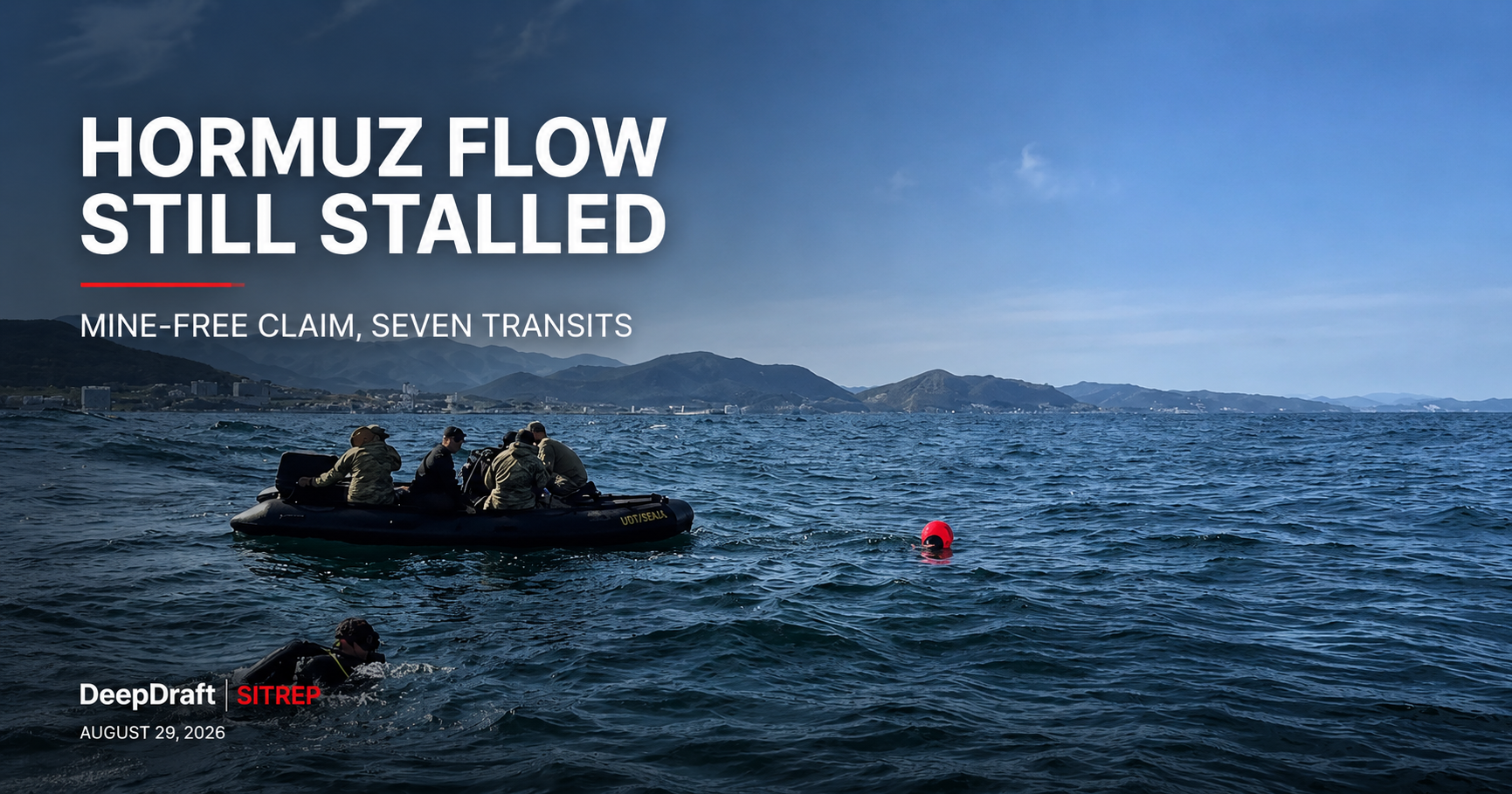
CENTCOM says Hormuz transit routes are mine-free, but traffic has not normalized. Reuters counted only seven commodity vessels through the Strait while IMO says 400 ships and 6,000 seafarers remain unable to depart safely.
1. Hormuz Clearance Claim Fails to Restore Normal Flow
• CENTCOM said internationally recognized Strait of Hormuz transit routes are free of Iranian sea mines after U.S. forces cleared mines from the shipping lanes.
• Admiral Brad Cooper said U.S. forces used Navy divers, Navy SEALs and aircraft from multiple services during the clearance effort.
• Reuters reported only seven commodity vessels transited Hormuz on Thursday, down from 17 a day earlier and below a 10-day average of 15.
• The seven visible transits included two MR tankers, one VLGC, one Ultramax, one intermediate tanker and two chemical tankers. Four vessels exited the Strait and three entered.
• Reuters cautioned that the vessel count could change because some ships switch off transponders during voyages.
2. IMO Seafarer Crisis Remains Active
• IMO says more than 20,000 seafarers, port workers and offshore crews are affected by the Middle East operating situation.
• IMO’s evacuation framework remains paused, despite the earlier evacuation of 136 vessels and an estimated 2,900 seafarers between June 23 and June 26.
• Maritime Executive, citing IMO Secretary-General Arsenio Dominguez’s August 28 statement, reported that up to 400 ships carrying around 6,000 seafarers remain unable to depart the Persian Gulf safely.
• The seafarer issue converts Hormuz from a routing and energy-security file into an active crew-welfare, crew-change, medical-support and safe-passage problem for ship managers and flag states.
3. U.S. Sanctions Add Banking, Payment and Charterparty Exposure
• The U.S. Treasury moved to cut Banque Misr’s UAE branches from dollar transactions and proposed revoking their correspondent banking access to U.S. financial institutions.
• Treasury said it views Banque Misr’s six UAE branches as a critical node for Iranian access to U.S. dollars.
• Treasury estimated Banque Misr UAE processed approximately USD 1.8 billion between January 2024 and June 2026 for 103 companies potentially linked to Iranian shadow-banking networks.
• OFAC separately sanctioned the manager of Iran’s Bank Melli branch in the UAE and a Hong Kong entity accused of helping launder money for a sanctioned Iranian exchange house.
• Iran-linked voyage finance, bunker payment, port disbursements, freight settlement, dollar clearing and charterparty sanctions clauses now require renewed screening before voyage approval.
4. UKMTO Operating Picture Still Shows Suppressed and Re-Routed Traffic
• UKMTO’s August 28 Voluntary Reporting Area overview says AIS-detected Hormuz transits remain approximately 90% below pre-conflict baselines.
• The same overview says operators are increasingly favouring the northern route after projectile attacks, security concerns and heightened enforcement activity.
• UKMTO’s last-seven-day Hormuz transit detail shows 101 outbound and 103 inbound transits, with both flows only around 22 to 23% of pre-conflict averages.
• UKMTO’s AIS-only route table shows no traffic using the Traffic Separation Scheme in the last-seven-day route count, with movement split between northern and southern routes.
• Tankers remain the dominant traffic class, with UKMTO noting that tanker traffic accounts for 45% of all Hormuz movement in the summary period.
5. Chokepoint Cost Layer: Panama Auction Confirms Wider Routing Pressure
• The Hormuz operating file is not isolated from wider chokepoint economics, with charterers also pricing canal, queue and slot-risk exposure.
• Reported Panama Canal auction pressure remains relevant for LNG, LPG and tanker desks where security disruption, low-water constraints and laycan pressure compete for voyage margins.
• Operators should treat Hormuz security clearance, Panama auction cost and Bab el-Mandeb risk as separate decision files, but combine them in voyage authority, delay pricing and customer notification.
Strategic Summary & Actions Required
• Masters approaching Hormuz should not treat the mine-clearance claim as normal passage authority. Confirm company approval, insurer position, latest UKMTO/JMIC guidance, route plan, EMCON policy and abort criteria before committing.
• Ship managers should update fleet instructions for mine-risk reporting, bridge evidence capture, GNSS/AIS cross-checking, VHF discipline and controlled response to any coastal-state or military instruction.
• Charterers and operators should re-screen Iran-linked cargoes, counterparties, banks, remittance channels, port agents and freight-payment routes after the Banque Misr UAE action.
• Crewing teams should identify vessels unable to depart, expired contracts, medical cases, fatigue exposure, port-state limits and emergency evacuation options under the paused IMO framework.
• P&I, legal and commercial desks should separate three risks before fixture approval: physical transit risk, sanctions/payment risk and crew-welfare risk.
Operational Status
CRITICAL RED — Hormuz Mine-Clearance Claim / Traffic Still Suppressed / 400 Ships and 6,000 Seafarers Unable to Depart / Sanctions and Payment Exposure Active
Latest DeepDraft Analysis
Fire Wires on Tankers: The Safety Control That Became the Hazard
https://thedeepdraft.com/2026/08/24/fire-wires-on-tankers-safety-control-became-hazard/
Fire-wire handling remains a tanker safety exposure where historical injury records, OCIMF/Lloyd’s Register findings and ship-shore interface risk now outweigh legacy emergency assumptions.
Related DeepDraft Articles & Analysis
Sources
Reuters, IMO, UKMTO, U.S. Treasury / FinCEN, Anadolu Agency
This update is part of the DeepDraft SITREP series covering developing maritime operational situations.




Leave a Reply