
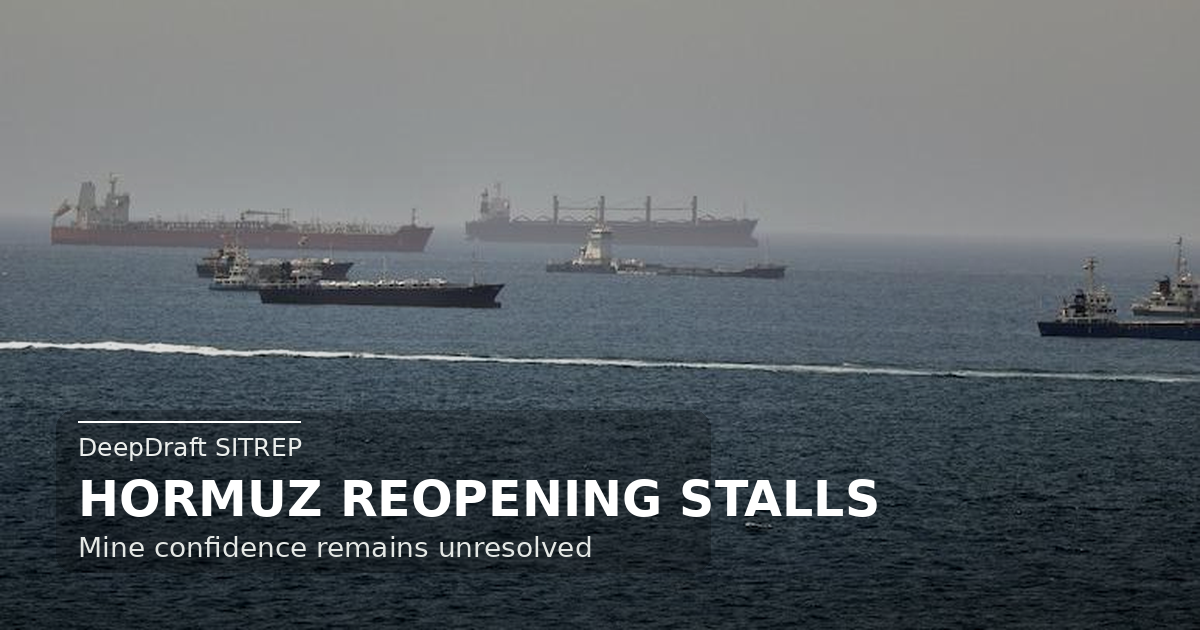
Hormuz has not returned to normal operating confidence. Mine-clearance claims, corridor talks and a fresh ALSALAM II warning now sit against traffic still far below normal.
1. Hormuz Reopening Still Runs Through Mine Confidence and Vessel Flow
• Reuters, citing preliminary Kpler data, reported only five commodity vessels transited the Strait of Hormuz on Tuesday, against a 10-day average of 15.
• The reported movement comprised two LPG tankers and one bitumen tanker exiting the Gulf, while two empty product tankers entered from the Gulf of Oman.
• Iran and Oman have discussed a temporary joint shipping corridor and agreed to work on mine removal, but the operating picture remains short of full reopening.
• Mine-clearance claims do not remove all commercial uncertainty, with analysts warning that drifting, uncharted or newly laid mines can keep owners and insurers reluctant to resume normal passage.
2. ALSALAM II Warning Adds Vessel-Level Caution Near Jazirat Tawakkul
• NAVAREA IX Warning 299/26 was issued at 1500 UTC on August 26 for the Strait of Hormuz.
• The warning named oil tanker ALSALAM II as involved in a security incident.
• The vessel was reported anchored at 26-23.4N 056-30.5E, approximately 0.8 nautical miles northwest of Jazirat Tawakkul.
• The warning cautioned mariners, but did not identify the incident as a confirmed mine strike, blast, projectile attack, boarding, detention, fire or casualty.
Reading this as a maritime insider, seafarer, or enthusiast?
Subscribe to The DeepDraft for maritime analysis, daily SITREP updates, weekly briefings, and operational signals worth watching.
3. Blacklist and STS Exposure Tighten Tanker Chartering Risk
• At least three Indian refiners and one global energy major plan to avoid vessels on Iran’s 45-ship blacklist because of security concerns.
• Iran has threatened action against ships that conduct ship-to-ship transfers with listed vessels, creating direct exposure for Gulf crude, products and LNG movements using Fujairah or Sohar transfer patterns.
• The listed vessels have reportedly been used for shuttling crude, refined products and LNG out of the Gulf for transfer outside Iranian control.
• Charterers should treat blacklist exposure, STS history, AIS gaps, prior voyage pattern and cargo-chain documentation as commercial acceptance issues, not only sanctions-screening checks.
4. Corridor Talks Do Not Yet Restore Commercial Transit
• AP reported that Iran has described a potential Hormuz arrangement under which military vessels would be excluded from the waterway.
• The same reporting said commercial traffic into the Persian Gulf would pass through Iranian waters, while outbound traffic would pass partly through Iranian and Omani waters.
• That routing logic would turn Hormuz passage into a managed corridor rather than a restored open transit system.
• Masters should expect route, communication, documentation and authority questions to remain active until navigational warnings, security advisories and insurer positions align.
5. Congestion and War-Risk Cover Add the Wider Cost Layer
• Port Technology reported that more than 4.3 million TEU of containership capacity is waiting to berth globally, based on Linerlytica data.
• The same congestion figure represents 12.6% of the 34.4 million TEU global fleet, adding schedule and berth uncertainty outside the Gulf security file.
• Financial Times reporting says Saudi Arabia has discussed a state-backed war and political-risk insurance scheme for ships and marine cargo in the region.
• The proposed pool could reportedly provide up to SAR 700 million, or about USD 186 million, in commercial cover per insured event such as seizure or missile attack.
Strategic Summary & Actions Required
• Masters approaching Hormuz should treat mine confidence, not corridor language, as the controlling passage issue and keep NAVAREA IX Warning 299/26 in the bridge risk file.
• Ship managers should require CSO, DPA, P&I and chartering review before Hormuz transit where blacklisted vessels, STS cargo chains, Iranian instructions or route-control communications are involved.
• Charterers and operators should preserve AIS records, cargo papers, STS evidence, voyage instructions, fixture terms and sanctions-screening records before accepting Gulf-linked cargo.
• Tanker desks should price Gulf fixtures against detention, deviation, off-hire, war-risk premium, alternative tonnage and corridor-delay exposure rather than assuming normal Strait reopening.
• Compliance teams should not classify ALSALAM II as a mine strike unless an official or stronger industry source confirms the incident type.
Operational Status
CRITICAL RED — Hormuz Mine Confidence Risk / Suppressed Strait Traffic / ALSALAM II Security Warning / Routing, Insurance and Charterparty Exposure
Latest DeepDraft Analysis
Fire Wires on Tankers: The Safety Control That Became the Hazard
Fire-wire practice still appears in tanker terminal rules, but SIRE 2.0, ISGOTT 6 and injury history now challenge whether it protects crews.
Related DeepDraft Articles & Analysis
Sources
NAVAREA IX, Reuters, AP, Al Jazeera, Financial Times, Port Technology, The DeepDraft
This update is part of the DeepDraft SITREP series covering developing maritime operational situations.




Leave a Reply