
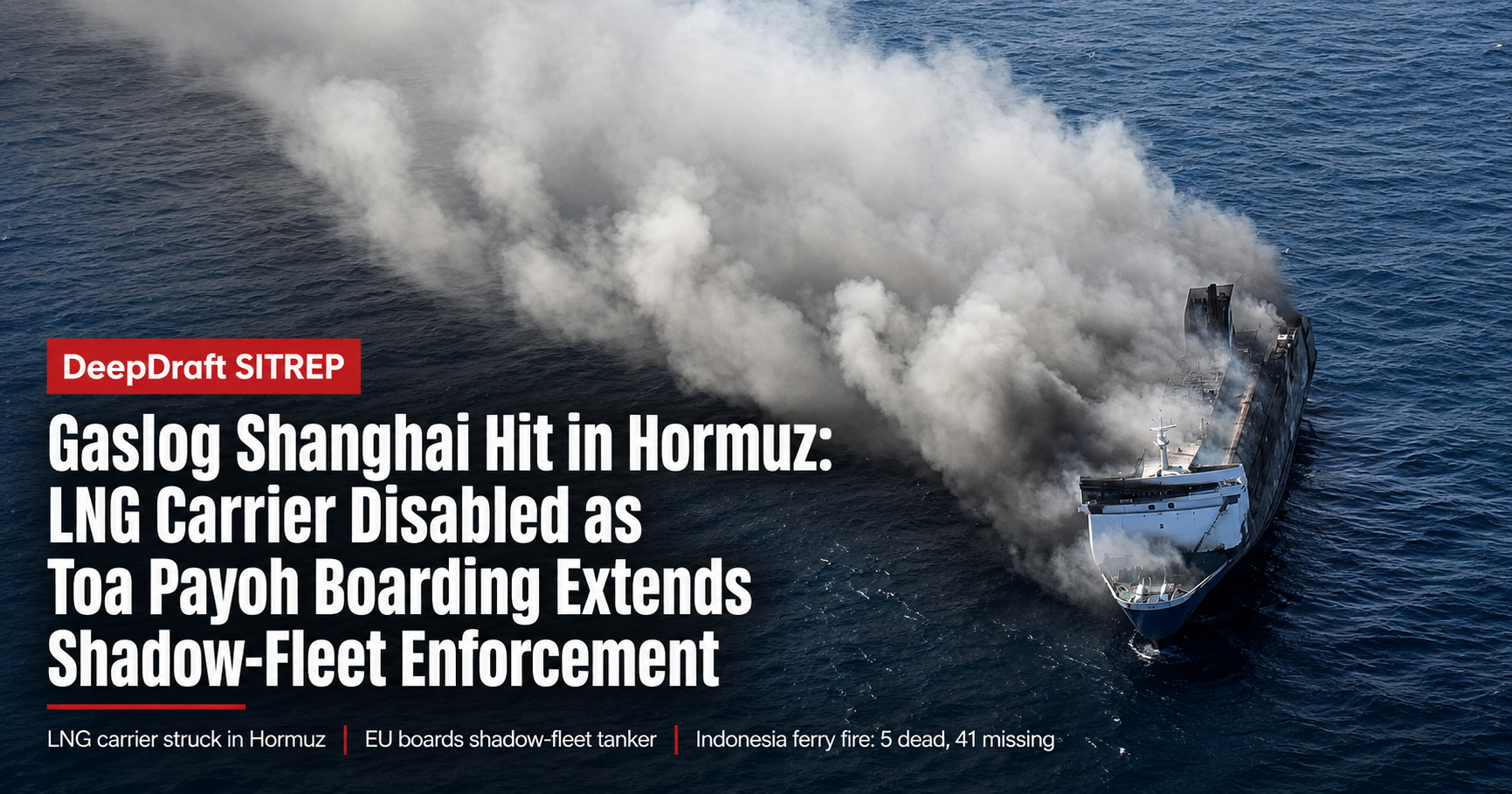
A loaded LNG carrier has been struck in the Strait of Hormuz, creating the day’s strongest vessel-level transit signal.
The same reporting window produced an EU boarding of a sanctioned shadow-fleet tanker and a fatal passenger-ferry fire off Indonesia.
1. Gaslog Shanghai Hit in Hormuz
• The Bermuda-flagged LNG carrier Gaslog Shanghai was reported struck by an unknown projectile while transiting near the Strait of Hormuz.
• The vessel was carrying a Qatari LNG cargo from Ras Laffan, making the incident a direct Gulf LNG export and chokepoint security signal.
• Maritime security reporting placed the impact near the portside engine-room area, with fire, blackout and loss of power reported.
• No crew injuries were reported, but the incident converts Hormuz from controlled-passage uncertainty into a fresh vessel-damage and emergency-response exposure.
• A separate Liberian-flagged tanker also reported a near-miss from an explosion close to the starboard side while westbound in the Omani coastal channel.
2. Toa Payoh Boarding Extends Shadow-Fleet Enforcement
• An Italian-led EU Irini boarding team inspected the sanctioned tanker Toa Payoh in the Mediterranean west of Pantelleria.
• The tanker is linked to Russia’s shadow fleet and had reportedly shifted to Cameroon registry before the operation.
• Reuters reported that the vessel was not detained, but documents collected during the inspection may support later action by national authorities.
• The boarding follows a separate EU inspection of another suspect tanker in July, showing a more active enforcement pattern against sanctions-linked tonnage.
• Owners, operators, managers and charterers should treat registry changes, sanction-list exposure and Mediterranean inspection risk as live voyage-control issues.
Reading this as a maritime insider, seafarer, or enthusiast?
Subscribe to The DeepDraft for maritime analysis, daily SITREP updates, weekly briefings, and operational signals worth watching.
3. Hormuz, Suez and Red Sea Routing Impact
• Gaslog Shanghai adds a fresh LNG-specific strike to an operating theatre already shaped by thin Hormuz traffic, controlled-route claims and war-risk pressure.
• The incident follows the recent Al Areesh controlled Qatar LNG exit through Hormuz, which DeepDraft treated as a limited vessel-level restart rather than a return to normal Gulf LNG flow.
• The Damietta drone strike against gas vessels in Egypt remains a relevant corridor-risk layer because it raised security concerns around Suez and SUMED energy movements.
• Reuters reported that growing Saudi oil volumes and other shipping have been moving north toward Suez and SUMED as regional routing options compress.
• LNG, crude and product desks should separate Hormuz, Suez/SUMED, Bab el-Mandeb and Cape routing into distinct insurance, laycan, demurrage and deviation calculations.
4. Indonesia Ferry Fire Adds Safety and SAR Layer
• The passenger ferry Mutiara Sentosa 2 caught fire off Indonesia’s Madura Island while sailing from Surabaya to Makassar.
• The vessel was carrying 271 people, including 232 passengers and 39 crew.
• AP and Reuters reported at least five dead, 41 missing and 225 rescued during the initial response.
• Communications with the ferry reportedly ceased after the fire was reported, and rescue operations were affected by sea conditions and vessel-response limits.
• The casualty reinforces passenger-vessel fire detection, evacuation control, muster discipline, rescue coordination and abandon-ship readiness as live fleet-management issues.
Strategic Summary & Actions Required
• Masters and CSO teams approaching Hormuz should preserve VDR, AIS, ECDIS, VHF, cargo, voyage-order and routing records, and treat any coastal-state instruction as controlled communication requiring company authorization.
• LNG operators should revalidate Hormuz transit approval, war-risk cover, tug and emergency-response assumptions, terminal readiness and buyer notification before committing Gulf liftings.
• Charterers and owners should price Hormuz, Suez/SUMED, Red Sea and Cape options separately, with deviation, delay, off-hire, force majeure, sanctions and safe-port language checked before fixture execution.
• Compliance teams should treat Toa Payoh as a registry, sanctions and inspection-risk warning for shadow-fleet-linked tonnage, especially where flag changes or opaque beneficial ownership appear in voyage chains.
• Passenger-vessel operators should review fire response, communications continuity, lifesaving-appliance readiness, passenger accounting and local SAR escalation triggers after the Mutiara Sentosa 2 casualty.
Operational Status
CRITICAL RED – Hormuz LNG Carrier Strike / Shadow-Fleet Boarding / Passenger-Ferry Casualty / Routing, Insurance, Sanctions and Emergency-Response Exposure
Latest DeepDraft Analysis
MEG-4 Mooring Numbers: Why Ships Are Still Getting Confused
MEG-4 turns mooring records into an inspection and competence test: SDMBL, WLL, LDBF and brake-render settings must trace back to the ship’s design basis.
Related DeepDraft Articles & Analysis
Sources
Reuters, Associated Press, Seatrade Maritime, The Maritime Executive, The Edge, The DeepDraft
This update is part of the DeepDraft SITREP series covering developing maritime operational situations.



Leave a Reply