

Iran says its forces stopped two vessels attempting to exit Hormuz and turned four others back.
The claim remains unconfirmed, but thin Strait traffic, higher oil prices and a wider Red Sea war-risk zone now create a direct voyage, insurance and charterparty exposure.
1. Hormuz Tanker Stops Become the Primary 24-Hour Signal
• Iran said its forces stopped two vessels seeking to exit the Strait of Hormuz on July 31.
• Iranian reports said four other tankers turned back after intervention by Iranian forces.
• Kpler data still recorded two large tankers carrying Gulf-loaded oil transiting the Strait, with two other commodities vessels also passing.
• The operational signal is therefore not a confirmed closure, but a live interdiction claim inside the world’s most sensitive oil and gas chokepoint.
2. Thin Hormuz Traffic Keeps Voyage Authorization Under Pressure
• The VLCC Spain B exited Hormuz carrying crude loaded at Saudi Arabia’s Ras Tanura on July 12 and was later anchored off Fujairah.
• The VLCC Noble, carrying Iraqi Basrah crude loaded on July 25, was heading for China.
• Both VLCCs were reported to be carrying about 2 million barrels of crude each.
• Only four commodities vessels had transited the Strait by the time of the Reuters report, up from three on Thursday.
• Kpler’s count does not include vessels transiting with AIS disabled, leaving operators exposed to an incomplete surface picture.
3. Red Sea Insurance Move Converts Security Risk Into Voyage Cost
• London’s marine insurance market widened its Red Sea high-risk zone after recent Houthi attacks on shipping.
• The change extends war-risk attention toward coastline adjacent to Saudi ports.
• Reuters reported that recent Houthi attacks and Saudi-linked exposure helped trigger the wider notification area.
• Saudi Arabia also announced plans for a multinational maritime defence coalition to protect Red Sea shipping and energy supply routes.
• Charterers, owners and brokers should treat Red Sea routings, Saudi port calls, Suez alternatives and Cape deviations as separate cost and cover calculations, not one generic war-risk assumption.
4. Market and Routing Layer: Oil Rises as Chokepoint Flows Stay Distorted
• Oil prices rose more than 1% on July 31 after the Iranian Hormuz claims.
• Brent crude remained on course for a sharp July gain as traders priced continuing supply and transit uncertainty.
• Bab el-Mandeb recorded 29 commodities vessels on Thursday, including two VLCCs, two Suezmax tankers and six Aframax tankers.
• A growing volume of Saudi oil and other shipping has been moving north through the Red Sea toward the Suez Canal and SUMED pipeline.
• For Asian customers, longer routing around Africa remains the fallback if Red Sea or Hormuz exposure becomes commercially or operationally unacceptable.
5. Oman Spill Layer Adds Shadow-Fleet Pollution Exposure
• Reuters separately reported an oil slick spreading from the sanctions-hit tanker Caroline Bezengi off Oman.
• The slick creates a pollution and coastal-exposure layer near the same wider operating theatre.
• The casualty reinforces the need to separate security risk from pollution, sanctions and emergency-response exposure.
• Operators trading near Oman should verify spill advisories, coastal-state instructions, P&I position, sanctions screening and contingency reporting requirements before arrival or deviation.
Strategic Summary & Actions Required
• Masters approaching Hormuz should preserve VDR, AIS, ECDIS, VHF, cargo and voyage-instruction records, and treat any coastal-state demand as a controlled communication requiring company authorization.
• Ship managers should revalidate Hormuz transit permissions, war-risk cover, armed-escort assumptions, routing instructions and emergency contact trees before vessels enter the Gulf of Oman or Arabian Gulf.
• Charterers should review deviation, delay, off-hire, war-risk, sanctions, force majeure and safe-port language for Gulf, Red Sea, Suez and Cape routing options.
• Insurance and claims teams should separate three active exposures: unconfirmed Hormuz interdiction risk, widened Red Sea high-risk notification, and Oman-linked pollution response.
• Commercial desks should avoid pricing Gulf and Red Sea voyages from standing assumptions; the day’s hard change is the combination of alleged tanker stops, thin traffic, higher oil prices and expanded war-risk geography.
Operational Status
CRITICAL RED — Hormuz Interdiction Claim / Thin Strait Traffic / Expanded Red Sea War-Risk Zone / Voyage Authorization and Insurance Exposure
DeepDraft Weeky Analysis
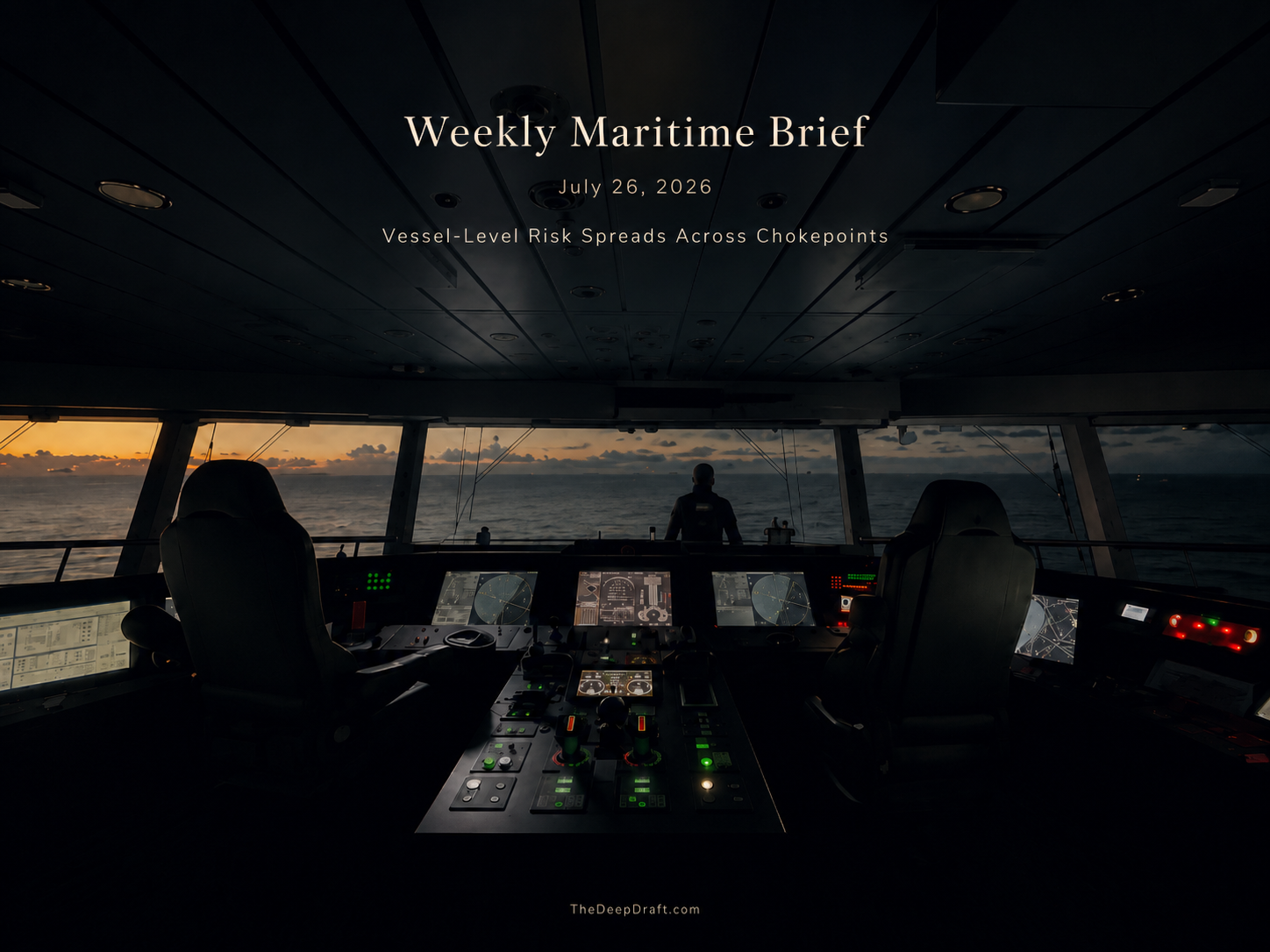
DeepDraft Weekly Maritime Brief | July 26, 2026: Vessel-Level Risk Spreads Across Chokepoints
Related DeepDraft Articles & Analysis
Sources
Reuters, IRNA, Kpler, London Joint War Committee, The DeepDraft
This update is part of the DeepDraft SITREP series covering developing maritime operational situations.




Leave a Reply